
Simon the Zealot
The Holy and All-praised Apostle Simon the Zealot, one of the Twelve
Apostle · Martyr · d. 1st century; by tradition crucified, the place variously transmitted
Commemorated 10 May — Memory of the holy Apostle Simon the Zealot, 30 June — Synaxis of the Holy Twelve Apostles
Simon the Zealot is the eleventh name in every apostolic list of the New Testament and one of the Twelve of whom the Gospels record nothing but the name. Matthew and Mark call him Σίμων ὁ Καναναῖος, the Cananaean; Luke and Acts call him Σίμων ὁ ζηλωτής, the Zealot — the same epithet, once in Aramaic and once in Greek. Byzantine tradition, reading "Cananaean" as "of Cana in Galilee," made him the bridegroom of the wedding at Cana who, seeing the water made wine, left his own marriage-feast to follow Christ, and derived his surname from the burning zeal with which he afterwards preached. The Greek synaxaria send him through Egypt, Cyrene, Libya and Mauretania and at last to Britain, where idolaters crucified him; the Latin books martyr him in Persia with Jude, sawn asunder; and the Abkhazians keep his grave on the Black Sea coast at Nikopsia. His feast is May 10, and he is numbered again in the Synaxis of the Twelve on June 30.
_-_%D0%B8%D0%BA%D0%BE%D0%BD%D0%B0_09101_%D0%A1%D0%B8%D0%BC%D0%BE%D0%BD_%D0%97%D0%B8%D0%BB%D0%BE%D1%82.png)
The name: Cananaean, Zealot, and Cana of Galilee
Everything that is certainly known of Simon is his name and his place in the apostolic band, and even the name has been the occasion of a long argument.
In Matthew 10:4 and Mark 3:18 he is Σίμων ὁ Καναναῖος — "Simon the Cananaean." In Luke 6:15 and Acts 1:13 he is Σίμων ὁ ζηλωτής — "Simon the Zealot." The two are almost certainly one and the same designation: Καναναῖος is not a Greek word at all but a transliteration of the Aramaic קַנְאָנָא (qan'ānā), "the zealous one," which Luke — writing for Greeks — simply translates. On that reading the epithet says nothing about geography: it is neither "the Canaanite" (a nation extinct for centuries before Christ) nor "the man of Cana."
The Byzantine synaxaria, however, took Καναναῖος as a place-name and understood it of Cana of Galilee, the village of the first sign; and from that reading grew the tradition, universal in the Greek and Slavonic books and repeated by the Orthodox Church in America, that Simon was the bridegroom of the marriage at Cana (John 2:1–11). He was of Cana, the account runs, and known to the Lord and to His Mother; the Saviour and the Theotokos were guests at his wedding; and when he saw the water become wine he believed with his whole heart, left the feast and the bride, and followed Christ — for which fervour he was afterwards surnamed the Zealot, ζηλωτής, "because of his zeal and ardour in preaching the word of the Gospel." The Church has never made this a dogma, and the philological objection to it is old and strong; but it is the tradition the liturgical books transmit, and it gives the day its characteristic note: the apostle who exchanged a wedding for the Cross.
A third reading takes "Zealot" as a party label — membership in the Zealots, the insurrectionary faction of Judaea. The difficulty is chronological: Josephus knows an organised Zealot party only from the 60s of the first century, a generation after the calling of the Twelve. If Simon bore the name in Christ's lifetime, it will have meant what it means when Paul calls himself "a zealot for the traditions of my fathers" (Gal. 1:14; cf. Acts 22:3) — a man of fierce and observant piety — rather than a member of the later revolutionary movement. Modern historians who see in the Twelve a deliberately representative company (a tax-gatherer beside a zealot for the Law) find the epithet significant for that reason.
Among the Twelve
Simon stands in all four lists of the apostles — Matthew 10:2–4, Mark 3:16–19, Luke 6:14–16 and Acts 1:13 — always in the eleventh place, and always in the last group of four, next to Judas Thaddaeus and James the son of Alphaeus. He never speaks in the Gospels, is never named in a narrative scene, and is credited with no writing. He is one of that silent half of the Twelve whose whole New Testament record is a name in a catalogue and, at the end of it, the upper room: after the Ascension he is numbered among the eleven "continuing with one accord in prayer and supplication, with the women, and Mary the mother of Jesus" (Acts 1:13–14), and so he received the Holy Spirit with the rest at Pentecost.
The Greek synaxaristes calls Simon the brother of Jude Thaddaeus, and one strand of tradition makes them both — with James the son of Alphaeus — sons of Clopas and so kinsmen of the Lord according to the flesh. That genealogy is the root of a persistent confusion with Simeon the Kinsman of the Lord, the second bishop of Jerusalem (April 27), and is treated under Disputed questions below.
The traditions of his preaching
Nothing in Scripture follows Simon out of Jerusalem, and what the tradition supplies is plainly a compilation of several independent local claims. The Byzantine geography, which the Greek synaxaristes gives at length, runs thus: after Pentecost Simon preached first in Persia and Media, overthrowing the myth of the many gods; then passed into Africa, and taught "from Egypt to Mauretania" — that is through Egypt, Cyrene and Libya and along the whole southern shore — and at the last came to Britain, at the ends of the earth, where he preached until the idolaters seized him. Nikephoros Kallistos Xanthopoulos gives the same route, and the pseudo-Dorotheus list of the apostles' provinces already sends Simon Zelotes to Britain. The Orthodox Church in America compresses the whole of it into a phrase: he preached "from Britain to the Black Sea."
The Latin tradition sends him east, not west. The Roman Martyrology and the Western passions join him to Jude (Thaddaeus) in Persia, where the two are said to have worked and died together, and the Latin Church accordingly keeps them on one day, October 28.
A third and quite separate claim is Caucasian. The Georgians and Abkhazians hold that "Simon the Canaanite" (Simon Kananit) came with Andrew the First-called along the eastern Black Sea, preached among the Abasgi, and died and was buried at Nikopsia near the modern Novy Afon (New Athos) above Sukhumi. His reputed grave and the cave in the gorge of the Psyrtskha where he is said to have lived are venerated there to this day, and the nineteenth-century Russian monastery of New Athos was founded upon the site. This tradition belongs to the same family as the Byzantine claim that Andrew's mission-field lay on those coasts, and it is quite independent of the Persian and the British stories.
Martyrdom
The manner of Simon's death is transmitted in three irreconcilable forms, and the Church's own books do not agree.
- Crucifixion. The Greek Menaion and the whole Byzantine tradition say that he was crucified by the pagans among whom he was preaching; the day's distich fixes on the image — "on the tenth, great-souled Simon was stretched upon the tree" (Ἐν ξύλῳ ἀμφετάθη Σίμων δεκάτῃ μεγάθυμος) — and the second verse makes the martyr say to Christ, "zealous for Thy Passion, I endure the passion of the Cross." Where the Byzantine geography places the crucifixion, it places it in Britain.
- Sawn asunder. The Western passions have him cut in two with a saw in Persia, and the saw became his fixed attribute in Latin art from the Middle Ages onward — which is why nearly every Western painting or statue of Simon shows him holding one.
- Repose in peace. A minority strand, chiefly in the Eastern lists that place his labours at Edessa or in Egypt, has him die peacefully in old age; and one late Ethiopian tradition crucifies him in Samaria.
The repository records the disagreement and adopts none of the versions as certain. What all the traditions agree upon is the shape of the life: an apostle of the second rank in the lists and the first rank in labour, who went to the furthest edges of the known world and did not come back.
Relics and later cultus
His relics are claimed in more than one place, as befits a saint with three martyrdoms. Rome keeps the chief Western claim: the bodies of Simon and Jude are said to lie together beneath the altar of the left transept of Saint Peter's, whither they were translated in the Middle Ages. A portion is claimed at Saint-Sernin in Toulouse, which gathered relics of many of the apostles. In the East his tomb is shown at Nikopsia in Abkhazia, and the Anacopia region kept a continuous local cult; the Georgian church still counts him among the enlighteners of its coast. There is no Byzantine translation-feast of his relics, and the Constantinopolitan synaxarion knows him only by his May 10 notice.
Feast and commemoration
Simon's memory is kept on May 10 (church date; New Calendar civil May 10, Old Calendar civil May 23), and the day is his throughout the Orthodox world: the Menaion's heading for May 10 is simply "the memory of the holy Apostle Simon the Zealot," and the other commemorations of the day — the martyred brothers of Lentini, Hesychius, the venerable Laurence — follow his notice. Because the day's position in the year moves with Pascha, the service is sung with the Pentecostarion, and in years when May 10 falls on a Sunday of the Paschal season the apostle's propers are abridged or transferred according to the ordinary rules; the Greek books of the day also carry, in some editions, the Sunday commemoration of the Samaritan Woman, which is movable and does not belong to the fixed date.
He is commemorated a second time, with the whole college, at the Synaxis of the Holy Twelve Apostles on June 30, the day after the feast of Peter and Paul.
The Latin Church keeps him with Jude Thaddaeus on October 28, following the Persian tradition of their common martyrdom; the Coptic and Ethiopian calendars keep him on their own days. In Russian usage May 10 carries in addition the name-day commemoration of Simon of Yuryevets, the sixteenth-century fool-for-Christ who was baptised in honour of this apostle and whose own feast of repose is November 4.
Hymns
Synaxarion
Well may Simon say this to Thee, O Christ: zealous for Thy Passion, I endure the passion of the Cross. On the tenth, great-souled Simon was stretched upon the tree.
Apolytikion — Tone 3
Holy Apostle Simon, intercede with the merciful God, that He grant unto our souls forgiveness of offences.
Kontakion — Tone 2
Let us praise in hymns the great Simon, who set the sure teachings of wisdom in the souls of the pious; for he stands now before the throne of glory and rejoices with all the bodiless hosts, unceasingly interceding for our souls.
Original translation from the Greek
Appointed readings
Epistle — 1 Corinthians 4:9–16
9For I think that God hath set forth us the apostles last, as it were appointed to death: for we are made a spectacle unto the world, and to angels, and to men. 10We are fools for Christ’s sake, but ye are wise in Christ; we are weak, but ye are strong; ye are honourable, but we are despised. 11Even unto this present hour we both hunger, and thirst, and are naked, and are buffeted, and have no certain dwellingplace; 12And labour, working with our own hands: being reviled, we bless; being persecuted, we suffer it: 13Being defamed, we intreat: we are made as the filth of the world, and are the offscouring of all things unto this day. 14I write not these things to shame you, but as my beloved sons I warn you. 15For though ye have ten thousand instructers in Christ, yet have ye not many fathers: for in Christ Jesus I have begotten you through the gospel. 16Wherefore I beseech you, be ye followers of me.
Gospel — Matthew 13:54–58
54And when he was come into his own country, he taught them in their synagogue, insomuch that they were astonished, and said, Whence hath this man this wisdom, and these mighty works? 55Is not this the carpenter’s son? is not his mother called Mary? and his brethren, James, and Joses, and Simon, and Judas? 56And his sisters, are they not all with us? Whence then hath this man all these things? 57And they were offended in him. But Jesus said unto them, A prophet is not without honour, save in his own country, and in his own house. 58And he did not many mighty works there because of their unbelief.
Iconography
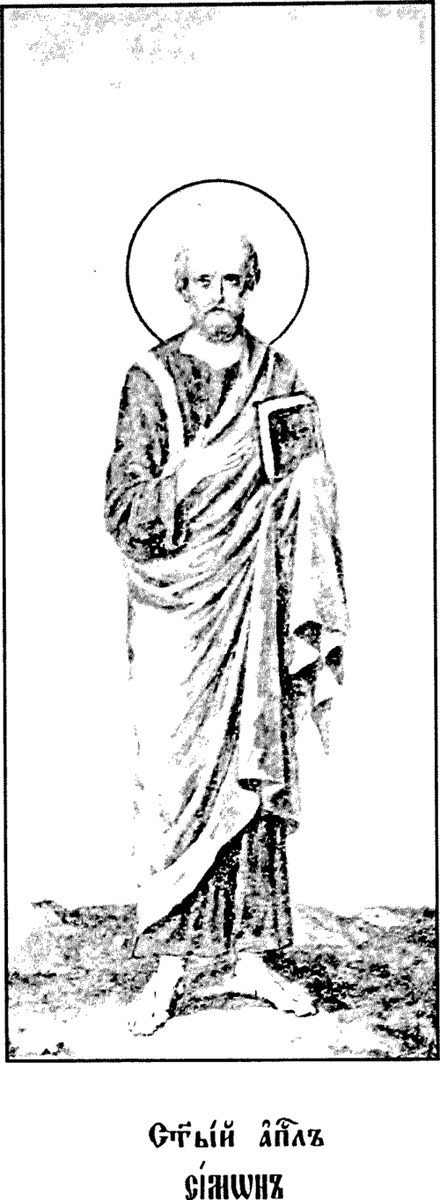
Simon is painted as an elder apostle: a high, balding forehead, grey or white hair drawn back, and a long pointed beard, in the chiton and himation of the apostolic type and never in priestly vesture, holding either a closed Gospel book or a scroll, and sometimes blessing with the free hand. He has no attribute of his own in the Eastern tradition, and in practice he is identified by his inscription — Ο ΑΓΙΟΣ ΣΙΜΩΝ Ο ΖΗΛΩΤΗΣ, or in Slavonic Стый Апостолъ Сімwнъ — because his type is not distinctive enough to tell him from the other elder apostles. His fixed places in a painted church are the apostle tier of the iconostasis, the Deesis range, the composition of the Pentecost in the dome or vault where the Twelve sit in the horseshoe about the empty place, the Communion of the Apostles in the sanctuary, and the roll of the Twelve painted about the drum. Menologion cycles for May put his crucifixion beside him.
Latin art gives him what the East does not: the saw of the Persian passion, held upright like a staff, by which Western Simons are instantly recognisable — the attribute belongs to the sawn-asunder tradition and is properly absent from Orthodox icons. In Abkhazia the local cult produced a distinct iconography of Simon Kananit standing before his cave and the church built over his grave at New Athos.
The stored image is an engraved plate from the illustrated Moscow Lives of the Saints (Zhitiya Svyatykh after Dimitry of Rostov, 1903–1911), belonging to the May 10 notice and inscribed in Church Slavonic Стый Апл Сімwнъ, "the Holy Apostle Simon": the apostle stands full-length in chiton and himation, grey-bearded and balding, the Gospel held in the covered left hand and the right open before him.
Disputed questions
- Simon the Zealot and Nathanael. The printed Greek Menaion identifies the two outright. Its notice for April 22 reads "the memory of the holy Apostle Nathanael, who is Simon the Zealot — that is, the remembrance of his coming to know Christ" (Ναθαναήλ, ὃς ἐστι Σίμων ὁ Ζηλωτής), and the Greek synaxaristes accordingly cross-references Nathanael's principal feast to May 10 and lends him Simon's missionary geography. Two things made the identification attractive: Nathanael is called "of Cana in Galilee" (John 21:2) and Simon is "the Cananaean"; and Nathanael, a named and prominent disciple, is absent from every apostolic list, while Simon is a name in the lists with no story attached — so that each supplies exactly what the other lacks. Against it stands the majority tradition, Western and Slavonic alike, which identifies Nathanael with Bartholomew (June 11) instead — whose entry now exists in this collection, cross-references this one, and likewise leaves the identification open, entering neither April 22 among Bartholomew's feasts nor June 11 among Nathanael's — and the plain philological objection that Καναναῖος renders the Aramaic for zealot and is not a name of Cana at all. This repository keeps Nathanael in a separate entry and leaves the identification open in both directions: neither file adopts it, neither file rejects it, and no merge should be made silently. If a future editor judges the Menaion's identification certain, the two entries must be merged with April 22 added as the feast of the calling; if the Bartholomew identification is judged certain instead, April 22 belongs with Bartholomew and Simon's own entry is unaffected. The present state of the corpus — three separate entries and a documented question — is the deliberate reflection of the Church's own divided books.
- Not Simon Peter. The commonest confusion of all, and the reason the Byzantine notice and the OCA entry both say so explicitly. Peter, first-called and chief of the apostles, is Simon bar-Jonah of Bethsaida, renamed Cephas; he stands first in every list, and his feast is June 29. The two share only the commonest of first-century Jewish names.
- Not Simeon the Kinsman of the Lord. Simeon of Jerusalem (April 27, †107), son of Clopas and second bishop of the mother church, was crucified at a great age under Trajan. The overlap with Simon the Zealot is uncomfortably close — the same name, a crucifixion, and a strand of tradition that makes both of them sons of Clopas — and some Greek calendars style Simeon ὁ Ἀδελφόθεος, "the Brother of God," which would identify him with the Simon of the four brethren named at Nazareth (Matthew 13:55; Mark 6:3). That question is set out in Simeon's own entry and is likewise left open there. What is not in doubt is that the calendars keep the two on different days with different histories: the apostle of the Twelve on May 10, and the bishop of Jerusalem on April 27.
- Was he a Zealot, or zealous? See The name above. The party-membership reading is chronologically strained and is not the reading of the liturgical books, which derive the epithet from his fervour after Cana; but it is the reading of much modern scholarship and is recorded here as such.
- Where he died. Britain (Greek), Persia (Latin, with Jude), Abkhazia (Georgian), Egypt or Edessa (minority Eastern lists) — see Martyrdom. The three principal claims are not variants of one story but three separate local cults attached to one name, and no source earlier than the fourth century supports any of them.