
Simeon of Jerusalem
The Holy Apostle and Hieromartyr Simeon the Kinsman of the Lord, Second Bishop of Jerusalem
Apostle of the Seventy · Hieromartyr · Bishop · b. c. 13 BC, in Galilee (implied by the age of 120 given at his death) — d. 107, crucified at Jerusalem
Commemorated 4 January — Synaxis of the Seventy Apostles (numbered fifth in the traditional roll), 27 April — Crucifixion at Jerusalem under Trajan
Simeon, son of Clopas, was the second bishop of Jerusalem and a kinsman of the Lord according to the flesh — by the witness of Hegesippus a cousin of Christ, since Clopas was the brother of Joseph the Betrothed. Chosen to the throne of the mother church after the martyrdom of James the Brother of the Lord, he governed the Christians of Judea through the catastrophe of the Jewish War, the flight of the community across the Jordan to Pella, and the destruction of the Temple in the year 70, and held the see for some forty years — the longest bridge in the record between the apostolic generation and the Church of the second century. In the reign of Trajan, denounced by heretics both as a descendant of David and as a Christian, he was tortured for many days before the consular governor Atticus and at last crucified, in the year 107, at the reputed age of one hundred and twenty; his judges, says Hegesippus, marvelled that so old a man could endure. He is honoured as apostle of the Seventy, hierarch and martyr, and his feast is April 27.
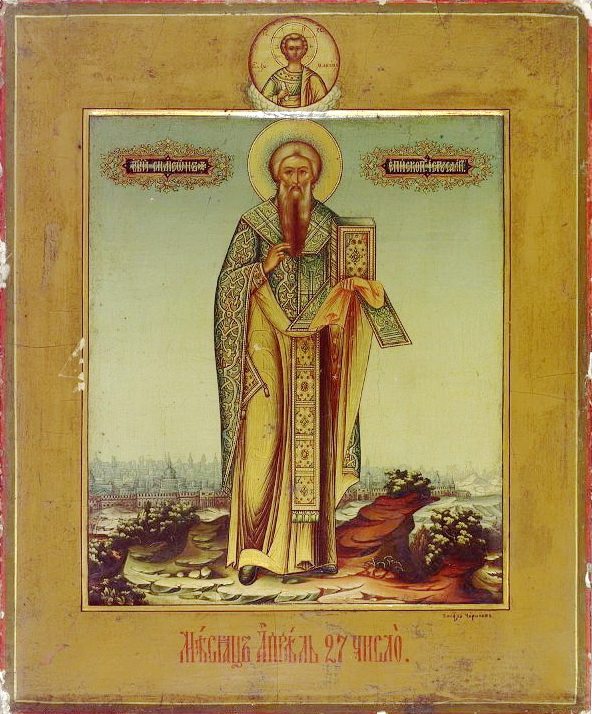
_by_O.Chirikov_(Muz.it._relig).jpg)
The kinsman of the Lord
Everything securely known of Simeon comes from a single second-century Palestinian writer, Hegesippus, whose five books of Memoirs (Hypomnemata, c. 175–180) are lost but survive in the quotations of Eusebius of Caesarea. Hegesippus is the nearest thing the Church possesses to a local historian of the Jerusalem community, and he had his information from the Judean Christians themselves; it is he who reports, in the words Eusebius preserves, that Clopas was a brother of Joseph, and that his son Simeon was therefore cousin (ἀνεψιός) of the Saviour.
The Clopas in question is the man of John 19:25, where among the women at the Cross stands "Mary of Clopas" — on the natural reading his wife. The Byzantine tradition goes further and identifies this Clopas with the Cleopas of Luke 24:18, one of the two disciples who walked to Emmaus on the day of the Resurrection and knew the Lord in the breaking of bread; the roll of the Seventy Apostles accordingly numbers "Cleopas, brother of Joseph the Betrothed" fourth and "Simeon, son of Cleopas, bishop of Jerusalem" fifth. On this reading Simeon was the child of a household already gathered about Christ before the Passion: a father who saw the risen Lord, a mother who stood by the Cross.
Simeon himself, the synaxaria say, saw the Lord's miracles in his own mature years and believed; he is not named in the Gospels among the disciples, but he belonged to that circle of the Lord's relations — the desposynoi, "those of the Master's household," as the third-century chronographer Julius Africanus called them — who are found in Acts 1:14 gathered with the apostles and the Theotokos in the upper room, and who afterwards carried great weight in the churches of Palestine precisely because of their kinship. The Church numbers him among the Seventy whom the Lord sent out two by two (Luke 10:1), and this is the sense in which she calls him apostle.
Second bishop of Jerusalem
When James the Just was put to death by the Temple authorities — about the year 62 by the reckoning of Josephus, or on the eve of the war by the sequence Hegesippus implies — the church of Jerusalem had to be given a new head. Eusebius, drawing on Hegesippus, describes what happened with unusual concreteness: the surviving apostles and disciples of the Lord, together with those who were of His kindred according to the flesh (for most of them, he notes, were still living), came together in council and with one voice judged Simeon the son of Clopas worthy of the throne of that church. The mother church of Christendom thus passed, for a second time, into the hands of a kinsman of the Lord — a fact from which later writers drew a doctrine of the desposynoi as a kind of hereditary Christian caliphate at Jerusalem, and from which the tradition draws only the honour of the family of Joseph.
Simeon's tenure was long — the synaxaria give him about forty years, which fits an accession in the sixties and a martyrdom in 107. He is the third figure, after James and the apostles themselves, in the roll of the fifteen bishops of Jerusalem down to Hadrian whom Eusebius lists, all of them, he insists, Hebrews and of the circumcision, receiving the knowledge of Christ in purity: James, Simeon, Justus, Zacchaeus, Tobias, Benjamin, John, Matthias, Philip, Seneca, Justus, Levi, Ephres, Joseph, Judas. Simeon is second in that list, and the only one of the fifteen after James of whom any story at all survives.
The flight to Pella and the fall of the city
The years of Simeon's episcopate were the years in which the Judea of the New Testament was destroyed. Eusebius records that before the war closed upon the city, the Christians of Jerusalem departed, being commanded by an oracle given through revelation to approved men among them, and settled in a town of Peraea called Pella, beyond the Jordan in the Decapolis; and that the judgement of God then overtook the men who had risen against Christ and His apostles, blotting out that generation of the impious from among men. Epiphanius of Salamis, writing later, knows the same tradition and adds that the community afterwards returned to the ruined city.
The Church's memory places Simeon at the head of that exodus, and the chronology of a forty-year episcopate requires it: the bishop who had received the flock from James led it out of the doomed city, kept it together in exile beyond the Jordan while Titus levelled the Temple in August of the year 70, and brought it back to encamp among the ruins. Whether he was already bishop when the flight took place is, however, a real question, since Eusebius's own narrative sets his election after the capture of the city (see Disputed questions). What is not in doubt is that Simeon presided over the Jerusalem church in the generation that had to learn to be the Church without the Temple, and that the community he governed was still a Hebrew community, keeping the Law, worshipping Christ, and living in the shadow of both the synagogue and Rome.
Hegesippus adds one further note about these years that shows the internal cost of the change. So long as the sacred choir of the apostles and the generation that had heard the wisdom of God with its own ears remained, the Church, he says, continued a virgin, uncorrupted; and it was only after Simeon's own martyrdom that a certain Thebouthis, because he had not been made bishop in his place, began to corrupt her — drawing his errors, Hegesippus says, out of the seven sects that already divided the Jewish people. Simeon's long life is thus, for the earliest historian of the Church, the boundary between the age of apostolic purity and the age of the heresies.
The desposynoi and the search for the seed of David
The kinsmen of the Lord were dangerous men to be, because they were of the house of David, and Rome had learned to fear a Jewish messianic pretender. Hegesippus records two imperial inquisitions into David's line, and Simeon fell in the second.
Under Domitian (81–96) the emperor ordered the execution of all who were of David's family, and the grandsons of Jude, called the brother of the Lord according to the flesh, were informed against and brought before him. Asked whether they were of David's line, they admitted it; asked what property and money they had, they answered that between them they owned nine thousand denarii' worth of land — thirty-nine plethra — from which they paid their taxes and which they worked with their own hands, and they held out their hands to show the calluses of labour. Asked concerning the Christ and His kingdom, of what sort it was and when and where it would appear, they answered that it was not of this world nor earthly, but heavenly and angelic, and that it would come at the end of the age, when Christ should come in glory to judge the living and the dead and to render to each according to his works. At this Domitian despised them as simpletons, dismissed them, and by decree stopped the persecution against the Church. The two came home and, Hegesippus says, ruled churches as being at once witnesses and of the Lord's family, and lived on in peace until the reign of Trajan.
This is one of the most extraordinary scenes surviving from the sub-apostolic Church: the emperor of Rome interrogating two Galilean peasant-farmers about the eschatology of the Kingdom, and letting them go. It is also the immediate background of Simeon's own end, for it shows both what the Romans were looking for and how the desposynoi stood in the Palestinian churches at the turn of the century.
Martyrdom under Trajan
In the reign of Trajan (98–117) certain of the heretics — Hegesippus's word, and he means the Jewish-Christian and Jewish sectaries whose rise he has just described — laid information against Simeon before Atticus, the consularis (ὑπατικός) charged with Judea. The accusation was twofold and shrewdly framed to make him a political danger and a religious offender at once: that he was of the family of David, and that he was a Christian. Hegesippus adds, with grim satisfaction, that his accusers were themselves hunted down for the same crime of Davidic descent, being of the royal tribe of Judah.
Simeon was tortured for many days, and neither age nor pain would move him; the proconsul and his attendants were astonished, Hegesippus says, that a man of one hundred and twenty years could endure so much. He was condemned at last to be crucified, and so he died — the kinsman of the Lord perfected in the Lord's own death. Eusebius's Chronicle places the martyrdom in the tenth year of Trajan, that is AD 107, and this is the date the Byzantine calendar has kept.
The Church has always felt the fitness of the manner of his death, and her hymns say little else about it. The synaxarion couplet for the day plays on the double sense of the Greek: Ἀδελφὰ πάσχεις, Συμεών, τῷ Κυρίῳ, / Ξύλῳ κρεμασθείς, ὡς ἀδελφὸς Κυρίου — "Thou sufferest, Simeon, in brotherly wise with the Lord, hanged upon the tree as the Lord's own brother"; and the kontakion says simply that, having led his flock well to the heavenly fold, "thou wast crucified for Christ, imitating His divine Passion."
Veneration and later memory
Simeon's cult is old and universal in the East, but it never acquired a body of legend: what the synaxaria have is what Hegesippus gave, condensed. The Greek Menaion heads the day "Memory of the holy hieromartyr Simeon, bishop of Jerusalem, kinsman of the Lord" (Μνήμη τοῦ Ἁγίου Ἱερομάρτυρος Συμεών, Ἐπισκόπου Ἱεροσολύμων, συγγενοῦς τοῦ Κυρίου) and appoints a full office with a canon in Tone 4. In the Slavonic tradition, followed by the OCA, he is styled "Apostle of the Seventy and hieromartyr Simeon of Jerusalem, kinsman of the Lord." He has no relics widely venerated and no great shrine; his monument is the episcopal list of Jerusalem, in which he stands second, and the Church's memory of a bishop who kept the faith of the mother city intact across the ruin of the Temple and into the second century.
For the Antiochian tradition Simeon has a particular interest, because his episcopate is exactly contemporary with the earliest generations of the see of Antioch — his death in 107 falls in the same years as the martyrdom of Ignatius the God-bearer, third bishop of Antioch, and the two hierarchs together mark the passage of the Syrian and Palestinian churches out of the apostolic age.
Feast and commemoration
April 27 (church date; Old Calendar civil May 10) is Simeon's principal feast, universal in the Byzantine rite. The day falls in the second half of April, and its position in the year's cycle therefore depends on the date of Pascha: in some years it comes in the last weeks of Great Lent or in Holy Week, in others in the Pentecostarion, and the Typikon provides for both, the service being sung with the paschal propers when the day falls after Pascha.
Simeon is commemorated again on January 4, in the Synaxis of the Seventy Apostles, where the traditional roll numbers him fifth, immediately after his father Cleopas and after the three evangelist-apostles at the head of the list; the synaxis entry gives the roll in full.
The Greek and Slavonic books agree on the day and on the substance but differ in title — "kinsman of the Lord" in the Menaion's heading, "Brother of God" in some Greek synaxaria, "Apostle of the Seventy and hieromartyr" in the Slavonic — and the divergence is recorded in Disputed questions rather than resolved. In the Roman calendar he was long kept on February 18, a date the Byzantine rite does not know for him.
Hymns
Apolytikion — Tone 1
Thee, the kinsman of Christ, O Simeon the hierarch and steadfast martyr, we praise with sacred hymns: for thou didst destroy delusion and keep the faith unharmed. Wherefore, as we keep today thy most holy memory, by thy prayers we receive the loosing of our sins.
Kontakion — Tone 2
Having become a citizen of the Sion that is above, thou wast entrusted with the throne of the Sion that is below; and having guided thy flock well to the heavenly fold, thou wast crucified for Christ, O Simeon, imitating His divine Passion.
Original translation from the Greek
Synaxarion
Thou sufferest, Simeon, in brotherly wise with the Lord, hanged upon the tree as the Lord's own brother. On the twenty-seventh, Simeon was fastened upon a tall tree.
Iconography
Simeon is painted as an aged hierarch: high forehead, long white or grey beard, vested in phelonion (or, in the later Russian manner, sakkos) and omophorion, blessing with the right hand and holding the Gospel book in the left — the standard type of the bishop-saint, with nothing to distinguish him but his inscription and his great age. Where his martyrdom is shown, it is shown as a crucifixion, the aged bishop bound or nailed to the cross in his vesture; this is the one iconographic feature proper to him, and it deliberately conforms his image to the Lord's, as the hymns do. He may also appear among the ranks of the Seventy Apostles in the January 4 composition, and among the first bishops of Jerusalem in cycles of the apostolic succession.
The stored image is a Russian menologion panel for April 27 painted by Osip Semyonovich Chirikov about 1893–1894 (State Museum of the History of Religion, St Petersburg): the saint stands full-length in a gold-patterned phelonion and crossed omophorion before a wide landscape of a city, blessing with his right hand and holding the jewelled Gospel in his left, with the Slavonic inscription "St Simeon … Bishop of Jerusalem" flanking the halo and, along the lower border, "Month of April, day 27." A small medallion of a haloed figure is set into the upper margin, as often in these name-day panels. The identification is secured by the icon's own dated calendar inscription.
Disputed questions
- Joseph's son or Joseph's nephew? The two constructions of Simeon's kinship are
both ancient, and the calendars themselves do not speak with one voice.
- The Hegesippan (cousin) view. Hegesippus, as quoted by Eusebius, says plainly that Clopas was the brother of Joseph and that Simeon was therefore the Lord's cousin (ἀνεψιός). This makes Simeon a nephew of Joseph the Betrothed and a kinsman, not a brother, of the Lord; it is the reading of the Greek Menaion's own heading (συγγενοῦς τοῦ Κυρίου, "kinsman of the Lord"), of the Slavonic tradition and of the OCA, which calls Cleopas "the younger brother of Saint Joseph the Betrothed," and it is the position of most modern historians of Jewish Christianity.
- The Adelphothean (step-brother) view. Other Greek synaxaria and calendars style him ὁ Ἀδελφόθεος, "the Brother of God" — the very title given to James — which identifies him with Simon, one of the four brethren named at Nazareth ("James, and Joses, and Simon, and Judas," Matthew 13:55; Mark 6:3). On the Epiphanian view of the brethren, which the Orthodox Church holds (see James the Brother of the Lord), those four were sons of Joseph by a wife who died before his espousal to the Virgin; Simeon would then be Joseph's own son, the Lord's elder step-brother, and James's full brother, and his succession to the see would be a succession from brother to brother.
- The difference is not trivial: it decides whether the "family" that twice supplied a bishop to Jerusalem was Joseph's household or Joseph's wider clan, and whether Simeon is one of the four brethren of the Gospels or a fifth kinsman not named there. This entry follows the Menaion's own heading and Hegesippus in calling him kinsman rather than brother, and records the other usage without pronouncing against it. No resolution is asserted here: the earliest witness (Hegesippus) says cousin; a substantial strand of Greek liturgical usage says brother; and the Church has kept both epithets in her books.
- Clopas and Cleopas. The Greek forms differ — Κλωπᾶς at John 19:25, Κλεόπας at Luke 24:18 — and philologically they are not the same name: Clopas is a Semitic name transliterated, Cleopas a Greek short form of Cleopatros. The tradition identifies the two men, and the roll of the Seventy treats "Cleopas the brother of Joseph" (October 30) as Simeon's father. The identification is traditional and attractive but not demonstrable, and it is the reason the calendars variously spell Simeon "son of Clopas" and "son of Cleopas."
- When was he made bishop? The traditional chronology gives him about forty years, from the death of James (c. 62) to 107, and therefore has him leading the church through the flight to Pella and the fall of Jerusalem. But Eusebius's own sequence in Church History III.11 sets the council that elected him after the martyrdom of James and the conquest of Jerusalem which immediately followed it — that is, after 70 — which would make him the bishop who returned the community from Pella rather than the one who led it out. Both readings are defensible from the text; the entry records the flight and the exile as events of his lifetime and of his community without insisting on his precise office at the moment of the exodus.
- The age of 120, and the date. Hegesippus's figure would put Simeon's birth about 13 BC and make him some forty years older than the Lord — possible, but the number is suspiciously the age of Moses at his death (Deuteronomy 34:7) and is best treated as the tradition's way of saying "extreme old age." Some scholars, holding the 120 to be a round figure and looking to what is known of consular legates of Judea under Trajan, place the martyrdom later in the reign, towards 115–117; the identification of Hegesippus's Atticus with a particular known governor is itself debated. Eusebius's Chronicle gives 107, and the Byzantine calendar and this entry follow it.
- Not to be confused with the several other Simeons of the calendar: Symeon the God-receiver, who took the Child in his arms in the Temple (February 3); Symeon the Stylite of Syria (September 1); Symeon the New Theologian (October 12); and Simeon called Niger, the teacher of the church of Antioch in Acts 13:1, who is a different man altogether — the Wikidata item used for the external identifier here (Q359829) unfortunately carries a description conflating the two, and the reader should not be misled by it. He is likewise distinct from Simon the Cananaean (the Zealot) of the Twelve (May 10), with whom the similarity of name and the shared Palestinian setting can easily cause confusion — the more so because one strand of tradition makes that Simon too a son of Clopas, and because the Ἀδελφόθεος title discussed above would identify this Simeon with the Simon of the brethren named at Nazareth. Both entries leave that question open, and note that the coincidence by which Simeon's April 27 feast falls on the Old Calendar civil May 10 is not a second commemoration of him on the apostle's day.