
Sixtus II of Rome
The Holy Hieromartyr Sixtus, Pope of Rome
Hieromartyr · Bishop · d. 6 August 258, at Rome
Commemorated 10 August — Kept with Laurence the Archdeacon; martyred in the cemetery of Praetextatus, 6 August 258
Sixtus — Xystus in the Greek and in the older Latin — was bishop of Rome for less than a year, from August 257 to August 258, and is one of the most securely dated martyrs of the whole third century. On 6 August 258, days after Valerian's second rescript ordered the immediate execution of all Christian clergy, he was seized while seated in the teaching chair in the cemetery of Praetextatus on the Via Appia and beheaded on the spot, with the deacons Felicissimus and Agapitus and others of his clergy. Four days later his archdeacon Laurence followed him. The Greek Menaion keeps Sixtus not on his own day of death but on the tenth, in a single notice with Laurence and Hippolytus; the Latin Church, which knows him best, names him in the Canon of the Mass, and remembers him above all as a peacemaker — the bishop who healed the rupture between Rome, Africa and Asia over the rebaptism of heretics without conceding either side's dignity.

An Athenian at Rome
The Byzantine synaxarion and the Greek notice of August 10 call Sixtus an Athenian, and add that he had been a philosopher before he was a Christian — a report the Liber Pontificalis also carries, though it may be no more than an inference from his very Greek name, Ξύστος, "the polished." He is the second Roman bishop of that name, following the Sixtus of the early second century. Nothing is known of his life before his election.
He became bishop of Rome about 30 August 257, in the middle of a persecution and in the middle of a quarrel. His predecessor Stephen I had died on 2 August of the same year, having spent his short pontificate in bitter dispute with the Churches of Africa and of Asia Minor over the question whether converts baptised by heretics must be baptised again on entering the Church. Stephen had held, in the Roman tradition, that they must not — that a baptism given in the name of the Trinity is valid whoever gives it; Cyprian of Carthage and Firmilian of Caesarea in Cappadocia had held that they must, and Stephen had threatened to break communion with them.
The peace of the Churches
Sixtus did not surrender the Roman position, but he stopped the breach. Dionysius of Alexandria, whose letters Eusebius preserves and who wrote to Sixtus more than once, calls him a man of peace, and testifies that under him the Churches of Africa and the East remained in communion with Rome although they continued their own practice. Pontius, the deacon and biographer of Cyprian, and Cyprian's own correspondence show the same. It is a small episode by later standards and an important one: the first great test of whether the Roman Church would use its primacy to force uniformity of discipline, and Sixtus's answer — that the question could be left open while the communion was preserved — became a precedent of the first rank. Dionysius also consulted him on the case of a man scrupulous about the validity of his own baptism, and the reply was that a communicant of long standing was not to be disturbed.
Martyrdom in the cemetery of Praetextatus
Valerian's second rescript, of the summer of 258, ordered that bishops, presbyters and deacons be put to death on identification. Cyprian of Carthage, writing to Successus from his own exile (Epistle 80), reports the news that reached Africa: Xystum autem in cimiterio animadversum sciatis VIII iduum Augustarum die et cum eo diacones quattuor — "know that Sixtus was executed in the cemetery on the eighth day before the ides of August, and with him four deacons." That letter, written within weeks of the event by a bishop who was himself executed a month later, makes Sixtus's death one of the best-attested facts of third-century Church history.
The place was the cemetery of Praetextatus on the Via Appia, where the Christians were assembled in defiance of the ban on the use of the burial-grounds; the tradition is that the soldiers came upon him seated in the chair, preaching, and that he was beheaded where he sat, refusing to let his people be taken in his place. Pope Damasus, a century later, set a verse inscription over his tomb which says just this: that as the sword-point was at his throat he thought of his flock and offered himself first. Two of the seven deacons, Felicissimus and Agapitus, died the same day at the same cemetery; the Depositio martyrum of 354 enters them together — VIII idus Aug. Xysti in Callisti et in Praetextati Agapiti et Felicissimi.
His body was carried across the road and laid in the papal crypt of the cemetery of Callistus, among his predecessors; the fourth-century pilgrim itineraries all direct visitors to it, and the crypt with Damasus's inscription is still shown.
The parting from Laurence
Between the martyrdom of Sixtus and that of his archdeacon there stand four days, and in those four days the tradition places the exchange which Ambrose of Milan records in his De officiis and which passed from him into every retelling: the deacon following the condemned bishop, weeping, asking whether the father meant to go without his son and whether the priest had ever offered the sacrifice without his minister; and the bishop's answer — no desertion, but a greater struggle kept back for the younger man, who would follow in three days. Whether or not the words were spoken, they express exactly the relation of a third-century Roman bishop to his archdeacon, and they are the reason the two are inseparable in the calendar. The Athenian bishop who kept the peace of the Churches survives in the memory of Christendom chiefly as the man who said goodbye to Laurence.
Feast and commemoration
August 10 (church date; Old Calendar civil August 23) in Byzantine usage, within the Dormition Fast and the afterfeast of the Transfiguration; he is sung with Laurence and Hippolytus under the single Greek heading of the day and has no proper office of his own in the Menaion. In the West his day is 6 August, the true day of his death, and his name stands in the Roman Canon in the list of martyrs — Xysto, Cornelio, Cypriano, Laurentio — where it has been read daily for more than fifteen centuries. The Slavic calendars and the OCA list him first among "those with" Laurence.
Hymns
Apolytikion — Tone 4 (common of a hieromartyr)
Thou didst share the manner of life of the Apostles and didst sit upon their throne; and finding in the active life, O inspired of God, the path to contemplation, thou didst rightly divide the word of truth and didst contend for the faith even unto blood, O hieromartyr Sixtus: intercede with Christ God that our souls may be saved.
Iconography
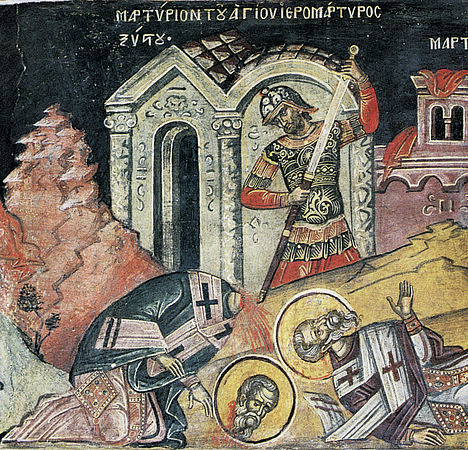
Sixtus is painted in the Byzantine manner as an aged hierarch — grey-bearded, in the phelonion and the crossed omophorion, blessing and holding the jewelled Gospel — and is distinguished from other Roman bishop-martyrs only by his inscription, Ο ΑΓΙΟΣ ΞΥΣΤΟΣ ΠΑΠΑΣ ΡΩΜΗΣ. Where the scene of his death is shown, it belongs to the menologion cycles of the Athonite refectories and narthexes: the soldier with the drawn sword in the doorway of the cemetery-chapel, and the bishops fallen in their omophoria with the severed head on the ground. In Western art he is almost never independent, appearing instead in the great cycles of the legend of St Laurence — Fra Angelico's frescoes in the Vatican, Michael Pacher's altar-panel of the farewell — where he is the old pope who consecrates his deacon and takes leave of him.
The stored image is a late-medieval Athonite fresco inscribed ΜΑΡΤΥΡΙΟΝ ΤΟΥ ΑΓΙΟΥ ΙΕΡΟΜΑΡΤΥΡΟΣ ΞΥΣΤΟΥ — "the martyrdom of the holy hieromartyr Xystus" — showing the executioner with raised sword before the little domed building of the cemetery, and the hierarchs bowed and fallen beneath him.
Disputed questions
- August 6 or August 10? Sixtus certainly died on 6 August, and the Latin Church keeps him on that day (in the modern Roman calendar an optional memorial, displaced in rank by the Transfiguration). The Byzantine calendar commemorates him on 10 August, the day of Laurence, because it received the Roman company as a single group through the Laurentian passio rather than through the Roman calendar. This entry follows the Eastern usage in placing his feast on the tenth, and records the true date of death in the Life; no separate August 6 entry is made, since the Greek and Slavic books do not keep one.
- The four deacons. Cyprian names four deacons killed with Sixtus; the Depositio entered Felicissimus and Agapitus, and the later Roman legend supplied the names Januarius, Vincentius, Magnus and Stephanus for the four of the cemetery. Whether the six are two groups or one confused group cannot now be determined.
- Athenian and philosopher? The Greek notice and the Liber Pontificalis make him a Greek of Athens and a former philosopher. It is possible; it is also the kind of detail that Greek hagiography readily supplies for a bishop with a Greek name, and no contemporary source confirms it.
- Not the writings. A collection of pagan-flavoured moral maxims circulated in antiquity under the name of "Sextus" and was translated into Latin by Rufinus; Jerome identified its author with this martyr-pope, wrongly. The Sentences of Sextus are the work of a Pythagorean writer and have nothing to do with him — a point on which Jerome himself was corrected in his own century.
- Not to be confused with Sixtus I (c. 115–125), Sixtus III (432–440), or with the Renaissance popes of that name.