
Stephen I of Constantinople
Our Father among the Saints Stephen, Archbishop of Constantinople New Rome and Ecumenical Patriarch
Patriarch · Bishop · b. c. 867 — d. 17 May 893
Commemorated 17 May — Repose of the Patriarch Stephen at Constantinople
Stephen (c. 867 – 893) was the youngest son of the emperor Basil I the Macedonian and the brother of the emperor Leo VI the Wise, ordained to the diaconate by the great patriarch Photius and raised by his brother to the throne of Constantinople in 886, at little more than nineteen years of age, when Photius withdrew from it. He held the patriarchate for seven years and reposed in peace in 893, not yet thirty, and was buried in the monastery of the Sikelia. The Church remembers him not for any act of government — his youth and his short tenure left him little scope for one, and the Photian quarrel he inherited outlasted him — but for what his contemporaries thought worth recording of him: his abstinence, his mildness, his readiness to intercede for those in trouble, and his personal care for widows and orphans. He is one of the few Byzantine patriarchs canonised who were also born in the purple.
.jpg)
A prince ordained
Stephen was born about the year 867, the youngest of the sons of Basil I, founder of the Macedonian dynasty, by the empress Eudokia Ingerina; his elder brother Leo would succeed their father as Leo VI, called the Wise, and another brother, Alexander, would reign after Leo. A younger imperial son was commonly destined for the Church, and Stephen was so destined early: he was educated for it, and was ordained deacon by the Patriarch Photius — the greatest scholar and the most contested churchman of the age, then in his second patriarchate — and made synkellos, the patriarch's chief assistant and the customary stepping-stone to the throne itself.
He therefore grew up inside the two great tensions of ninth-century Byzantium at once: the dynastic quarrel between his father and his brother, which was bitter enough that Leo spent a period under house arrest before Basil's death; and the ecclesiastical division between the partisans of Photius and those of the deposed patriarch Ignatius, a division that had already twice changed the occupant of the throne of Constantinople and had strained the communion of the Old and the New Rome.
Patriarch at nineteen
Basil I died in 886. One of the first acts of the new emperor Leo VI was to remove Photius from the patriarchate — whether by deposition or by a resignation the emperor required is disputed by the sources and by their modern readers — and to install his own brother in his place. Stephen was enthroned patriarch of Constantinople in December 886, aged about nineteen.
The elevation was, on any reading, an act of dynastic politics, and it left him in an awkward canonical position: he owed his diaconate to Photius, whose ordinations the Ignatian party held void, and he owed his throne to the removal of the man who had ordained him. The sources record that his consecration was performed not by the deposed patriarch but by another hierarch — the metropolitan of Caesarea — precisely to avoid the difficulty; and that the Ignatians and the papal legates were, for a season, unwilling to recognise him. The schism between the Photian and Ignatian parties therefore continued through his patriarchate, and was only formally healed under his successors.
The manner of the man
What the Byzantine sources choose to say about Stephen is almost entirely personal, and it is uniform. He is remembered as abstinent in his own life to a degree unusual in a man of his birth; gentle in his dealings; and, most insistently, as an intercessor — one who used the extraordinary access a patriarch who was also the emperor's brother possessed to obtain mercy for the condemned, relief for the wronged, and provision for the poor. The care of widows and orphans, the classical duty of a Christian bishop, is singled out as his own particular charge; he is said to have visited and provided for them himself rather than by deputy.
That such a portrait should be all that survives of a seven-year patriarchate is itself informative. Stephen governed in the shadow of a formidable emperor who was his brother and who intended to be obeyed in church matters, and of a schism he had not made and could not end. The Church's judgment on him was nevertheless favourable, and it was made quickly: he was numbered among the saints, and his memory entered the synaxarion on the day of his repose.
Repose and burial
Stephen died peacefully, worn out early — the sources speak of a wasting illness and of his own austerities — on 17 May 893, in his twenties. He was buried in the monastery of the Sikelia (τῆς Σικελίας) at Constantinople, a house with which he had been associated in life. His successor was Antony II Kauleas, under whom, in 899, the council that at last reconciled the Photian and Ignatian parties was held.
Feast and commemoration
May 17 (church date; New Calendar civil May 17; Old Calendar civil May 30). The day always falls within the Pentecostarion, since Orthodox Pascha cannot come later than May 8, and the movable office of the year takes precedence over the fixed. Stephen's commemoration is a minor one, served with the common of a hierarch; he is listed on this day in the Greek synaxaria and by the Slavic and Antiochian calendars, generally styled "Stephen, Archbishop of Constantinople," and the Slavic books add "brother of the emperor Leo the Wise" to distinguish him. He has no proper office in the printed Menaion and no surviving local cultus at the Sikelia monastery, whose site is lost.
Hymns
Apolytikion — Tone 4
O God of our fathers, who always dealest with us according to thy gentleness: take not thy mercy from us, but by the intercessions of thy hierarch Stephen, direct our life in peace.
Iconography
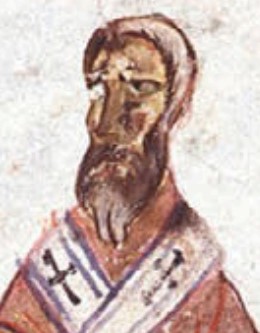
Stephen is painted as a young hierarch — and the youth is his distinguishing mark, for he is one of very few patriarchs shown in the phelonion and omophorion with a short dark beard and an unlined face. He blesses with the right hand and holds the Gospel-book in the left, and where he is named the inscription styles him patriarch of Constantinople. In the illustrated chronicles he appears in the narrative cycle of the reign of Leo VI rather than in a devotional pose.
The stored image is such a chronicle miniature: the bust of the patriarch from the Madrid Skylitzes, the illustrated copy of the Synopsis of Histories of John Skylitzes made in Norman Sicily in the twelfth century and now in the Biblioteca Nacional de España (the Commons file dates the manuscript c. 1050; the scholarly consensus is mid-twelfth century). The figure is a bishop in the crossed omophorion, brown-bearded, at the folio where Skylitzes narrates Stephen's patriarchate; the miniature itself carries no inscription, and the identification rests on its place in the manuscript's narrative and on the cataloguing of the source, not on a legible name — a limitation recorded here rather than passed over.
Disputed questions
- The date of repose and the day of commemoration. The calendars keep his memory on May 17, and this is the day given in the Greek and Slavic synaxaria and by the Orthodox Church in America; some historical sources place his death on 18 May 893. Where the two differ, the liturgical date governs this entry, and the historical variant is recorded here.
- His paternity. Because his mother Eudokia Ingerina had been the mistress of the emperor Michael III before her marriage to Basil, the parentage of her elder sons — Leo VI above all — has been argued over since Byzantine times. For Stephen, born about 867, the question is much weaker than for Leo: Michael III was killed in September 867, and the Byzantine sources call Stephen without qualification the son of Basil. This entry follows them.
- The canonicity of his elevation. Whether Photius resigned or was deposed, and whether a patriarch consecrated in his place while he lived could be canonically seated, were live questions in 886 and remain matters of scholarly disagreement. The Church resolved them in practice by receiving Stephen and, in due course, by canonising him; the historical difficulty is not thereby erased, and the synaxarion, characteristically, says nothing about it.
- Not to be confused with the other Stephens of Constantinople and of the calendar: Stephen the Almsgiver, the courtier of the emperor Maurice who founded the almshouse for the aged (February 27, †c. 614); Stephen II, metropolitan of Amasea and patriarch of Constantinople 925–928, whom the Greek synaxaria commemorate on July 18 together with John of Chalcedon; and Stephen the New, the great confessor of the holy icons martyred on Mount St Auxentius (November 28, †765) — the last confusion is actually met with, some day-lists for May 17 styling this patriarch "Stephen the New," which he is not.