
Stephen II of Constantinople
Our Father among the Saints Stephen the Second, Archbishop of Constantinople New Rome and Ecumenical Patriarch
Patriarch · Bishop · d. 18 July 928, at Constantinople
Commemorated 18 July — Repose of the Patriarch Stephen II, kept with John of Chalcedon
Stephen II, metropolitan of Amasea in Pontus and afterwards Ecumenical Patriarch, held the throne of Constantinople from 925 until his death on 18 July 928, in the ascendancy of the emperor Romanos I Lekapenos. He succeeded Nicholas Mystikos and inherited a church only just healed of the schism over the fourth marriage of Leo the Wise, which the Tomos of Union of 920 had closed. The Greek synaxaria keep his memory on the day of his repose together with John, Metropolitan of Chalcedon, a confessor of whom almost nothing survives beyond the fact of his confession.

Amasea
Nothing certain is transmitted of Stephen's birth or family. He appears in the record as metropolitan of Amasea, the ancient metropolis of the Pontic province — a great see, the burial-place of the Mithridatic kings and the city of St Basil of Amasea and of St Theodore the Recruit — and it is from that see that he was translated to the capital.
Patriarch of Constantinople
He was enthroned in 925, on the death of Nicholas Mystikos (†15 May 925), the patriarch who had twice held the throne, had defied Leo VI over the emperor's fourth marriage, and had at last brought the tetragamy schism to an end with the Tomos of Union proclaimed in July 920. Stephen's short patriarchate falls entirely inside the period when Romanos I Lekapenos, father-in-law and colleague of the young Constantine VII Porphyrogennetos, governed the empire, and it belongs to the years in which the imperial house was manoeuvring to place its own candidate on the patriarchal throne — as it did within a few years, when Romanos's son Theophylact, still a boy, was made patriarch in 933.
The sources for his three years are the Byzantine chroniclers rather than any surviving act of his own: the church was quiet, the union held, and the see was governed without further schism. He reposed on 18 July 928 — the date given by Leo the Grammarian, on which the Greek commemoration rests.
John of Chalcedon
The Greek synaxaria do not commemorate Stephen alone but couple him with John, Metropolitan of Chalcedon, of whom the notice says only that he is honoured as having "borne the bright crown of confession." The word marks him as a confessor — one who suffered for the faith without dying of it — and the association is usually referred to the iconoclast persecution, in which the see of Chalcedon gave the Church more than one confessor. No life of him survives, and the joint entry is one of the many pairings in the Byzantine calendar whose logic is now lost: it may be the coincidence of a burial-day, or the association of two hierarchs in a single church of the capital.
Feast and commemoration
July 18 (church date; New Calendar civil July 18, Old Calendar civil July 31), the day of his repose. The commemoration is Greek: the Synaxaristes and the Greek calendars carry Stephen II with John of Chalcedon on this day, and OrthodoxWiki reproduces them, while the Slavonic and Antiochian calendars of July 18 give only Emilian, Hyacinth and the two Pambos. No proper office is appointed; the common of a hierarch is sung.
Hymns
Apolytikion — Tone 4 (common of a hierarch)
The truth of things hath revealed thee to thy flock as a rule of faith, an image of meekness and a teacher of abstinence; therefore thou hast achieved the heights by humility, and riches by poverty. O father and hierarch Stephen, intercede with Christ God that our souls may be saved.
Iconography
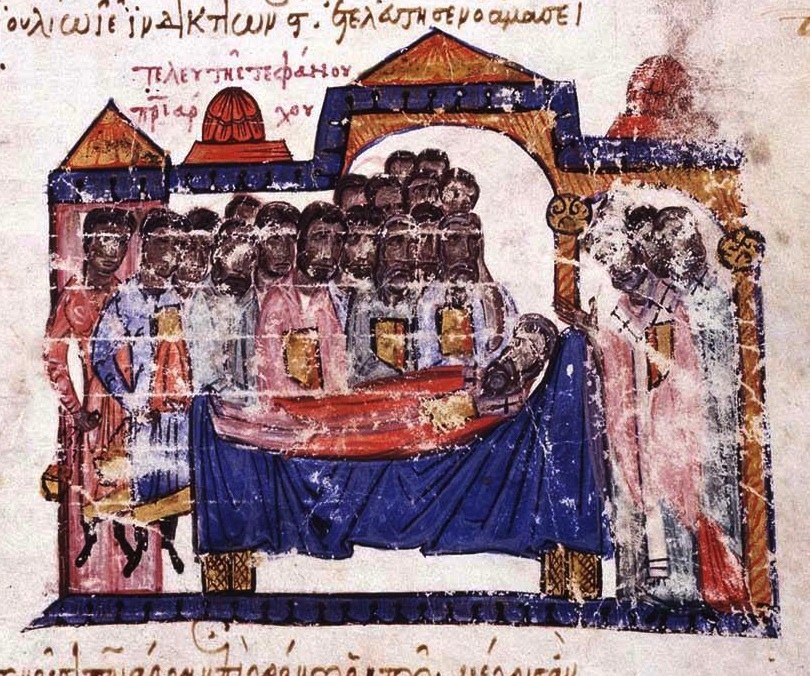
Stephen is painted as a hierarch: an elder in phelonion and omophorion, blessing with the right hand and holding the jewelled Gospel in the left, and — as a patriarch of Constantinople — often in the polystavrion, the cross-covered vestment proper to the ecumenical throne. He has no distinguishing attribute, and in practice his image is generated from the type rather than from any transmitted likeness; the manuscript chronicles that supply portraits of the tenth-century patriarchs (the Madrid Skylitzes above all) show the enthronements of the period, and it is there that any early representation of him would be sought — and it is exactly there that the stored image was found: the 13th-century chronicle miniature of his death, the patriarch laid on the draped bier amid the mourning clergy, a second hierarch censing at the right, the Greek caption above the frame reading τελευτὴ Στεφάνου πατριάρχου, "the death of Patriarch Stephen." (Portrait-files under "Stephen of Constantinople" on the public repositories belong to Stephen I and were rejected as depicting a different patriarch.)
Disputed questions
- The year of his death. The synaxarion, following Leo the Grammarian, gives 18 July 928, and this entry follows it. Several modern handbooks of the patriarchate end his tenure in 927, which would put the see vacant for the better part of a year before Tryphon; the discrepancy is one of the many small disagreements in the chronology of the tenth-century patriarchs and is not resolved here.
- Not to be confused with three other saints of the same name and city: his ninth-century namesake Stephen I of Constantinople (†17 May 893), the son of the emperor Basil the Macedonian, whose feast is May 17 and who is the "Stephen, Archbishop of Constantinople" of that day; Stephen the New (†764), the monastic martyr of Mount St Auxentius under Constantine V, whose feast is November 28; and Stephen of Constantinople the Almsgiver. English lists that print "St Stephen, Archbishop of Constantinople" against July 18 without a regnal number are the usual source of the confusion.