
Stephen the Great of Moldavia
The Holy and Right-believing Voivode Stephen the Great, Prince of Moldavia
Prince · Righteous · b. c. 1438–1440, in Moldavia — d. July 2, 1504, at Suceava
Commemorated 2 July — Repose at Suceava, 1504; canonised by the Romanian Church in 1992
Stephen the Great (Ștefan cel Mare, c. 1438–1504) ruled Moldavia for forty-seven years, from 1457 until his death on July 2, 1504, and is the central figure of Romanian Orthodox memory: the prince who held the eastern gate of Christendom against the Ottoman advance, and who is said to have built a church for every battle he fought. Under the direction of his spiritual father, the hesychast elder Daniel, he founded or endowed some four dozen monasteries and churches — Putna above all, where he lies buried — and created in the process the Moldavian architectural style. He was canonised by the Romanian Orthodox Church in 1992 and is commemorated on the day of his repose.

The winning of the throne
Stephen was the son of the voivode Bogdan II, who was murdered in 1451 by his own kinsman Petru Aron. The young man took refuge in Wallachia with Vlad Țepeș, and returned in 1457 with a small force; the boyars and the people met him on the plain of Direptate — "the field of Justice" — and there, by the acclamation of the assembly and the blessing of the metropolitan, he was raised to the throne of Moldavia on April 12, 1457. He was, by the reckonings, some eighteen or twenty years old.
Moldavia in the fifteenth century was a small principality squeezed between four powers: the kingdom of Poland to the north, Hungary to the west, the Tatars of the Crimea to the east, and behind all of them the Ottoman empire, which had taken Constantinople four years before Stephen's accession and was moving up the Danube. Stephen's whole reign was the improbable defence of that position.
The wars
He fought, by the count the tradition has kept, forty-seven battles, and lost very few. In 1467 he broke Matthias Corvinus of Hungary at Baia; in 1475, at Vaslui in the marshes on a January morning of fog, he destroyed an Ottoman army several times the size of his own — the victory that made his name in Europe, after which Pope Sixtus IV is said to have called him athleta Christi, the athlete of Christ. Stephen himself wrote to the Christian princes to tell them that Moldavia was "the gate of Christendom," and that if the gate were lost all Christendom would be in danger; the help he asked for never came in any quantity.
The next year, 1476, Mehmed II came in person, and at Războieni (Valea Albă) Stephen was defeated. It is at this point that the tradition places the best-remembered scene of his life. He rode to the cell of the hermit Daniel the Hesychast at Putna — the elder would not open the door, but answered through it — and asked whether he should submit to the Turks. Daniel told him not to yield; that he would drive them out and be victorious; and that when he had conquered he should build a monastery in honour of Saint George. Stephen went back, raised the country again, and the Ottomans withdrew, unable to hold what they had taken; and the monastery of Voroneț was built in 1488, in three months and three weeks by its inscription, and dedicated to Saint George. The victories continued into his old age: at Codrii Cosminului in 1497 he destroyed a Polish royal army that had invaded him.
The builder
The counsel Daniel is said to have given him at the beginning — that if he raised a church after every battle he would prevail in all his wars — is the frame in which Romanian piety holds the whole reign, and the count of the foundations matches the count of the battles: forty-eight churches and monasteries for forty-seven fights. The number is traditional rather than archival, but the building programme is real and is the material fact of the Moldavian fifteenth century. Putna, dedicated to the Dormition, was founded in 1466 at Daniel's urging and consecrated in 1470, and Stephen intended it from the first for his own burial; Voroneț (1488), Sfântul Ilie, Pătrăuți (1487), Dobrovăț (1503), the church of St John at Vaslui, the princely churches of Piatra Neamț, Borzești, Bacău and Hârlău, and the great fortified monastery of Neamț rebuilt and enlarged — together they created what is now called the Moldavian style, the compact stone church with its trilobed plan, tall drum, banded exterior and enamelled discs, on which the next generation would paint the famous exterior frescoes.
He endowed as widely as he built. Gifts of his went to Mount Athos — the tower and refectory of Zographou, and support for other houses of the Holy Mountain at a time when Athos depended on the Romanian lands for its survival — and to Jerusalem and Sinai. The manuscripts, embroidered epitaphioi, chalices, crosses and Gospel-bindings made for him are among the treasures of Romanian art; the votive miniature of the Humor Gospel of 1473 shows him kneeling to offer the book to the Mother of God.
Repose and canonisation
Stephen died on July 2, 1504, at Suceava, after a long illness — his leg had been wounded at Chilia in 1462 and never properly healed — and was buried in the church of the Dormition at Putna, where his tomb, under the slab he had prepared, is still the chief place of Romanian national pilgrimage. Moldavian chronicle and folk memory alike made him at once more than a prince: the chronicler Grigore Ureche wrote that at his death the whole country wept for him "as for a father," and that men called him holy for the goodness he had done, "not because he was a righteous man, but because they saw the great things he had accomplished."
Popular veneration was continuous from that time, but the formal act came late. On 20 June 1992 the Holy Synod of the Romanian Orthodox Church canonised him as Binecredinciosul Voievod Ștefan cel Mare și Sfânt — "the right-believing voivode Stephen the Great and Holy" — and appointed his memory on July 2, the day of his repose. The proclamation was made at Putna. The OCA receives the commemoration in its calendar; the Greek and Antiochian calendars do not keep it.
Feast and commemoration
July 2 (church date; New Calendar civil July 2, Old Calendar civil July 15), the day of his repose in 1504. He is kept by the Romanian Orthodox Church, which canonised him in 1992, and by the OCA, which lists him for the day; the Greek, Antiochian and Russian calendars do not. His feast falls on the great commemoration of the Deposition of the Robe of the Theotokos, and the pilgrimage to Putna on July 2 — where the Divine Liturgy is served at his tomb — is one of the largest gatherings of the Romanian church year. He is honoured as a patron of Moldavia, of Bukovina, and of the Romanian armed forces.
Hymns
Apolytikion — Tone 4 (common of a right-believing ruler)
Thou didst rule the people committed to thee in righteousness and in the fear of God, and didst raise up temples to his glory in all thy land; and having guarded the inheritance of the faithful from them that assailed it, thou wast found worthy of a crown that is not of this earth, O right-believing Stephen. Wherefore entreat Christ God that our souls may be saved.
Iconography
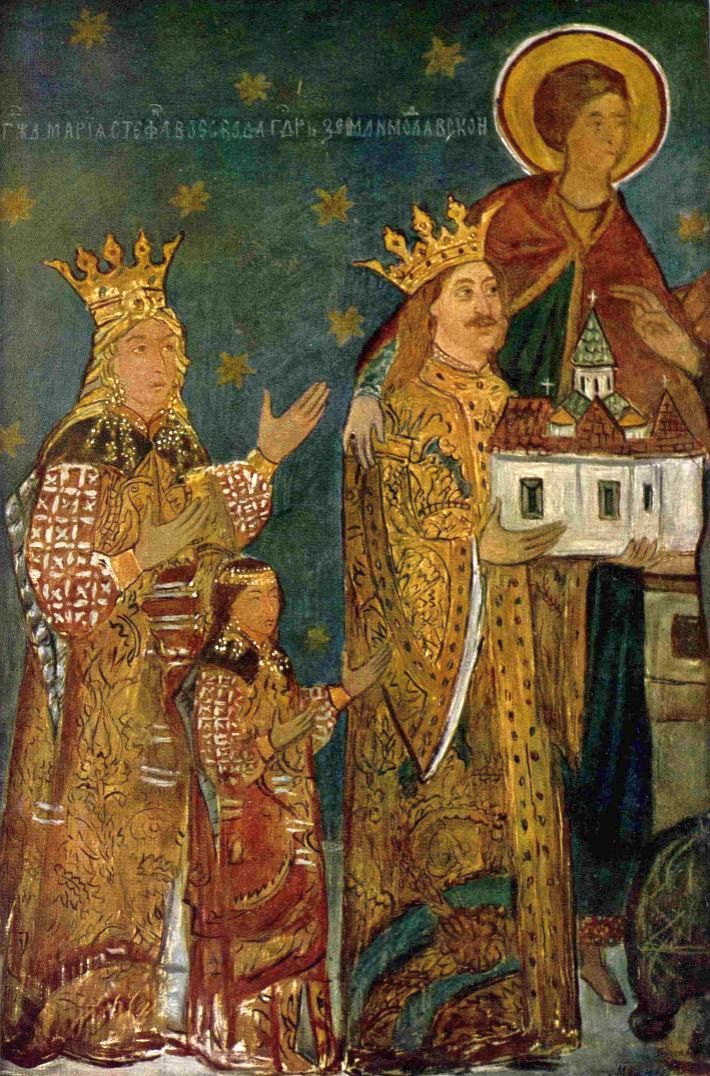
Stephen's image was fixed long before his canonisation, by the votive portraits he himself commissioned. In these he appears crowned, with long fair hair falling to the shoulders and a small moustache, in a heavy brocaded caftan of gold and red, holding out in both hands the model of the church he has built, and presented to Christ or to the Mother of God by the saint to whom the church is dedicated; his wife and children stand behind him. The type is repeated at Voroneț, Pătrăuți, Dobrovăț and elsewhere, and in the manuscript miniature of the Humor Gospel (1473), where he kneels alone to offer the Gospel-book to the Theotokos. Since 1992 he has been painted as a saint with the halo, in the same princely dress, holding a church in one hand and a cross — or, in some recensions, a sword held downward — in the other; new icons of him are in every Moldavian church, and the Putna cycle shows the scene at the door of Daniel the Hesychast's cell.
The stored image is the votive fresco of the church of St George at Voroneț (c. 1496), in which Stephen, crowned, offers the model of the church, presented by St George; his wife Maria Voichița and their son Bogdan stand at the left, and the Slavonic inscription across the starred ground names "Stefan voievod, gospodar of the land of Moldavia." The file is an anonymous colour plate of the fresco published in the Romanian journal Arta și Arheologia in 1928.
Disputed questions
- The count of forty-seven battles and forty-eight churches. The pairing is the tradition's, and its neatness is part of its meaning; the historical count of Stephen's foundations depends on what is counted (new building, rebuilding, endowment) and is generally given as between thirty and fifty. The entry reports the tradition as tradition.
- Sanctity and the record. Stephen's canonisation was debated, and the objections are not hidden by the Romanian Church: he was a hard ruler, put boyars to death, repudiated a wife, and fathered children out of wedlock; his raids into Wallachia and Transylvania were as ruinous as any. The Synod's act rested on his defence of Christendom, his building and endowment of the Church, his repentance, and the unbroken popular veneration at his tomb — the ground on which the Church has generally glorified rulers, from Constantine onward.
- The year of his birth is not recorded; c. 1438–1440 is inferred from his age at accession. His reign is firmly dated 1457–1504.
- Not to be confused with the Serbian despot Stephen Lazarević, nor with Stephen the Protomartyr, nor with the several Hungarian and Serbian royal Stephens; nor with Stephen the Great of Serbia (Stefan Nemanja / St Symeon the Myrrh-streaming). The Moldavian Stephen is distinguished in Romanian by the double epithet cel Mare și Sfânt.