
Symeon the God-receiver
The Holy and Righteous Symeon the God-receiver
Righteous · d. 1st century (traditionally, shortly after the Meeting)
Commemorated 3 February — The righteous elder who received the Christ-child; leader of the afterfeast of the Meeting
Symeon the God-receiver (Θεοδόχος, "he who received God") is the righteous and aged elder of Jerusalem who, "just and devout, waiting for the consolation of Israel," took the forty-day-old Christ-child into his arms in the Temple and knew him for the Salvation of God (Luke 2:25–35). To him the Holy Spirit had revealed "that he should not see death, before he had seen the Lord's Christ"; and holding the Infant he sang the last of the Gospel canticles — "Lord, now lettest thou thy servant depart in peace… for mine eyes have seen thy salvation" — the Nunc Dimittis that the Church prays at every Vespers. He blessed the Mother and foretold to her the sword that should pierce her own soul. A cherished tradition numbers him among the Seventy translators of the Septuagint, kept alive across centuries until the prophecy he had doubted — the Virgin who should conceive — was fulfilled before his eyes. With Anna the Prophetess he leads the afterfeast of the Meeting, commemorated on February 3.
.jpg)
The witness of the Gospel
Everything certain of Symeon is contained in a single passage of the Gospel of Luke, and it is enough to have made him one of the most beloved figures of the Church's memory. When, forty days after the Nativity, the Virgin and Joseph brought the Child Jesus up to Jerusalem "to present him to the Lord" and to offer the sacrifice of the poor — "a pair of turtledoves, or two young pigeons" — there was in the city "a man… whose name was Simeon; and the same man was just and devout, waiting for the consolation of Israel: and the Holy Ghost was upon him" (Luke 2:25). Three times in as many verses the Evangelist binds Symeon to the Holy Spirit: the Spirit was upon him; it had been revealed to him by the Spirit that he should not see death before seeing the Lord's Christ; and he came "by the Spirit into the temple" at the very hour the Child was brought in. He is, in the reading of the Fathers, the last of the prophets of the Old Covenant, standing on the threshold of the New — the aged embodiment of a whole people's expectation, at last permitted to hold in his arms the One for whom it had waited.
Taking the Infant up "in his arms," he blessed God and spoke the words the Church has never ceased to repeat:
Lord, now lettest thou thy servant depart in peace, according to thy word: for mine eyes have seen thy salvation, which thou hast prepared before the face of all people; a light to lighten the Gentiles, and the glory of thy people Israel. (Luke 2:29–32)
It is the Nunc Dimittis, the Song of Symeon, the fourth and last of the canticles of Luke's infancy narrative (after the Magnificat, the Benedictus, and the angels' Gloria) and the only one placed in the mouth of one about to die. In it the old man asks his release — "now lettest thou thy servant depart" — as a bondservant asks leave to go, his watch kept and his charge fulfilled; and he names the Child, in the language of the prophet Isaiah, "a light to lighten the Gentiles," the salvation prepared "before the face of all people." The Church took the song into the daily office of Vespers, where it is sung or read as the lamps are lit and the day closes — the whole Church, each evening, asking with Symeon to depart in peace, having seen its Salvation.
The prophecy of the sword
Joseph and the Mother "marvelled at those things which were spoken of him." And Symeon "blessed them, and said unto Mary his mother, Behold, this child is set for the fall and rising again of many in Israel; and for a sign which shall be spoken against; (yea, a sword shall pierce through thy own soul also,) that the thoughts of many hearts may be revealed" (Luke 2:34–35). The blessing is also a prophecy of the Passion: the Child is a stone of division, over whom Israel will stumble or rise; a sign contradicted; and the sword that shall pierce the Mother is read by the Church as her sorrow at the Cross, foretold at the very hour of the Presentation. The Byzantine hymnography dwells on the paradox that the aged Symeon holds the Ancient of Days as an infant, and that the same arms which received the Consolation of Israel foretell to the Consoler's Mother the anguish of Golgotha. From this word Symeon is styled not only Theodochos, God-receiver, but a prophet of the Passion.
The tradition of the Seventy and the promise
Around the bare Gospel notice the tradition of the Church wove a fuller account, which the synaxaria and the hymnography transmit and which gives the elder his particular glory. According to it, Symeon was one of the seventy (or seventy-two) translators commissioned at Alexandria under Ptolemy II Philadelphus to render the Hebrew Scriptures into Greek — the version the Church calls the Septuagint. Assigned the book of the prophet Isaiah, he came to the words "Behold, a virgin shall conceive, and bear a son" (Isaiah 7:14), and his reason rebelled: a virgin cannot bear. He took up his pen to alter the word parthenos, "virgin," to neanis, "young woman" — when an angel stayed his hand and told him that he should not taste death until he had seen with his own eyes the Christ born of a Virgin. From that day, the tradition holds, Symeon lived on — through generations, some accounts saying two hundred and seventy years, others more — a man kept alive by a promise, until the day the Spirit led him into the Temple and the Virgin's Child was placed in his arms, and he could ask at last to be let depart. The story is a pious tradition, not a datum of Scripture; but it crystallises the meaning the Gospel itself gives him — the man who "should not see death, before he had seen the Lord's Christ" — and it makes of his doubt over Isaiah's word a witness, across the centuries, to the very virginity he had questioned.
Repose and relics
Having received his release, Symeon reposed soon after — the tradition places his death within the same year, an old man full of days who had held his salvation and been let go in peace. His relics were later gathered and honoured. Byzantine sources record their translation to Constantinople, where they were enshrined among the treasures of the imperial city. In the West, the city of Zadar in Dalmatia venerates relics said to be those of the righteous Symeon, kept in the church that bears his name in a celebrated silver reliquary; the Orthodox East keeps his memory above all in the office of the Meeting and its afterfeast, of which — with the prophetess Anna — he is the human protagonist.
Feast and commemoration
Symeon is commemorated on February 3 (church date; Old Calendar civil February 16), the day after the Meeting of the Lord in the Temple (February 2, the ninth of the Twelve Great Feasts), as the leader of that feast's afterfeast together with Anna the Prophetess. The arrangement follows the Byzantine pattern by which the morrow of a Great Feast honours the chief human ministers of the mystery it celebrates: as December 26 keeps the Theotokos after the Nativity and January 7 the Forerunner after the Theophany, so February 3 keeps Symeon and Anna, the two aged witnesses through whom the Old Covenant received its Lord. The Antiochian, Greek, and Slavic calendars agree on the day. Symeon has no proper office distinct from the afterfeast hymns of the Meeting; his figure is woven through the whole feast, and his Song is the Gospel canticle of every Vespers.
Hymns
Troparion — Tone 1
Rejoice, O Virgin Theotokos, full of grace, for from thee has dawned the Sun of Righteousness, Christ our God, enlightening those in darkness. Be glad, O righteous Elder, thou who didst receive in thine arms the Deliverer of our souls, who granteth unto us the resurrection.
Original translation from the Greek
Kontakion — Tone 1
Thou who by thy birth didst sanctify the Virgin womb, and as was fitting didst bless the hands of Symeon, hast now come and saved us, O Christ our God. Give peace amid wars unto thy commonwealth, and strengthen those whom thou hast loved, O only Lover of mankind.
Original translation from the Greek
Canticle
Lord, now lettest thou thy servant depart in peace, according to thy word: for mine eyes have seen thy salvation, which thou hast prepared before the face of all people; a light to lighten the Gentiles, and the glory of thy people Israel. (Luke 2:29–32)
Appointed readings
Gospel — Luke 2:25–32 (the Meeting; the Song of Symeon)
25And, behold, there was a man in Jerusalem, whose name was Simeon; and the same man was just and devout, waiting for the consolation of Israel: and the Holy Ghost was upon him. 26And it was revealed unto him by the Holy Ghost, that he should not see death, before he had seen the Lord’s Christ. 27And he came by the Spirit into the temple: and when the parents brought in the child Jesus, to do for him after the custom of the law, 28Then took he him up in his arms, and blessed God, and said, 29Lord, now lettest thou thy servant depart in peace, according to thy word: 30For mine eyes have seen thy salvation, 31Which thou hast prepared before the face of all people; 32A light to lighten the Gentiles, and the glory of thy people Israel.
Iconography
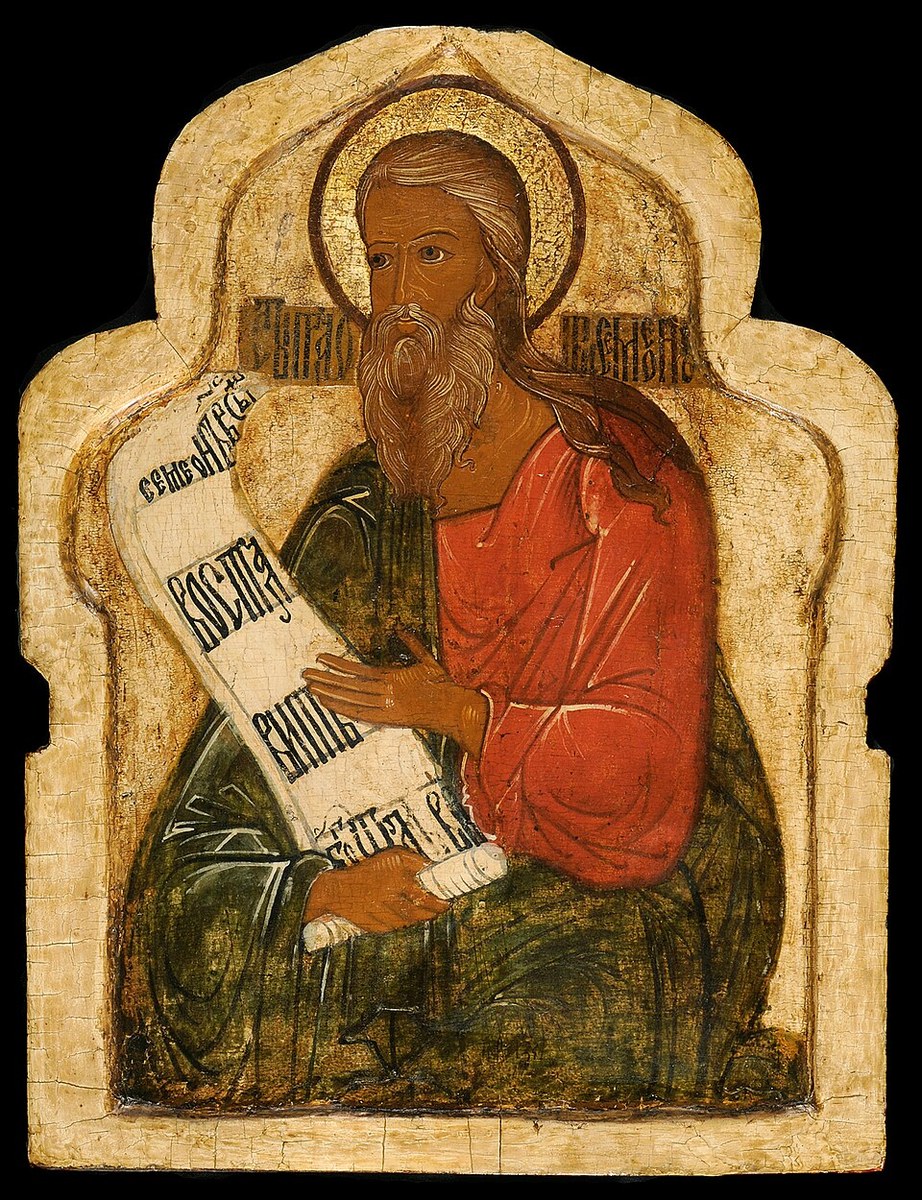
Symeon appears above all in the icon of the Meeting itself, where he is the counter-pole to the Virgin: an aged, white-bearded man, bowed forward, his hands veiled with a cloth or with the fold of his himation in reverence, receiving the Christ-child who reaches toward him across the altar of the Temple, with the Mother, Joseph bearing the two doves, and Anna the prophetess completing the group. In his own portrait type he is shown as a venerable elder in the flowing robes of a priest or an Old-Testament righteous man, often holding the Christ- child in his veiled arms, or bearing a scroll of his prophecy of the sword.
The stored image is a mid-17th-century Russian icon of the righteous Symeon, depicted as an aged, grey-bearded elder in the vesture of an Old-Covenant righteous man, holding an open scroll of his words (source, public domain, pd-old-work).