
Symeon the Stylite of the Wonderful Mountain
Our Venerable and God-bearing Father Symeon the Stylite of the Wonderful Mountain
Venerable · Priest · Wonderworker · b. 521 — d. 596
Commemorated 24 May — Repose on his pillar on the Wonderful Mountain near Antioch
Symeon of the Wonderful Mountain (521–596), called the Younger to distinguish him from his great namesake, is the supreme ascetic of the Antiochene church in the sixth century: a Syrian who mounted a pillar as a child of seven and stood on one for sixty-eight years, the last of them on the Wonderful Mountain (Θαυμαστὸν Ὄρος, Mons Admirabilis) above the road between Antioch and Seleucia Pieria, where a great monastery and one of the chief pilgrimage shrines of Syria grew up around his column. Orphaned by the earthquake of 526, raised by his mother St Martha (July 4), ordained deacon and then priest on the column itself, he was a wonderworker of vast reputation — healing, reading hearts, foretelling earthquake, plague and Persian invasion — whose blessing-tokens of clay travelled the whole Mediterranean. His enormous Life, written by an eyewitness disciple, is one of the richest documents surviving from sixth-century Syria.

Origins and early life
Symeon was born at Antioch in 521, the only child of John, a perfumer originally from Edessa, and of Martha, an Antiochene woman of deep piety who is herself numbered among the saints (commemorated July 4; she is not the Martha who was mother of Symeon the Elder). The Life — and the separate Life of Martha transmitted with it — relates that Martha had from girlhood desired virginity and the monastic life, and consented to marriage only under pressure from her parents and after praying before the shrine of St John the Forerunner, where she was assured that her obedience would be blessed with a child dedicated to God. The boy was accordingly vowed to God before his birth, and the hagiographer surrounds his infancy with the signs proper to such a vow: visions of Christ, a precocious refusal of the left breast, an instinctive fasting.
When Symeon was about five or six, the great earthquake of 526 destroyed Antioch — one of the worst catastrophes of the ancient world, in which a large part of the city's population died. John was killed in the collapse. The child was separated from his mother for some days in the ruin and confusion (the Life says an angel kept him), and mother and son afterwards settled outside the shattered city. This disaster stands at the head of Symeon's life and colours the whole of it: he grew up in a city that had been shaken down, and the tremors, plagues and invasions that recur through his ninety years of witness are the substance of his prophecies.
The child on the pillar
While still a boy Symeon left his mother and went inland to the community of a stylite named John, at the monastery of the pillar in the hill-country west of Antioch (the Life places it near Pilasa, on the coastal range). Received by the elder, tonsured, and set on a small column of his own at about seven years of age, he began the ascetic career that would last until his death. The gift of healing appeared in him almost at once, and with it the crowds.
At about eleven he was moved to a taller column — the Life gives it as forty feet — and about this time bishops from Antioch and Seleucia came and ordained him deacon, so that a child stood in the diaconate on a pillar. He remained on that column some eight years. The Life records a descent of the Holy Spirit upon him "in the likeness of a burning light," after which he began to dictate and write: letters and homilies on repentance, on the monastic life, on the Incarnation of the Word and on the judgement to come, of which a body of texts survives in Greek. His daily rule, once his elder had died and he was left to himself, was severe and orderly: from sunrise until mid-afternoon reading and copying the Scriptures, and then prayer through the whole night.
The Wonderful Mountain
About 541, after a vision in which he saw Christ standing upon a column on a bare summit, Symeon moved to the height thereafter called the Wonderful Mountain — Θαυμαστὸν Ὄρος, in Latin Mons Admirabilis, a hilltop of some 479 metres about 29 kilometres south-west of Antioch, overlooking the harbour city of Seleucia Pieria and the mouth of the Orontes. There he first lived on the naked rock and then raised his last pillar, standing where the sea-wind comes up the valley and where the road from the port to the capital of Syria passed below.
The mountain became a monastery and then a pilgrimage city. Sick people whom he had healed built a church there out of gratitude; a coenobium gathered at the foot of the column, with guest-houses for pilgrims; through his prayer a spring was opened for the community's water, and the Life tells of empty granaries filled with wheat. The complex that grew around the column — a great cruciform layout enclosing three churches, with the base of the pillar standing at the centre of an octagon, on the plan made famous at his namesake's shrine — was among the largest monastic sites of Syria.
In 560 the bishop Dionysius of Seleucia came to the mountain and ordained Symeon priest on the column, ascending a ladder to lay hands on him, so that thereafter the Eucharist was offered on the pillar's platform. The Life connects the ordination with his mother: Martha had died about 551 and was buried at the foot of the mountain, and her son desired to offer the Holy Sacrifice for her memory with his own hands. Symeon built a chapel over her tomb, and her cult grew up beside his own — one of the few instances in the calendar of a mother and son venerated together at one shrine.
Wonderworking and prophecy
Symeon's reputation in his own lifetime was extraordinary, and — unusually for a saint of this period — it is corroborated outside the hagiography. Evagrius Scholasticus, the lawyer of Antioch who wrote his Ecclesiastical History in the same generation, reports the saint's miracles as a contemporary and states that he had himself experienced Symeon's knowledge of men's hidden thoughts. The Life fills chapter after chapter with healings of the blind, the lame, the paralysed and the leprous, with deliverances from demons, from wild beasts and from shipwreck, with the discernment of hearts, and with raisings of the dead.
He was, above all, the prophet of Antioch's calamities. The sixth century in Syria was one long series of disasters: the earthquakes of 526 and 528; the sack of Antioch by the Persians under Khusrau I in 540; the great plague from 542 onward, returning in waves; further earthquakes and the chronic insecurity of the Persian frontier. From his column Symeon warned of these visitations, called the city to repentance, and interceded for it; the Life presents him as the standing intercessor who holds the wrath of God off a guilty and much-punished metropolis. Emperors and officials sought his prayers, and his authority in the Chalcedonian confession mattered in a province where the christological divisions were bitter and where a large part of the Syriac-speaking population had gone into the anti-Chalcedonian camp.
A distinctive feature of his cult, and a fact of real importance for the history of Christian images, is the eulogia token: small stamped medallions of clay, made from the earth of the Wonderful Mountain, bearing Symeon on his column, distributed to pilgrims and carried across the Mediterranean, where examples survive in numbers in modern museum collections. The sources record cures worked through these tokens and through painted images of the saint — testimony, a century and a half before the iconoclast controversy, to the veneration and miraculous power attributed to the image of a holy man.
Repose
The Life relates that in his seventy-fifth year the Lord forewarned him of his death; he called the brotherhood together, gave them a last address, blessed them, and reposed on his pillar on 24 May, having spent sixty-eight years as a stylite. He was buried on the mountain, and the miracles continued at his tomb: the sick, the possessed and the shipwrecked are recorded as helped there, and the shrine remained a goal of pilgrimage.
The monastery after him
The mountain kept his name — Arabic Samʿān, whence the modern Turkish Samandağ, the town below the site in the Hatay. In the mid-eleventh century the physician Ibn Buṭlān described the monastery as vast and thronged. It was destroyed in 1084 by Sulaymān ibn Qutlumush, rebuilt in the Crusader period, and flourished again into the thirteenth century until the Mamluk sultan Baybars destroyed it in 1268; it was never restored. The site is extensive and today ruinous, but the base of the pillar still stands in its octagon amid the remains of the three churches and the mosaic pavements — the visible ground of one of the greatest ascetic careers of the Antiochene church.
Feast and commemoration
May 24 (church date; New Calendar civil May 24, Old Calendar civil June 6). The feast is kept throughout the Byzantine rite and is of particular weight in the Patriarchate of Antioch, whose own soil holds the shrine: Symeon of the Wonderful Mountain is, with the Elder, the pre-eminent ascetic saint of the Antiochene tradition, and Antiochian usage honours him as a local father as well as a universal one. Some Greek sources also note a commemoration of him on April 27. The day always falls within the Pentecostarion, and in years of early Pascha it can coincide with the movable Sunday of the Fathers of the First Ecumenical Council or with the days after Pentecost; whatever belongs to the movable cycle in a given year takes precedence over the fixed office.
The saint's mother, St Martha, is commemorated separately on July 4, and the two are naturally kept together in the devotion of the shrine.
Hymns
Troparion — Tone 1
Thou didst become a pillar of patience, O God-bearing father, and didst rival the forefathers: Job in his sufferings and Joseph in his temptations, living as one of the bodiless powers while yet in the flesh. O Symeon, our venerable father, intercede with Christ God that our souls may be saved.
Original translation from the Greek
Kontakion — Tone 2
Set as a lamp upon the Wonderful Mountain, thou didst shine upon Antioch and upon all the Syrian land; from childhood thou didst make the pillar thy dwelling, and standing between earth and heaven thou wast made a priest of the Most High. O Symeon, wonderworker and intercessor, pray unceasingly for those who honour thee.
Original translation from the Greek
Iconography
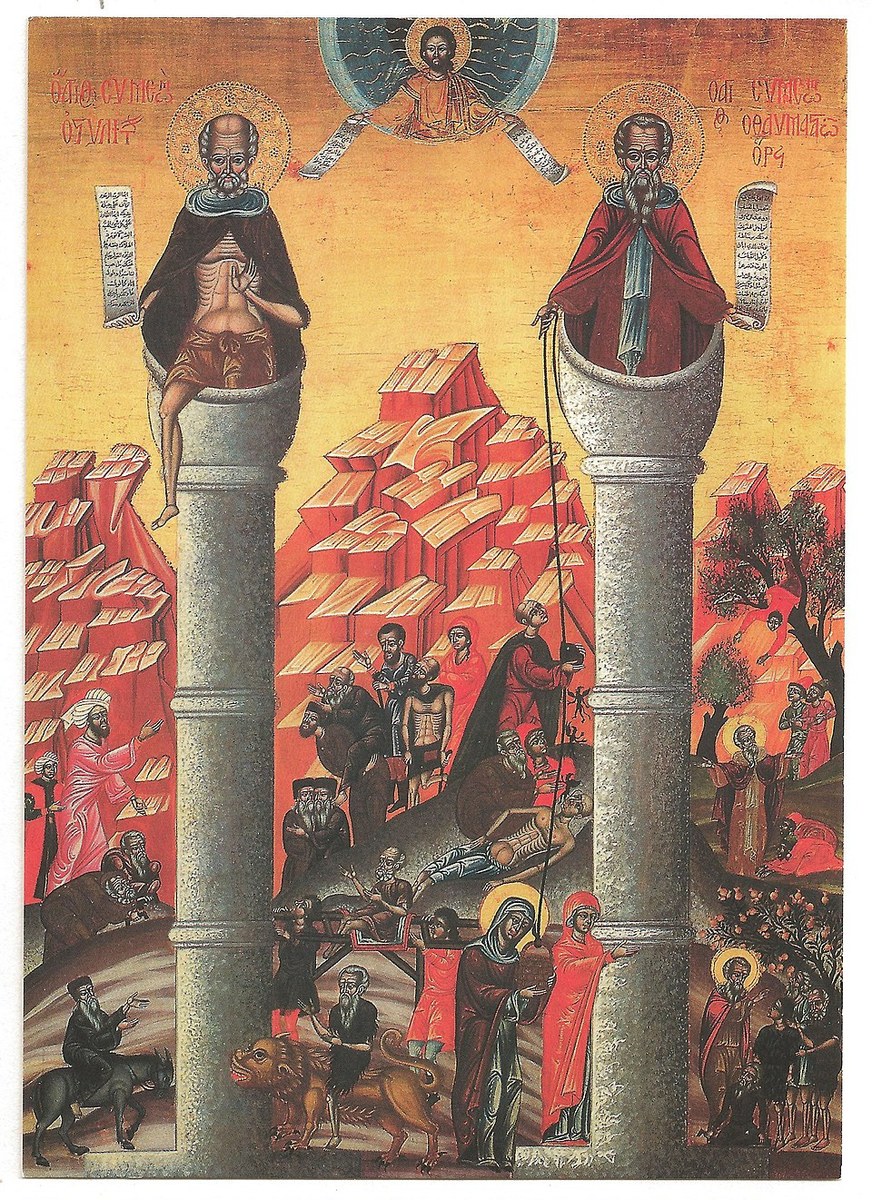
Symeon of the Wonderful Mountain is painted in the stylite type: a monk in the great schema, often with the koukoulion drawn back, emerging from the capital of a tall column, blessing with his right hand or holding an unrolled scroll; the column is regularly attended by a ladder, a basket on a rope by which food was drawn up, and the sick and the possessed crowded at its foot. Because he is the priest-stylite, some Antiochene and Melkite examples give him the stole. The one iconographic feature that reliably distinguishes him from the Elder is the inscription, Ο ΑΓΙΟΣ ΣΥΜΕΩΝ Ο ΘΑΥΜΑΣΤΟΡΕΙΤΗΣ — "Symeon of the Wondrous Mountain."
The stored image is a 1699 painted panel from the Greek Orthodox Convent of Our Lady of Balamand in Lebanon (now in the Ikonen-Museum, Frankfurt am Main) — an Antiochian, Arabic- inscribed icon of exactly the disambiguating kind. It shows the two Symeons on their two columns beneath Christ in glory: on the left, inscribed Ο ΑΓΙΟΣ ΣΥΜΕΩΝ Ο ΣΤΥΛΙΤΗΣ, the Elder, his emaciated body shown in the act of stepping down from the column at his abbot's command (or, in the other reading of the gesture, standing on one leg because of his ulcerated foot); on the right, inscribed Ο ΑΓΙΟΣ ΣΥΜΕΩΝ Ο ΘΑΥΜΑΣΤΟΡΕΙΤΗΣ, this saint, robed in a red mantle, holding a scroll written in Arabic, with the rope and basket hanging from his column. Between and below the pillars the painter has set the pilgrim crowds, the sick carried on biers, women bringing children, a lion and a tamed beast, and the rocky Syrian hills. It is used here on the strength of the right-hand inscription, which names this Symeon and no other.
Disputed questions
- Not to be confused with Symeon the Stylite the Elder (c. 390–459, feast September 1), the founder of the stylite life, whose column stood at Telanissos north-east of Antioch and over which the great martyrium of Qalʿat Simʿān was built. The two are the classic confusion of the Syrian calendar, and they are constantly conflated in picture collections, museum captions and popular accounts. They are distinct men of distinct centuries: the Elder was a shepherd of the Cilician border who mounted his pillar as a grown man about 423 and stood on it some thirty-six years, was never ordained, and died in 459, his relics going to Antioch in triumph; the Younger was an Antiochene born in 521, set on a pillar as a child of seven, ordained deacon and then priest on the column, and reposed in 596 on the Wonderful Mountain south-west of the city. An icon or fresco of an unnamed saint on a column is therefore never sufficient identification of either; only an inscription (the Younger is titled ὁ Θαυμαστορείτης, "of the Wondrous Mountain") or an unambiguous topography settles it. Lesser confusions, in collections of Syrian ascetics, are with Symeon the Ancient and, in Greek indexes of "St Symeon" simply, with Symeon the New Theologian (†1022); neither has any connection with the Wonderful Mountain.
- The year of his repose: 592 or 596. The manuscript tradition and the modern editors divide. 24 May is agreed, and the great critical edition of the Life is generally taken to place the death in 592; the synaxarial tradition followed by the Orthodox Church in America and by most calendar sources gives 596, and 596 is the figure that agrees with the other numbers the Life supplies — birth in 521, seventy-five years of age, sixty-eight years on the pillar counted from his seventh year. Some Western notices give 597. This entry follows the synaxarial 596 while recording the alternative.
- His age at ordination to the priesthood. The date 560 is transmitted for the ordination by Dionysius of Seleucia, at which Symeon would have been thirty-nine. Some English retellings attach "in his seventy-fifth year" to the ordination; this appears to be a compression of two separate notices — the ordination of 560 and the warning of his death received at seventy-five — and the two should not be run together.
- The birthplace of his mother's marriage and the location of the first pillar. The Life's topography of the coastal range west of Antioch (the monastery of the stylite John, variously located near Pilasa or Mandra) cannot be fixed with certainty against the surviving archaeology, and accounts differ over how many columns he occupied before the Wonderful Mountain.
- Forty-five or sixty-eight years on the Wonderful Mountain? Popular accounts sometimes say he spent his "last forty-five years" on the mountain and sixty-eight years as a stylite altogether; the two figures are compatible (the move to the mountain about 541 leaves roughly fifty-five years there on the 596 reckoning, or fifty-one on the 592 reckoning) but no source allows precision, and the round numbers should be treated as approximate.