
Telemachus
The Holy Monk-Martyr Telemachus
Venerable Martyr · b. unknown, in the East (Asia Minor) — d. c. 404, at Rome
Commemorated 1 January — Martyrdom in the amphitheatre at Rome, opposing the gladiatorial games
Telemachus (also Almachius; †c. 404) was an ascetic monk from the East who, according to the historian Theodoret of Cyrrhus, came to Rome and, entering the amphitheatre during the gladiatorial games, stepped down into the arena to part the combatants and put an end to a spectacle in which men killed one another for the crowd's pleasure. The enraged spectators — or, in another account, the gladiators at the prefect's order — fell upon him and killed him where he stood, so that he died a martyr not for confessing Christ before a persecutor but for the sanctity of human life. His death, Theodoret relates, so moved the Christian emperor Honorius that he issued the decree abolishing the gladiatorial combats, and Telemachus is remembered as the martyr whose blood ended the games of Rome. He is commemorated on January 1.
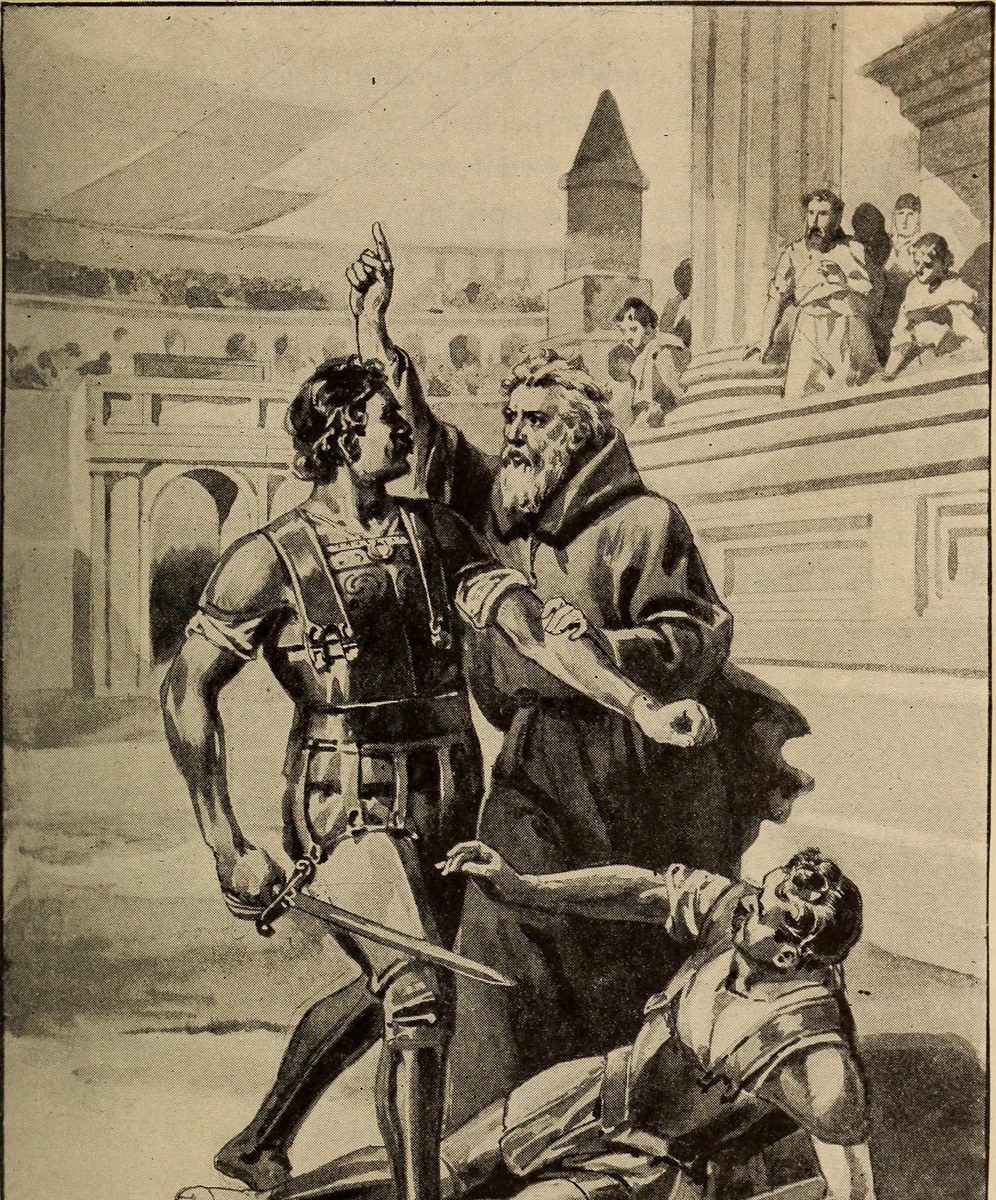

The martyr who ended the games
What is known of Telemachus comes almost entirely from a single paragraph of the church historian Theodoret of Cyrrhus (Ecclesiastical History V.26), who wrote in the mid-fifth century, within living memory of the events. Theodoret tells that a certain monk named Telemachus, "having embraced the ascetic life," came from the East to Rome at the time when the abominable spectacle of the gladiators was still kept in the city. When the games were being held, Telemachus went down into the arena and tried by his own body to stop the fighters and separate them. The crowd, cheated of its sport and inflamed, stoned him to death — Theodoret says the spectators themselves killed the peacemaker.
But his death was not in vain. When the pious emperor Honorius (reigned in the West 395–423) learned of it, he took the monk's martyrdom as the occasion, Theodoret writes, to abolish the gladiatorial combats altogether. Whatever edicts had gone before, the tradition fixes on Telemachus's death as the moment the games of Rome came to their end — a solitary ascetic, unarmed, halting by his murder a cruelty that centuries of law and preaching had not stopped. The date is placed about the year 404, in the consulship that saw the last recorded games; some accounts give an earlier year, and the name appears also as Almachius, under which the Western martyrologies commemorate him on the same day, January 1.
Name and memory
The variation of the name — Telemachus in Theodoret and the Greek tradition, Almachius in the Latin martyrologies — has led some to wonder whether one martyr or two lie behind the notices, but the Church has kept them as one: the monk from the East who died to end the games. In the Orthodox calendar he is numbered among the monastic martyrs (ὁσιομάρτυρες), for he was an ascetic slain in the witness of the Gospel's mercy; in the West he is honoured as the last martyr of the Colosseum, though the tradition does not name the amphitheatre in which he died. His memory has kept a particular power as a witness against public cruelty and for the dignity of human life.
Feast and commemoration
January 1 (church date; Old Calendar civil January 14), kept together with the Circumcision of Christ and Basil the Great, whose feast governs the day. His commemoration is a synaxarion notice (given, among the Slavic sources, in the Prologue of Ohrid, and kept by the Orthodox Church in America); the Roman Martyrology commemorates him as Almachius on the same day, January 1.
Hymns
Troparion — Tone 4
Thy martyr Telemachus, O Lord, in his contest received an incorruptible crown from thee our God; for, possessed of thy might, he cast down the tyrants and broke the feeble insolence of the demons. By his prayers, O Christ God, save our souls.
Original translation from the Greek
Iconography
Telemachus is depicted as a monk — in the dark tunic and mantle and the monastic koukoulion — most characteristically at the moment of his death: standing unarmed in the sand of the arena, his hands raised, as the crowd or the gladiators fall upon him, the tiers of the amphitheatre rising behind. The stored image is a Western work per §34: the 1907 Foxe plate of the monk in the arena, arms outstretched between the gladiators. An Eastern image remains wanted and is listed among the upgrade-wanted icons.