
Circumcision of Christ
The Circumcision according to the Flesh of our Lord and God and Saviour Jesus Christ
On January 1, the eighth day after the Nativity, the Church keeps the Circumcision according to the Flesh of our Lord Jesus Christ — the day on which, as the Law of Moses appointed for every male child of Israel, the newborn Christ was circumcised and received his name, Jesus, "which was so named of the angel before he was conceived in the womb" (Luke 2:21). It is a feast of the Lord, kept as the eighth day of the Nativity: the Church reads in it the proof that the Word truly took our whole flesh and blood and was truly subject to the Law he came to fulfil — against every teaching that his humanity was a mere appearance — and the moment when the eternal Son, in his manhood, was given the saving Name above every name. The Fathers read the eighth-day circumcision as the shadow whose reality is the "circumcision made without hands" of Baptism (Colossians 2:11–12), so that the feast looks back to the manger and forward to the Jordan. It coincides always with the memory of Basil the Great, and the two are kept together, the Liturgy of Basil being served on his day.
.jpg)
The Gospel: the eighth day (Luke 2:21)
The feast rests on a single verse. Luke, having told the birth at Bethlehem and the coming of the shepherds, continues: "And when eight days were accomplished for the circumcising of the child, his name was called JESUS, which was so named of the angel before he was conceived in the womb" (Luke 2:21). Two things are joined in that verse, and the feast keeps them together: the circumcision of the child on the eighth day, and the giving of his name.
Both belong to the Law. Circumcision was the sign of the covenant given to Abraham — "This is my covenant… Every man child among you shall be circumcised… and it shall be a token of the covenant betwixt me and you. And he that is eight days old shall be circumcised among you, every man child in your generations" (Genesis 17:10–12) — the mark cut in the flesh of every son of Israel, by which he was reckoned within the people of God and bound to keep the whole Law (Galatians 5:3). And the eighth day was also, by custom, the day of naming. So on the eighth day of his life the incarnate God was brought under the knife of the Law like any son of Abraham, and was given the name the archangel Gabriel had spoken to the Virgin at the Annunciation — Yeshua, "the Lord saves," "for he shall save his people from their sins" (Matthew 1:21).
Why the Lord was circumcised: the fulfilment of the Law
The Church has never read the circumcision of Christ as a thing he needed. He who was without sin had nothing to purge; he who was the Lawgiver stood above the Law. Why, then, does he submit? The Fathers answer, with Scripture, that he did it to fulfil the Law, not to be bound by it: "I am not come to destroy, but to fulfil" (Matthew 5:17), and, in Paul's words at the very heart of the feast's Nativity octave, God "sent forth his Son, made of a woman, made under the law, to redeem them that were under the law" (Galatians 4:4–5). By accepting circumcision on the eighth day the Lord takes upon himself the whole obedience of Israel, keeping the covenant of Abraham from its first requirement, that he might carry the Law through to its fulfilment and release those held under it. He is circumcised, the hymns say, not as one in debt to the shadow but as the one who ends the shadow — "fulfilling the Law," as the apolytikion sings, that he might "bring the shadows to an end."
The reality of the flesh: against Docetism
The deeper reason the Church dwells on this feast is that it is the hardest possible answer to those who would deny the reality of the Incarnation. The whole first heresy of the Church was Docetism — the teaching (already opposed by Ignatius of Antioch and by the Apostle John) that Christ only seemed to have flesh, that his body was a phantom, his birth and suffering an appearance. A phantom is not circumcised. A seeming body does not bleed on the eighth day. The circumcision is the Church's blunt, bodily proof that the Word "was made flesh" (John 1:14) in the fullest and most concrete sense: that he had real flesh, real blood, a real human body subject to the Law and to the knife, and that in him the fullness of the Godhead dwelt bodily (Colossians 2:9). The tradition presses the point further against Apollinarianism, which allowed Christ a human body but denied him a rational human soul: the feast confesses a complete and entire manhood, the whole of what is ours (sin alone excepted) taken up and healed. So the small, humble sign in the flesh of the eight-day-old child is set by the Church as a guard over the great doctrine of the Nativity — that God became truly and completely man, that man might become god.
Circumcision fulfilled in Baptism
Reading the feast, the Fathers set the old sign beside the new. Circumcision was the seal of entry into the covenant of Abraham; Baptism is the seal of entry into the covenant of Christ, and the epistle read at the Liturgy makes the one the shadow of the other. "In whom also ye are circumcised with the circumcision made without hands, in putting off the body of the sins of the flesh by the circumcision of Christ: buried with him in baptism, wherein also ye are risen with him through the faith of the operation of God" (Colossians 2:11–12). The knife that cut a mark in the flesh of one nation is fulfilled in the water that puts off the whole "body of sin" and raises the baptised, of every nation, into the death and resurrection of Christ. Circumcision touched the body of the male children of Israel on the eighth day; Baptism, its reality, is given to all — male and female, Jew and Greek (Galatians 3:28) — and the "eighth day" itself becomes, in the Fathers, the figure of the age to come, the day beyond the seven of this creation, into which the risen Christ leads his people. So the feast that keeps the last of the shadows keeps also the first pointing toward the font: the Lord is circumcised on the eighth day that we might be reborn into the eighth day without end.
The Name of Jesus
With the circumcision the child is named, and the Church keeps the feast as the day of the Holy Name. The name was not chosen by Joseph or by Mary but given from heaven, spoken by Gabriel to the Virgin before the conception (Luke 1:31) and to Joseph in his dream (Matthew 1:21), and it declares the whole work of the one who bears it: Jesus, "the Lord is salvation." It is the Name that Paul says God has exalted above every name, "that at the name of Jesus every knee should bow" (Philippians 2:9–10); the Name in which the Apostles healed and preached, and by which alone "we must be saved" (Acts 4:12); the Name that the Eastern tradition takes into the heart in the Jesus Prayer. The feast of the Circumcision is therefore, in the East, the nearest thing to a feast of the Holy Name of Jesus, keeping the day on which, in his flesh and under the Law, the Saviour was first called by the name that saves.
Feast and commemoration
January 1 (church date; New Calendar civil January 1, Old Calendar civil January 14), the eighth day of the Nativity of Christ and a feast of the Lord. It stands within the twelve festal days between the Nativity (December 25) and the Theophany (January 6); it has neither forefeast nor afterfeast of its own — the octave of the Nativity is its setting — and its rank is below that of the Twelve Great Feasts, a Dominical feast kept without the vigil-apparatus of the greater feasts but with a full festal Menaion office. Its whole service is sung together with that of Basil the Great, whose commemoration falls on the same day, so that the books of January 1 carry one joined office of the Circumcision and the great hierarch — the reason the proper kontakion of the feast ends by naming Basil, and the reason the Divine Liturgy served on January 1 is the Liturgy of Basil the Great, one of the ten days in the year appointed for it. January 1 is fast-free, falling within the loosed days of the Nativity octave that run to the eve of Theophany.
The Byzantine, Greek, and Slavic calendars agree on the day and keep the two commemorations together. In the West the eighth day of Christmas was long kept as the feast of the Circumcision (January 1) and is now, in the Roman calendar, the Solemnity of the Mother of God, with the Holy Name of Jesus kept on January 3; the Eastern feast keeps the older focus on the Circumcision and the Name together. The civil observance of January 1 as New Year's Day is a wholly separate matter of the secular calendar and touches the content of the feast not at all.
Hymns
Troparion — Tone 1
Being God in essence, O most compassionate Lord, thou didst take upon thee human form without change; and, fulfilling the Law, thou dost of thine own will accept circumcision in the flesh, that thou mightest bring the shadows to an end and remove the veil of our passions. Glory to thy goodness; glory to thy compassion; glory, O Word, to thine ineffable condescension.
Original translation from the Greek
Kontakion — Tone 3
The Lord of all endureth circumcision, and, being good, cutteth away the transgressions of mortals; today he giveth salvation to the world, while in the highest there rejoiceth the hierarch of the Creator, Basil, the light-bearing and divine initiate of Christ.
Original translation from the Greek
Appointed readings
Epistle — Colossians 2:8–12
8Beware lest any man spoil you through philosophy and vain deceit, after the tradition of men, after the rudiments of the world, and not after Christ. 9For in him dwelleth all the fulness of the Godhead bodily. 10And ye are complete in him, which is the head of all principality and power: 11In whom also ye are circumcised with the circumcision made without hands, in putting off the body of the sins of the flesh by the circumcision of Christ: 12Buried with him in baptism, wherein also ye are risen with him through the faith of the operation of God, who hath raised him from the dead.
Gospel — Luke 2:20–21, 40–52
20And the shepherds returned, glorifying and praising God for all the things that they had heard and seen, as it was told unto them. 21And when eight days were accomplished for the circumcising of the child, his name was called JESUS, which was so named of the angel before he was conceived in the womb. 40And the child grew, and waxed strong in spirit, filled with wisdom: and the grace of God was upon him. 41Now his parents went to Jerusalem every year at the feast of the passover. 42And when he was twelve years old, they went up to Jerusalem after the custom of the feast. 43And when they had fulfilled the days, as they returned, the child Jesus tarried behind in Jerusalem; and Joseph and his mother knew not of it. 44But they, supposing him to have been in the company, went a day’s journey; and they sought him among their kinsfolk and acquaintance. 45And when they found him not, they turned back again to Jerusalem, seeking him. 46And it came to pass, that after three days they found him in the temple, sitting in the midst of the doctors, both hearing them, and asking them questions. 47And all that heard him were astonished at his understanding and answers. 48And when they saw him, they were amazed: and his mother said unto him, Son, why hast thou thus dealt with us? behold, thy father and I have sought thee sorrowing. 49And he said unto them, How is it that ye sought me? wist ye not that I must be about my Father’s business? 50And they understood not the saying which he spake unto them. 51And he went down with them, and came to Nazareth, and was subject unto them: but his mother kept all these sayings in her heart. 52And Jesus increased in wisdom and stature, and in favour with God and man.
Iconography
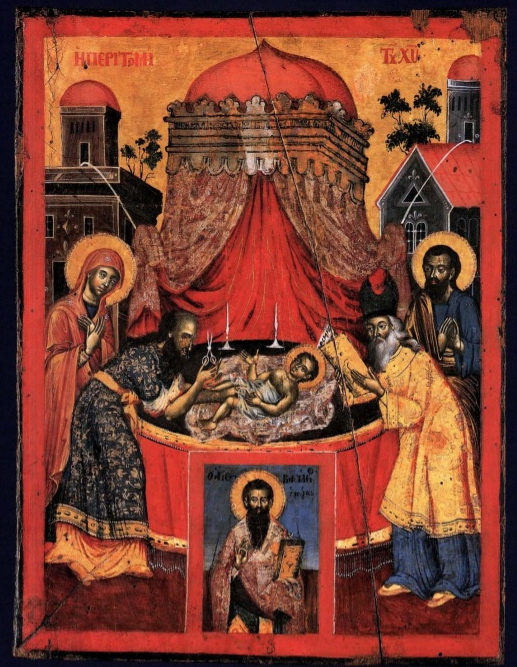
The icon of the feast renders Luke 2:21 directly. The scene is set in or before the Temple: the priest, an old man in the vesture of the Law, stands to perform the rite; the Christ-child is held forward — often by the Theotokos, or by Joseph, or presented on the altar — and the small company of the holy family attends. Unlike the great narrative feasts, the Circumcision has no crowded cast; its whole meaning is in the one act, the child of eight days brought under the Law. Because the day is Basil's, the icon of the feast is very frequently paired with, or set beside, the figure of Basil the Great, and in many festal calendars and menaion-icons the two share a single field — the Circumcision above or to one side, the great hierarch below or beside it — a visual form of the joined office of January 1.
The stored image is a post-Byzantine icon of the Circumcision painted about 1760–1780 in the region of Korçë (southern Albania, within the north-western Greek painterly world): the eight-day-old Christ is brought for the rite in the Temple, attended by the priest and the holy family, in the settled iconographic type of the feast.