
Thaddaeus of the Seventy
The Holy Apostle Thaddaeus, one of the Seventy, the Enlightener of Edessa
Apostle of the Seventy · d. c. 44, at Beirut (Byzantine tradition); the Armenian tradition places his martyrdom in Artaz c. 50
Commemorated 4 January — Synaxis of the Seventy Apostles, 21 August — Repose of the apostle of Edessa
Thaddaeus — Addai in his own Aramaic — was a Jew of Edessa who came up to Jerusalem, was baptised by John the Forerunner in the Jordan, followed Christ, and was numbered among the Seventy. After Pentecost he was sent back to his own city to fulfil the promise the Lord had made in his letter to the toparch Abgar: he healed the king of his disease, baptised him and his household and at length the whole city, put down the idols, ordained clergy and founded the church of Edessa — the mother-church of Syriac Christianity and the first Christian polity in the world by its own reckoning. He preached afterwards through Syria and Mesopotamia and built a church at Beirut, where the Byzantine tradition says he reposed in peace about the year 44. He is not the apostle of the Twelve who bears the same by-name, and the two have been confounded since antiquity.
_-_August_-_30_Thaddeus_of_Edessa.jpg)
A Hebrew of Edessa
The Byzantine notice is precise about his origin and unusually so: he was by descent a Hebrew, and born in Edessa — the Syriac Urhāy, capital of the little Aramaic kingdom of Osrhoene between Rome and Persia, the modern Şanlıurfa. Edessa had an old and considerable Jewish population, in touch with Jerusalem and with the Jewish communities of Adiabene and Babylonia; the road that took a young Edessene Jew up to the Temple for the feasts was a well-worn one, and it is that road the synaxarion sets him on.
At Jerusalem he heard the preaching of John the Forerunner and was baptised by him in the Jordan. This is the detail that most sharply distinguishes him in the apostolic lists: he belongs to the Forerunner's disciples, the men already prepared by the baptism of repentance when Christ began to preach, and out of whose number the Gospel repeatedly draws those who follow. He remained in Palestine, attached himself to the Lord, and was chosen among the Seventy whom Christ sent out two by two before his face (Luke 10:1). The Greek synaxarion's distich for the day claims for him the highest title the Church can give a disciple who is not of the Twelve: "Thaddaeus, what other crown shall I weave thee than to call thee an eyewitness and an initiate of the Word?"
The letter of Abgar and the promise of an apostle
The event that fixes Thaddaeus in the memory of the Church is the correspondence between Christ and Abgar the toparch of Edessa, which Eusebius of Caesarea says he translated himself out of the Syriac archives of the city (Ecclesiastical History I.13). Abgar, wasted with an incurable disease and hearing of the healings in Palestine, wrote begging the Lord to come and heal him, and offering his small but seemly city as a refuge. The reply blessed him for believing without seeing, declined the journey, and promised: after I have been taken up, I will send thee one of my disciples, that he may heal thy suffering and give life to thee and to those with thee.
That disciple was Thaddaeus. Eusebius adds — and the detail is not a Byzantine embroidery but the oldest form of the story — that he was sent by the Apostle Thomas, to whom the evangelisation of the East was assigned; the Byzantine books keep the sending by Thomas even while numbering Thaddaeus with the Seventy. The full account of the correspondence, of the envoy Ananias (Syriac Hannan), the king's archivist and painter, and of the cloth he carried back, belongs to the Translation of the Image Not-Made-by-Hands (August 16), where the growth of the tradition is set out in full; the essential point for this entry is that in every form of the story the letter promises an apostle and the apostle is Thaddaeus.
The healing of Abgar and the conversion of the city
Coming to Edessa, Thaddaeus lodged with a certain Tobias, a Jew of the city, and there began to heal the sick in the name of Jesus. The report reached the palace; Abgar, remembering the promise of the letter, sent for him. The Syriac and Greek accounts agree on the scene that followed. As the apostle entered, a great light shone from his face, and the king — who had been unable to rise — rose up and did reverence, and asked whether he were truly the disciple of Jesus who had been promised. Thaddaeus answered that if Abgar believed in Christ, the desires of his heart would be granted. The king confessed that he had so believed that he would gladly have taken an army against the Jews who crucified him, had the empire of Rome not stood between; and Thaddaeus laid his hand on him, and he was healed of his disease — a leprosy or a gout, the sources differ — and healed likewise of a disorder of the feet from which he had suffered.
What followed was not a private cure but the conversion of a city. Abgar had the people gathered, and Thaddaeus preached to them the economy of the Incarnation: the coming down of the Son, the Cross, the Resurrection, the Ascension and the judgement to come. The pagan priests of Edessa were converted with the rest; the sacred grove and the altars of Nebo and Bel were thrown down; and the king, his household, the nobles and the commons received baptism. Edessa thereby became — in the tradition it never afterwards relinquished — the first kingdom on earth to be Christian by the act of its ruler.
Abgar offered the apostle gold and silver in thanksgiving. Thaddaeus refused it with the word that has stayed in the account ever since: if we have left our own, how shall we take what is another's? He asked instead that the king's alms go to the poor, and he stayed to build.
Founder of the Church of Edessa
The organisation of the church he left behind is described with a concreteness rare in apostolic hagiography, and it is one of the most valuable things the Doctrine of Addai preserves. Thaddaeus set up an altar and taught the people to observe the days of the Church; he ordained clergy — presbyters and deacons — and appointed readers and singers; and he named as his own successor and head of the church Aggai, who had been the maker of the king's silk headbands and diadems. Aggai in his turn is said to have been succeeded by Palut, who was ordained at Antioch by Serapion — the notice by which the Syriac tradition itself binds the church of Edessa to the see of Antioch, and which gives this apostle his standing place in the Antiochian patrimony.
Two further men of the Edessene mission are named beside him and honoured with him in the East Syriac calendars: Aggai and Mari. From that pairing comes the ancient Anaphora of Addai and Mari, the eucharistic prayer of the Church of the East, in substance among the oldest liturgical texts in continuous use anywhere in Christendom, and a witness of the first importance to the Semitic-language worship of the earliest Mesopotamian Christians. Whether or not the anaphora is the apostle's own composition — no serious claim is made for that — the fact that the East named its central prayer after him measures what his memory weighed in the Syriac-speaking world.
Beirut, and the repose
Having refused to remain a court favourite at Edessa, Thaddaeus went on preaching: the Byzantine notice sends him through Syria and Mesopotamia, converting many and founding churches. He came at length to Beirut in Phoenicia, where he raised a church, and there — according to the Greek synaxarion and the Menaion, which the Antiochian and Greek calendars follow — he reposed in peace about the year 44. The distich of the day says simply, "on the twenty-first Thaddaeus flew away from life": the verb belongs to a peaceful death and not to a martyrdom, and the Byzantine books nowhere give him the martyr's crown. His body, one strand of the tradition adds, was carried back to Edessa and buried in the city he had won.
The Syriac Addai and the memory of the East
In Syriac the apostle is Addai — a genuine Semitic name, and almost certainly the original one, of which the Greek Θαδδαῖος is the hellenised form. He is Mar Addai, the apostle of Mesopotamia, in the Syriac Orthodox and Chaldean and Assyrian traditions alike; the Doctrine of Addai (c. 400), which is the classical Syriac telling of the whole Edessene story, takes its name from him; and the metrical homilies and the calendars of the Syriac churches carry his memory quite independently of the Byzantine day. For a corpus attentive to the Antiochian tradition he is a figure of particular weight: he stands at the head of Aramaic-speaking Christianity, in a city that received the Gospel in its own tongue and never had to receive it in Greek, and the line from him through Aggai and Palut to Serapion of Antioch is one of the oldest genealogies of a church that the East preserves.
Veneration and later cultus
At Edessa the apostle's memory was inseparable from the letter and the image. Pilgrims were shown the correspondence — Egeria in 384 was given copies of it by the bishop, and records the tour without a word of any picture — and the acheiropoieton, once it enters the tradition, is always the thing Thaddaeus's mission brought about. The Byzantine narrative cycle of the Holy Image accordingly puts him at the centre of its pictures: the apostle standing before the enthroned Abgar as the cloth changes hands. Constantinople kept his memory on August 21 and Constantinople's synaxarion carried it to every Byzantine-rite church.
In the West the apostle of Edessa was largely swallowed by the apostle of the Twelve, and his separate identity survives there chiefly as a puzzle in the martyrologies. In the East he never lost it: the Greek, Slavonic, Georgian and Antiochian books all keep the twenty-first of August for this Thaddaeus, and keep June 19 for the other.
Feast and commemoration
August 21 (church date; New Calendar civil August 21, Old Calendar civil September 3), within the afterfeast of the Dormition (August 15–23), whose hymns are sung together with his at every office of the day. The Greek Menaion prints one service for the day, of the apostle and of the martyr Bassa of Edessa and her sons, with a proper kontakion of Thaddaeus and the common apolytikion of an apostle. That the two Edessas — the Syrian city of the apostle and the Macedonian city of the martyr — should fall on one day is a coincidence of the calendar and nothing more, but it has caused the martyr to be transplanted to Syria in more than one modern day-list.
He is commemorated a second time, with the whole college, at the Synaxis of the Seventy Apostles on January 4.
The Syriac churches keep Mar Addai on days of their own reckoning, and the Armenian Church keeps its "Thaddaeus" — understood there as one of the Twelve — with a cycle of its own and a great pilgrimage at the Monastery of St Thaddeus. Where Latin reference works give this apostle a feast in early August or on other days, the divergence is a consequence of the identity question and not of a competing tradition about the man.
Hymns
Apolytikion — Tone 3
O holy Apostle Thaddaeus, make intercession with the merciful God, that he grant unto our souls forgiveness of offences.
Kontakion — Tone 3
The gladsome feast of the Apostle is come upon us: let us keep it today with rejoicing. For to them that honour him ever in faith he dispenseth the ransoming of sins and strength divine.
Original translation from the Greek
Synaxarion
Thaddaeus! what other crown shall I weave thee, than to call thee an eyewitness and an initiate of the Word? On the twenty-first Thaddaeus flew away from life.
Iconography
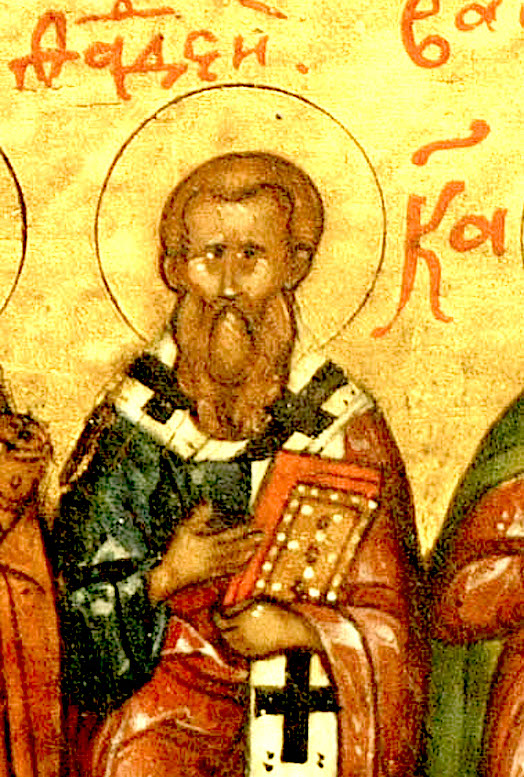
Thaddaeus is painted in two quite different ways, and the difference is itself a piece of evidence. Where he appears in a series of the Seventy he is an apostle: a middle-aged man in tunic and himation, dark-haired, with a rounded beard, holding a scroll or a closed codex and raising the right hand in speech. Where he appears in the Russian menaia and in the Edessene narrative cycle he is vested as a hierarch, in phelonion and crossed omophorion and holding the jewelled Gospel — the visual form of the Syriac tradition that he ordained the clergy of Edessa and left a successor at its head.
His narrative attribute is the Mandylion. The oldest surviving picture of the whole story is the tenth-century triptych at the Monastery of St Catherine on Sinai, where the apostle stands before King Abgar enthroned, who holds the cloth bearing the Lord's face; the same composition recurs in Byzantine and Slavic cycles of August 16 and is the ordinary way of identifying him. It is also, ironically, the source of the confusion with the other apostle: Western art transferred the medallion of Christ's face to Jude of the Twelve, and it is by that borrowed attribute that "St Jude" is generally recognised in the West.
The stored image is a detail from a Russian menaion icon for the month of August, of the seventeenth century (about 1650), from the Church-Archaeological Cabinet of the Moscow Theological Academy. The apostle is shown bust-length against gold, brown-bearded, in the dark phelonion over the red sticharion with the white omophorion crossed on the breast, holding a jewelled red Gospel-book in both hands, and inscribed in red above the nimbus Ѳадей — "Thaddaeus." Since the panel is the menologion of August and the only Thaddaeus in that month is the apostle of Edessa, the identification is secure; the hierarch's vesture is the Russian iconographic convention discussed above and not a claim this corpus makes in the classification.
Disputed questions
- He is not Jude Thaddaeus of the Twelve. This is the central distinction of the entry. The Church commemorates on June 19 Jude the Apostle, one of the Twelve, brother of James and (in the Eastern reckoning) son of Joseph the Betrothed, called Thaddaeus and Lebbaeus in the Gospel lists; and it commemorates on August 21 this Thaddaeus, one of the Seventy, a native of Edessa baptised by the Forerunner. The Byzantine books hold both and hold them apart, and they do so deliberately: the notice for June 19 says that Jude came to Edessa to complete what Thaddaeus had begun there, a sentence that only makes sense if the two are two. Yet the conflation is older than the separation. The Syriac tradition of Addai speaks of one apostle of Edessa without asking which; Eusebius, who is the earliest witness of all, calls the man sent to Abgar "Thaddaeus, one of the seventy," but the ambiguity of the by-name did the rest; the Armenian Church, which honours "Thaddaeus" with Bartholomew as its first illuminator, understands its Thaddaeus to be the apostle of the Twelve; and Western art has for centuries given Jude of the Twelve a medallion or cloth bearing the face of Christ, an attribute plainly borrowed from the Abgar story and belonging by right to this man. The full treatment of the confusion from the other side is in the Disputed questions of Jude the Apostle; this corpus follows the Byzantine calendar and treats them as two, while recording that the fusion is ancient and not a modern blunder.
- He is not Thaddeus the Confessor. Thaddeus the Confessor (December 29, †818) was a ninth-century monk of the Monastery of Stoudios, of servile or foreign birth, who was scourged to death for the holy icons under Leo the Armenian. He shares with the apostle nothing but the name, and English day-lists that give only "St Thaddeus" and a date are the usual cause of the error.
- Peaceful repose or martyrdom? The Greek Menaion and the Constantinopolitan synaxarion give a peaceful death at Beirut, about the year 44; the distich of the day confirms it. The Armenian tradition, which reckons its Thaddaeus among the Twelve, has him beheaded in the province of Artaz about the year 50, on 21 December, and venerates his tomb at the Monastery of St Thaddeus (the Qara Kelisa) in what is now Iranian Azerbaijan. The Slavonic notices sometimes carry both. Since the Armenian account is an account of the other apostle under the Armenian identification, its transfer to the man of Edessa is a consequence of the conflation rather than an independent report, and the peaceful repose is what this entry follows. The disagreement is recorded and not resolved.
- Where he died and where he lies. Beirut is the place of repose in the Greek books; some notices say instead that he died at Edessa, and others that he died at Beirut and was translated to Edessa. No relic-shrine of the apostle survived in either city into the documented period, and the question cannot be settled.
- Was he bishop of Edessa? The Syriac account has him ordain clergy and appoint Aggai as his successor at the head of the church, which implies an episcopal office in all but name, and both Latin reference works and the Russian iconography vest him as a hierarch, in phelonion and omophorion. The Greek liturgical books, however, style him simply ἀπόστολος, and the East does not number him among the bishops. This corpus follows the Greek usage and classes him as an apostle of the Seventy only, noting the hierarchical vesting under Iconography.
- How old is the Edessene mission? Critical scholarship has long held that the conversion of the Osrhoenian dynasty belongs not to Abgar V the Black, the contemporary of Christ, but to Abgar VIII at the end of the second century, and that the apostolic foundation was retrojected onto the earlier king. On that reading Addai is either a genuine second-century missionary whose date was pushed back, or a figure of the legend. The Church reads the tradition as it stands; the corpus records the objection. What is not in dispute is that Edessa was a Christian centre by the second century, that its church was Aramaic-speaking, and that it called its founder Addai.