
Translation of the Image Not-Made-by-Hands from Edessa to Constantinople
Kept 16 August — The reception of the Holy Mandylion into Constantinople, 16 August 944
On August 16 the Church keeps the reception into Constantinople, in the year 944, of the Holy Mandylion — the linen cloth of Edessa on which, the tradition holds, the Lord himself impressed the likeness of his face, and which he sent with a letter to Abgar, the toparch of that Syrian city. Recovered from the Muslim emir of Edessa by the armies of the empire and carried in triumph to the capital, it was received at Blachernae on the day of the Dormition and borne in procession the next morning through the city to the chapel of the Pharos in the Great Palace. The feast is the third of the "Saviour feasts" of August, and it is far more than the memorial of a relic's journey: the acheiropoieton, the image "not made by hands," was the standing argument of the defenders of the icons — proof that the Word made flesh had himself consented to be depicted — and its keeping on this day fixes that argument in the calendar of the Church.

Edessa and the letter of Abgar
Edessa — Syriac Urhāy, the modern Şanlıurfa in south-eastern Turkey — was the capital of the small buffer kingdom of Osrhoene, Aramaic in speech, Hellenistic in dress, poised between Rome and Persia. It was the mother-city of Syriac Christianity, and it was the first place in the world, on its own reckoning, to receive the Gospel by the invitation of its king. That claim rests on the correspondence between Abgar and Christ.
The oldest form of the story is given by Eusebius of Caesarea early in the fourth century (Ecclesiastical History I.13), who says he took it from the Syriac archives of the city and translated it himself. Abgar the toparch, wasted by an incurable disease and hearing of the wonders worked in Palestine, wrote to Jesus: that having heard he healed without drugs and raised the dead, he had concluded that he was either God or the Son of God; that he asked him to come and heal him; and that his own city, though small, was seemly and would suffice for the two of them to dwell in peace. The reply, as Eusebius gives it, blesses Abgar for believing without having seen — "for it is written of me that those who have seen me shall not believe, that those who have not seen may believe and live" — declines the journey, since the Lord must fulfil that for which he was sent and then be taken up to the Father, and promises that after the Ascension he will send one of his disciples to heal the king and to give life to him and to those with him. Both letters are read verbatim in the Greek Synaxarion appointed for this day.
The disciple sent was Thaddaeus (Addai), one of the Seventy, whom the Byzantine calendar keeps on August 21 and whom the Syriac tradition names Addai; he healed Abgar, baptised him and the city, and founded the church of Edessa. Thaddaeus of the Seventy is constantly confounded with the apostle of the Twelve who bears the same by-name — see the Disputed questions of Jude the Apostle, where the Church's own resolution of the confusion is set out. Neither is to be confused with the ninth-century Stoudite Thaddeus the Confessor.
Eusebius says nothing whatever about an image. In 384 the pilgrim Egeria, shown every corner of Edessa by its bishop and given copies of the correspondence, likewise records no picture. The image enters the tradition in the Syriac Doctrine of Addai (c. 400), where the royal envoy — there called Hannan (Ananias in the Greek), keeper of the archives and the king's painter — paints the Lord's likeness with choice pigments and brings it back to Abgar, who receives it with joy and sets it in honour in one of his palaces. The developed Byzantine form, which the liturgical books follow, takes the last step: the painter cannot capture the face because of the radiance that streams from it, and the Lord, calling him by name, asks for water and a cloth, washes and dries his face, and returns the linen bearing the imprint. What the envoy carries home is thus no work of human art at all, but an acheiropoieton — and that difference is the whole theological weight of the feast.
The hidden image and the siege of 544
The received account continues that Abgar fixed the cloth to a board, framed it in gold, and set it in a niche above the city gate in place of an idol, with the inscription "Christ God, no one who hopes in thee is put to shame"; and that the people of Edessa made reverence to it as they passed out of the gate. A later descendant returned to idolatry and meant to take the image down; the bishop, warned in a vision, walled up the niche by night with a lamp burning before the image and a tile laid over it. In time the memory of the place was lost.
The unsealing belongs to the great Persian siege. Procopius of Caesarea, writing soon after, reports that by his day the letter of Christ — now expanded with a promise that no enemy should ever enter the city — was inscribed over the gate, and that the wish to disprove it was part of what drew Chosroes I against Edessa in 544; Procopius knows of no image. It is Evagrius Scholasticus, writing about 593, who first attests a physical image at Edessa and calls it "the God-made icon" (ἡ θεότευκτος εἰκών), crediting it with the breaking of the siege: the Persians had raised a great mound against the wall, and the defenders' countermine and fire, kindled with water from the holy image, turned the works of the besiegers against them. The Byzantine narrative combines these into the form the synaxaria give: the Theotokos appears to the bishop Eulalios, the niche is opened, the lamp is found still burning after five centuries, the image has printed itself a second time upon the tile — the Keramion, honoured with the Mandylion in the hymnography of this day — and the bishop carries the cloth round the walls, whereupon the wind turns the besiegers' own fire upon them.
Edessa passed to the Arabs about 639. The new masters did not interfere with the honour paid to the cloth, and its fame spread through the whole East; when the iconoclast emperors of the eighth century made war on images, the acheiropoieton lay outside their reach, in a city they did not rule.
The recovery of 944
By the tenth century the empire was again on the offensive in Mesopotamia. In 943 the Domestic of the Schools, John Kourkouas, campaigning for the emperor Romanos I Lekapenos, brought his army before Edessa and offered the emir terms of a kind never before proposed for a relic: a chrysobull granting perpetual immunity to the city and its territory, the release of two hundred Muslim prisoners, and a payment in silver — the whole price of a province, for a piece of cloth. The emir referred the demand to the caliph al-Muttaqī at Baghdad, who put it to his jurists; after hesitation the surrender was allowed, and the image, with the letter of Christ, was handed over and escorted westward through Samosata by the bishops of the region.
The reception was staged with the full ceremonial of the capital. On 15 August 944, the feast of the Dormition, the relic reached the shrine of the Theotokos at Blachernae and rested there overnight. On the morning of 16 August it was carried by water round the walls and landed at the Golden Gate, and thence in procession through the length of the city — the emperor's sons Stephen and Constantine Lekapenos and his son-in-law Constantine VII Porphyrogennetos walking with it, while the aged and ailing Romanos waited at the palace — to the Great Church, where it was set upon the imperial throne in the sanctuary, and finally to the chapel of the Theotokos of the Pharos within the Great Palace, the chief reliquary of the empire. The court orator Gregory the Referendarius of Hagia Sophia preached the sermon of reception that same day; it survives, and is the earliest datable Greek witness to the arrival.
Four months later Constantine VII deposed the Lekapenoi and took the throne alone. It was under his hand, and probably by his commission, that the official narrative of the relic was drawn up — the Narratio de imagine Edessena, the "Story of the Image of Edessa," which welds Eusebius, the Doctrine of Addai, the legend of the walled-up niche and the account of the translation into a single authorised history. That text, and the synaxarion notice drawn from it, is what the Church reads on August 16.
The image and the theology of the icons
The Mandylion mattered to Byzantium out of all proportion to its size because of what it settled. The iconoclast argument was that the only admissible image of Christ is the Eucharist, that a painted likeness either divides his two natures or circumscribes his divinity, and that the making of images has no apostolic warrant. Against all three the acheiropoieton was a single answer in cloth: here was an image of the Lord's human face which the Lord himself had made and himself had sent; if the Incarnation permitted that, it permitted painting; and the warrant was not merely apostolic but dominical.
John of Damascus, writing in the safety of the caliphate against the first iconoclasm, appeals to the Edessene image in his orations on the holy images, and it belongs to the dossier of proofs which the iconodule party assembled and which was read into the acts of the Seventh Ecumenical Council at Nicaea in 787 — the council whose definition established that the honour paid to the image passes to its prototype. The defenders of the icons who suffered under Leo the Armenian sang the troparion of the Image Not-Made-by-Hands as their own hymn; and Pope Gregory II, writing to the emperor Leo III, could cite the healing of Abgar and the presence of the acheiropoieton at Edessa as facts too well known to be argued. It is for this reason that the same apolytikion, "We venerate thine immaculate image, O Good One," serves both this feast and the Sunday of Orthodoxy: the two commemorations make the same claim.
The loss of the relic and its rivals
The Mandylion remained in the Pharos chapel among the Passion relics for two and a half centuries, and disappears in the sack of 1204. From that point the traditions diverge, and no one of them can be established:
- One Byzantine tradition holds that the Crusaders took it and that the ship carrying it foundered in the Sea of Marmara.
- The relics of the Pharos passed to the Latin emperors and were pledged and then sold by Baldwin II to Louis IX of France, who housed them in the Sainte-Chapelle; the inventories of that treasury include a sancta toella — a holy cloth — which vanished in the French Revolution.
- A Mandylion given by an emperor of the Palaiologan house to the Genoese captain Leonardo Montaldo has been kept since 1384 at San Bartolomeo degli Armeni in Genoa; another is at San Silvestro in Capite in Rome, now in the Vatican. Both are panel paintings of the face on cloth, of medieval date.
The Church's own position is the one the sources take: the image "repeatedly produced copies of itself," the Keramion at Hierapolis and the tile-image of Edessa being the first of them, and the honour is paid to the likeness and not to the fabric. The feast survived the relic by eight centuries without difficulty.
The feast in the Slavic lands
Nowhere did the Image Not-Made-by-Hands strike deeper root than in Rus'. The Spas Nerukotvorny became one of the commonest of all Russian icons, painted on the campaign banners of the armies (whence the Russian word for a military standard, stiag, is bound up with the image of the Saviour), set over city gates in imitation of Edessa, and given to countless churches and monasteries as their dedication — among them the Spaso-Andronikov monastery on the Yauza at Moscow, founded by Alexis of Moscow in thanksgiving for his deliverance at sea on this very day and entrusted to Andronicus of Moscow. In the peasant calendar August 16 was the third and last of the "Saviour" days of the month — the Nut or Bread Saviour, following the Procession of the Cross on August 1 and the Transfiguration on August 6.
Feast and commemoration
August 16 (church date; New Calendar civil August 16, Old Calendar civil August 29), within the afterfeast of the Dormition, whose hymns are sung together with those of the Image at every office of the day. The Greek Menaion gives the Image three stichera at "Lord, I have cried" and a proper canon in Tone plagal 2, with a proper apolytikion in Tone 2 but no proper kontakion — the kontakion appointed is that of the Dormition. Slavic usage ranks the day higher: the Russian Typikon permits a vigil service of the Translation, with proper troparion, kontakion, magnification and readings, and the day is one of the three August feasts of the Saviour. In the Antiochian and Greek calendars the Image shares the day with the martyr Diomedes of Tarsus, whose service the Menaion prints in full alongside it.
The Greek synaxarion for August 16 appends to the Image three further Constantinopolitan commemorations of the day: the deliverance of the city from the Agarenes by the intercession of the Theotokos — the raising of the Arab siege in 718, kept here in the shadow of the Dormition; the miraculous draining and refilling of the holy water at the church of the Life-giving Fountain; and the memory of a great earthquake from which the city was spared. These are notices of the capital's own calendar rather than saints' commemorations, and no separate entry is made for them here.
Hymns
Apolytikion — Tone 2
We venerate thine immaculate image, O Good One, and ask forgiveness of our offences, O Christ our God; for of thine own will thou wast well pleased to ascend the Cross in the flesh, that thou mightest deliver from the bondage of the enemy those whom thou hadst fashioned. Wherefore we cry to thee in thanksgiving: thou hast filled all things with joy, O our Saviour, in that thou camest to save the world.
Kontakion — Tone 2
Knowing thine ineffable and divine dispensation towards mankind, O uncircumscribable Word of the Father, we honour the likeness of thy true incarnation — the image written by no hand of man but by God, and bearing victory — and we kiss it with love.
Original translation from the Greek
Magnification
We magnify thee, O Christ the Giver of Life, and we all honour the most glorious portrayal of thy most pure countenance.
Original translation from the Slavonic
Appointed readings
Epistle — Colossians 1:12–18 (Slavic usage; 2 Corinthians 3:4–11 is given as an alternative)
12Giving thanks unto the Father, which hath made us meet to be partakers of the inheritance of the saints in light: 13Who hath delivered us from the power of darkness, and hath translated us into the kingdom of his dear Son: 14In whom we have redemption through his blood, even the forgiveness of sins: 15Who is the image of the invisible God, the firstborn of every creature: 16For by him were all things created, that are in heaven, and that are in earth, visible and invisible, whether they be thrones, or dominions, or principalities, or powers: all things were created by him, and for him: 17And he is before all things, and by him all things consist. 18And he is the head of the body, the church: who is the beginning, the firstborn from the dead; that in all things he might have the preeminence.
Gospel — Luke 9:51–56; 10:22–24 (also the Matins Gospel)
51And it came to pass, when the time was come that he should be received up, he stedfastly set his face to go to Jerusalem, 52And sent messengers before his face: and they went, and entered into a village of the Samaritans, to make ready for him. 53And they did not receive him, because his face was as though he would go to Jerusalem. 54And when his disciples James and John saw this, they said, Lord, wilt thou that we command fire to come down from heaven, and consume them, even as Elias did? 55But he turned, and rebuked them, and said, Ye know not what manner of spirit ye are of. 56For the Son of man is not come to destroy men’s lives, but to save them. And they went to another village. 22All things are delivered to me of my Father: and no man knoweth who the Son is, but the Father; and who the Father is, but the Son, and he to whom the Son will reveal him. 23And he turned him unto his disciples, and said privately, Blessed are the eyes which see the things that ye see: 24For I tell you, that many prophets and kings have desired to see those things which ye see, and have not seen them; and to hear those things which ye hear, and have not heard them.
Iconography
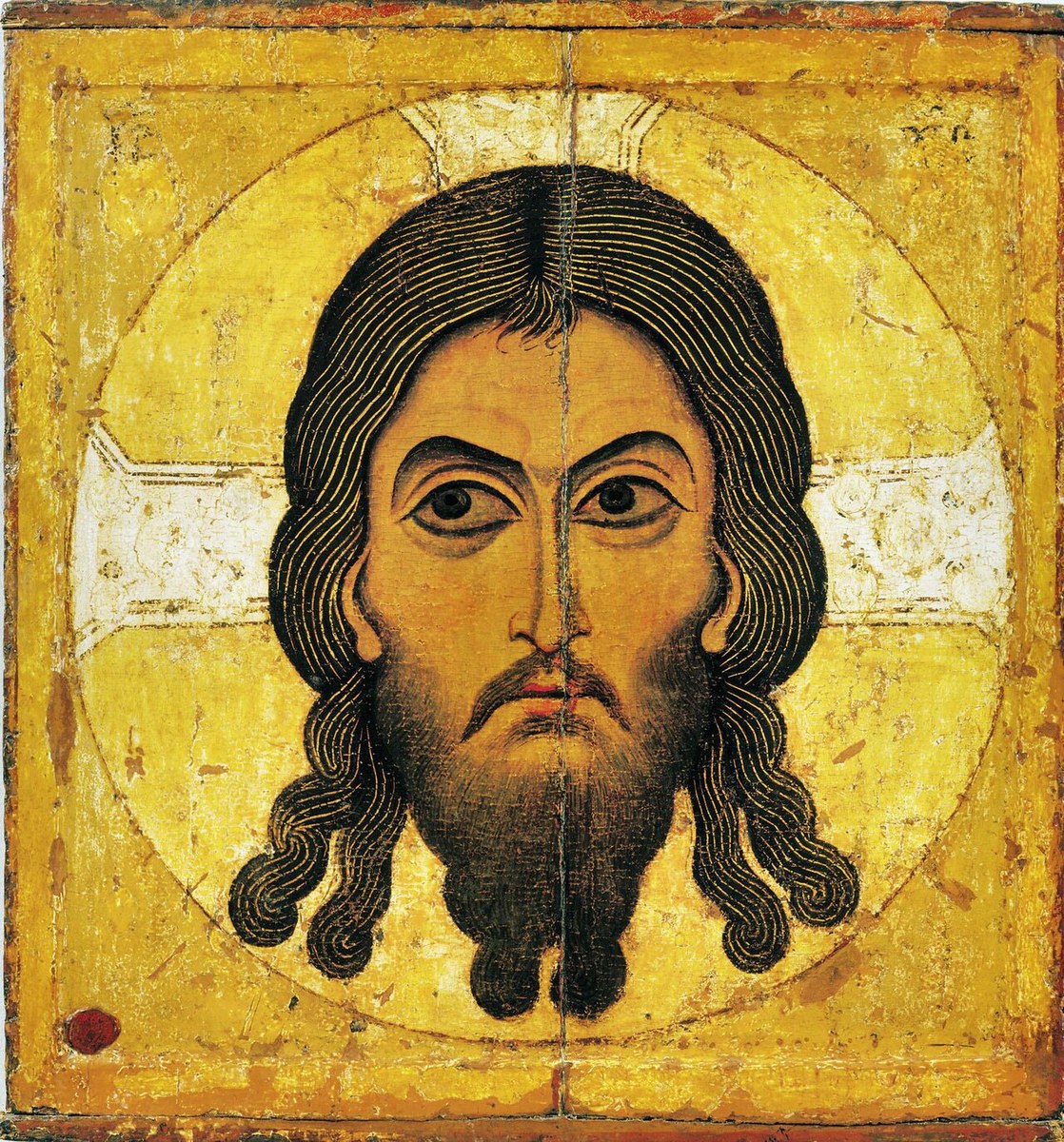
The image type is the strictest in all Orthodox iconography, because it claims to reproduce an original: the face of the Saviour alone, frontal, with long hair falling in strands to either side and a short forked beard, set within the cruciform nimbus and bearing the letters ΙС ХС and, in the arms of the cross, Ο ѠΝ — "He Who Is." There is no body, no hand, no gesture. Two families of the type are distinguished by their treatment of the cloth. In the Mandylion proper the linen is shown, sometimes held by angels at the upper corners, sometimes hanging with knotted ends; in the Keramion the face appears on the tile against a plain ground. The Russian tradition distinguishes further between the Spas na ubruse (the Saviour on the towel) and the Spas na chrepii (the Saviour on the tile), and often shows the cloth stretched flat with no folds at all — the face floating upon it, as an image and not as a portrait.
The stored icon is the celebrated Novgorod acheiropoieton of about 1100, now in the State Tretyakov Gallery in Moscow: the face alone against a gold ground, within a great circular nimbus crossed by the white arms of the cross, the hair drawn in fine parallel gold-lit strands and gathered into curls at the shoulders, the eyes wide and level. It is among the earliest and greatest surviving Russian panels, and the classic statement of the type. Byzantine examples of the same date survive at Sinai and in the manuscripts, and the narrative cycle of the feast — Abgar receiving the cloth from Ananias, the king enthroned holding the image, the apostle Thaddaeus before him — appears on a tenth-century triptych at the Monastery of St Catherine, the earliest surviving picture of the story.
Disputed questions
- The growth of the tradition. The stages are visible in the sources and are not disguised here: Eusebius (early 4th c.) has the letters and no image; Egeria (384) has the letters and no image; the Doctrine of Addai (c. 400) has a painted portrait; Evagrius (c. 593) has an image of divine origin used at the siege of 544; the tenth-century Narratio has the imprint on the towel, the walled-up niche and the Keramion. Critical scholarship therefore treats the acheiropoieton proper as a sixth-century development, plausibly connected with the discovery of a cloth during the rebuilding after the flood of the Daisan in 525 which Procopius describes. The Church reads the whole as one tradition; the corpus records the layers.
- The authenticity of the correspondence. The letters of Abgar and Christ were rejected as apocryphal in the West as early as the Decretum Gelasianum, and are universally regarded by modern scholarship as a Syriac composition of the third century at the latest. Eusebius' good faith in translating what he found in the archive is not in question; the archive's document is. The Eastern liturgical books continue to read the letters on this day, as documents of the faith of Edessa rather than as chancery originals.
- Which Abgar? The tradition names Abgar the Black (Ukkāmā), Abgar V, who reigned at the time of Christ. The historically attested conversion of the dynasty belongs to Abgar VIII (late 2nd–early 3rd c.), and the retrojection of the church's founding onto the earlier king is the ordinary modern explanation of how the legend arose.
- The Shroud hypothesis. A modern line of argument identifies the Mandylion with the Turin Shroud folded to show the face alone. It has been urged with ingenuity and is incompatible with the plain sense of every Byzantine description, which speaks of a small towel bearing a face and of a full-length burial cloth as different objects; it is noted here and not adopted.
- The Seventh Council. That the Edessene image stood among the iconodule proofs, and that John of Damascus appeals to it, is certain. The precise place of its citation in the acts of Nicaea II could not be verified against the conciliar text at authoring time and is flagged for checking.
- Not the Veronica of the veil. Western devotion knows a cloth bearing the Lord's features received on the way to Golgotha. That episode is medieval and Latin; it is not the Orthodox acheiropoieton, and the woman of the Gospel commemorated in the East is Veronica of Paneas (July 12), who has nothing to do with any veil.