
Theodotus, Asclepiodota and Maximus of Adrianople
The Holy Martyrs Theodotus, Asclepiodota and Maximus of Adrianople
Martyr · d. c. 305–311
Commemorated 19 February — The Adrianople martyrs again, in the four-name form with Hesychius, 15 September
Theodotus, Asclepiodota and Maximus were martyrs of Thrace under the emperor Galerius (305–311). Maximus and Asclepiodota, eminent citizens of Marcianopolis whose Christian life had drawn many to baptism, were arrested by Tiris, governor of Thrace; Theodotus was seized for rebuking the governor's cruelty. Tortured at Marcianopolis and again at Adrianople — where the beasts of the arena refused to touch them — they were beheaded near the village of Saltys on the road to Philippopolis, and the tradition adds that the governor was struck dead by lightning on his judgment seat. They are commemorated together on September 15.

The trio's passion belongs to the persecution of Galerius in the early fourth century, in the province of Thrace. Maximus and Asclepiodota were prominent citizens of Marcianopolis (near modern Devnya in Bulgaria), whose devout life and example had brought many of their neighbours to faith and baptism. When the governor Tiris made a circuit of the cities under his authority to hunt out believers, the two were summoned before him and commanded to renounce the faith; on their refusal he had them beaten. A bystander named Theodotus then openly reproached the governor for his inhumanity and was seized in his turn, hanged upon a tree and torn with iron hooks. The three were imprisoned, and when Tiris resumed his circuit some two weeks later he dragged them with him.
At Adrianople they were tortured again, their bodies seared with white-hot plates; the accounts record a voice from heaven encouraging them in their agony. Exposed to the beasts in the arena, they were unharmed: a she-bear released upon Maximus and Theodotus fawned upon them, and the bull to which Asclepiodota was tied would not move from its place. Continuing his journey, Tiris halted at the village of Saltys, short of Philippopolis, and after a final demand that they renounce Christ had the three beheaded — around the year 310. The tradition closes with the judgment of God upon the judge: lightning struck Tiris as he sat upon the tribunal.
Feast and commemoration
September 15 (church date; Old Calendar civil September 28), within the afterfeast of the Elevation of the Cross; a synaxarion commemoration without proper hymns, kept universally. The Greek books list Maximus and the two maidens separately, the Slavic books the three together (see above).
The same Adrianople martyrs are commemorated again on February 19 (Old Calendar civil March 4), where the calendars — the Greek Menaion, the Slavic calendars, and the OCA alike — give them in a four-name form: Maximus, Theodotus, Hesychius (Isychius) and Asclepiodota, adding a companion Hesychius not named in the September notice. The Greek synaxarion verses of February 19 still turn on the beheading of Asclepiodota ("Christ crowned Asclepiodota, whose head the sword struck off") and on a company of men who "played the man even unto the sword," confirming that the same passion is meant; the added name and the doubled date are recorded here rather than resolved. On February 19 the day is led by the apostle Archippus of Colossae and the martyr Philothei of Athens.
Hymns
Troparion — Tone 4 (from the common of martyrs)
Thy Martyrs, O Lord, in their contest received incorruptible crowns from Thee our God; for possessing Thy strength they cast down the tormentors and broke the feeble insolence of the demons: at their intercessions save our souls.
Original translation from the Greek
Iconography
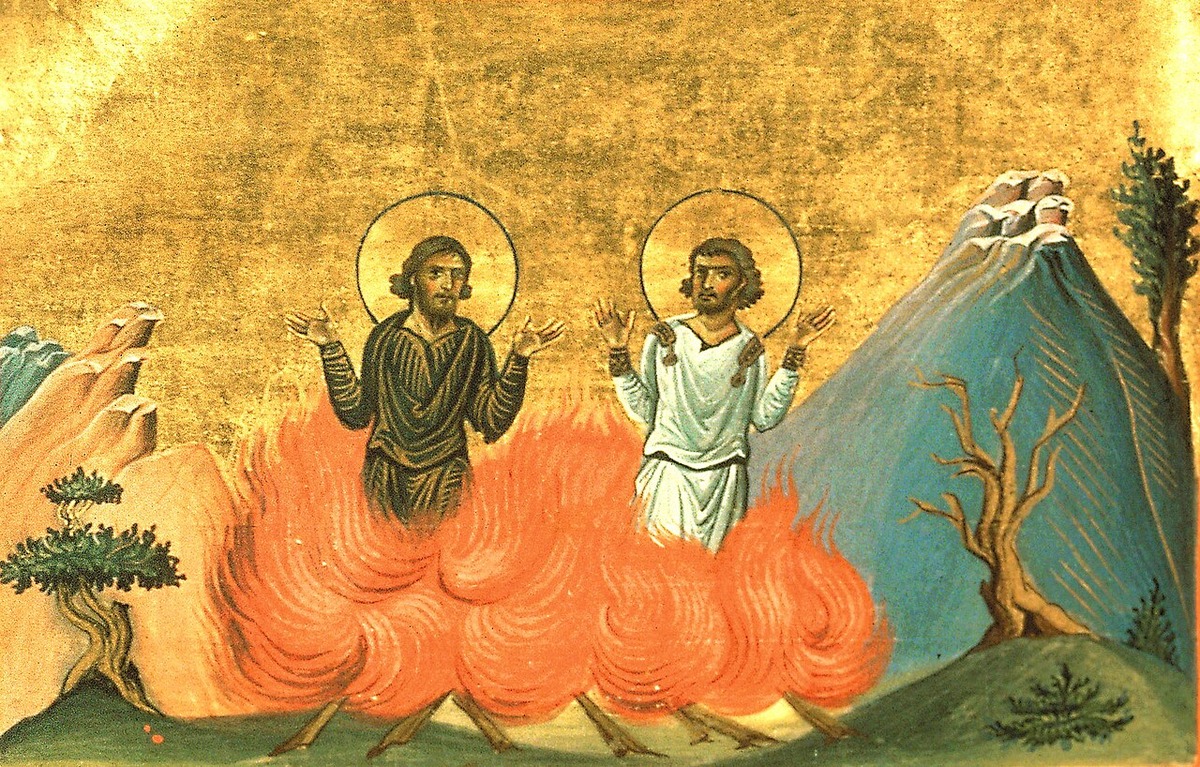
The Menologion of Basil II (c. 985) illustrates the commemoration with the martyrs' beheading: two lie already slain while the executioner's sword falls on the third, a companion standing in witness at the left — the miniature stored here, verified against the Vatican digitisation of the manuscript (Vat. gr. 1613, p. 39).
Disputed questions
- Names and gender. The Greek synaxaria transmit the company as the martyr Maximus, beheaded by the sword, together with "two holy maidens" (δύο Κόραι) who bent their necks to the sword "having one mind and one eagerness" — implying Theodote and Asclepiodote, both women, as the Menologion of Basil II's caption (Μάξιμος, Θεόδοτος καὶ Ἀσκληπιοδότη) also suggests. The Slavic tradition and the OCA transmit Theodotus as a man (Феодот), with Asclepiodota (Асклиада/Асклипиодота) the one woman of the group; the OCA's heading even prints the masculine "Asclepiodotus" while its narrative uses the feminine. The Slavic narrative form is followed in the Life above; the variance is recorded rather than resolved.
- The city. The martyrs were citizens of Marcianopolis and died near Saltys by Philippopolis, yet the calendars style them "of Adrianople" from the most dramatic station of their passion; all three cities appear in the tradition.
- Not to be confused with Theodotus of Ancyra and the seven virgins (May 18), the Galatian innkeeper who buried the martyrs and was beheaded for it — a confusion made easier by the fact that both companies pair a Theodotus with holy women, and by the Theodota who appears as an eighth name in one recension of the Ancyran seven; nor with Theodotus of Cyrenia, nor with the fifth-century Theodotus, Bishop of Ancyra of the Council of Ephesus.