
Theognostus of Kiev
Our Father among the Saints Theognostus, Metropolitan of Kiev and All Russia
Bishop · b. late 13th century, at Constantinople — d. 11 March 1353, at Moscow
Commemorated 14 March — Repose of the Metropolitan (buried in the Dormition Cathedral, Moscow)
Theognostus (died 1353) was a Greek of Constantinople who served for twenty-five years as Metropolitan of Kiev and All Russia, the chief hierarch of the Rus' Church, in the age when its centre was passing from Kiev to Moscow. Consecrated at Constantinople and sent north in 1328, he made Moscow his residence, confirmed the union of the metropolitan's see with the rising city, and upheld the Church's unity and its liberties against both the fragmentation of the princes and the demands of the Golden Horde, from whose khan he obtained the confirmation of the Church's ancient privileges — enduring, the tradition says, imprisonment and ill-usage rather than surrender them. He glorified his predecessor Peter as a saint and named Alexis his successor. He reposed in 1353 and is venerated among the holy hierarchs of Russia, kept on March 14.
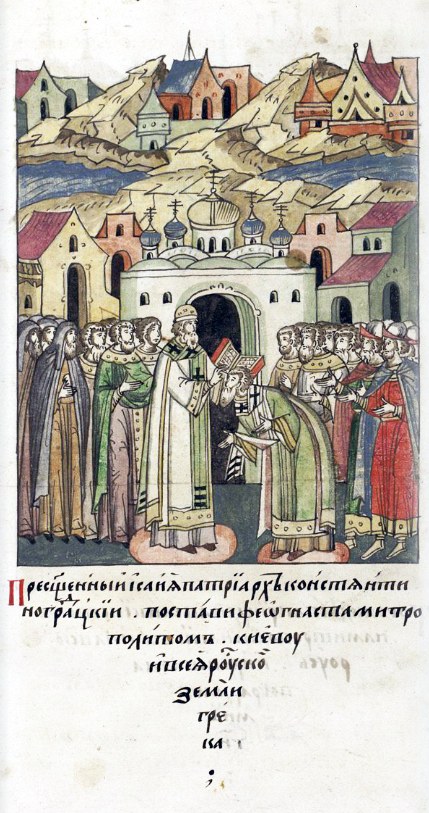

Theognostus was a Greek, born at Constantinople and formed in the Church of the imperial city, where he was ordained and rose to the episcopate. On the death of the metropolitan Peter — the first of the chief hierarchs of Rus' to fix his residence at Moscow — the Ecumenical Patriarch consecrated Theognostus Metropolitan of Kiev and All Russia, and he came north to his vast and divided charge in 1328.
Metropolitan of Kiev and All Russia
The title was still "of Kiev," but the reality had shifted: Kiev lay ruined and peripheral after the Mongol devastation, and the metropolitans had begun to reside elsewhere. After a period at Vladimir in Volhynia, Theognostus settled at Moscow, taking up the residence his predecessor Peter had chosen and binding the fortunes of the metropolitan see to those of the Muscovite princes, Ivan Kalita and his sons — a decision of lasting consequence, for the presence of the Church's head did much to raise Moscow above its rivals and to make it the gathering-point of the Russian land. Theognostus built and adorned churches in Moscow, including stone churches within the Kremlin, and governed the whole Church of Rus' — from Novgorod and Pskov to the Volhynian and Galician lands — through the turbulence of feuding principalities, labouring to reconcile the cities and princes and to keep the metropolia one against pressures, from Lithuania and Galicia, to divide it.
The glorification of Peter, and the defence of the Church
Theognostus revered the memory of his predecessor Peter, at whose tomb in Moscow miracles were reported; and, having gathered the testimony and referred the matter to Constantinople, he glorified Metropolitan Peter of Moscow among the saints — the act that gave Moscow its first heavenly patron among its hierarchs and set the seal on its ecclesiastical primacy. Under the overlordship of the Golden Horde, Theognostus stood firm for the Church's liberties: when the Tatars pressed him to yield up the Church's exemption and to render tribute from its people, he refused, and — the tradition holds — endured imprisonment and duress at the Horde until the khan confirmed anew the yarlyk, the charter of the Church's ancient privileges and freedom from tribute.
Repose and veneration
In his last illness Theognostus designated as his successor the bishop of Vladimir, Alexis — the future great Metropolitan of Moscow and wonderworker — and so provided for the continuity of the see. He reposed on 11 March 1353, in the great pestilence that swept the world in those years, and was buried in the Cathedral of the Dormition in the Moscow Kremlin, beside Peter. His relics were later found incorrupt, and he came to be venerated among the holy hierarchs of Moscow and All Russia, his commemoration formally confirmed in the Russian Church.
Feast and commemoration
Theognostus is commemorated on March 14 (church date; Old Calendar civil March 27); his repose fell on March 11, and his feast is kept on the 14th in the Russian synaxaria, among the holy hierarchs of the Russian Church. His veneration is kept in the Russian Church and by the Orthodox Church in America. March 14 commonly falls within Great Lent; on a Lenten weekday the full Liturgy is not served, so no fixed Epistle and Gospel are appointed and the readings follow the Lenten cycle.
Hymns
Troparion — Tone 4
O God of our fathers, who dealest ever with us according to thy gentleness, take not thy mercy from us, but by the prayers of thy holy hierarch Theognostus guide our life in peace.
Original translation from the Slavonic
Iconography
Theognostus is depicted as a hierarch of the Russian type: a bishop in the sakkos and omophorion, wearing the white klobuk of a metropolitan, blessing with his right hand and holding the Gospel-book in his left, often shown together with the metropolitans Peter and Alexis of Moscow in the company of the Moscow hierarchs. The stored image is the miniature of the Illustrated Chronicle of Ivan the Terrible (16th century) for his elevation: the Slavonic caption below the frame reads "the most holy Isaiah, Patriarch of Constantinople, set Theognostus as Metropolitan of Kiev and all Rus'," and the miniature shows the laying-on of hands before the church, the princes and clergy attending.