
Peter of Moscow
Our Father among the Saints Peter, Metropolitan of Kiev and All Russia, Wonderworker of Moscow
Bishop · Wonderworker · b. c. 1260 — d. 1326
Commemorated 24 August — Translation of the relics (1479, at the consecration of the Dormition Cathedral), 5 October — Translation of the relics (1472); kept also as the Synaxis of the Hierarchs of Moscow, 21 December — Repose at Moscow (1326)
Peter, Metropolitan of Kiev and All Russia (c. 1260–1326), was the first primate of the Russian Church to make his residence at Moscow, and by that act one of the founders of Moscow's greatness. Born in Volhynia, a monk, icon-painter and abbot of his own foundation on the river Rata, he was consecrated Metropolitan of Russia at Constantinople about 1308, in an age when the see, uprooted from devastated Kiev, had settled at Vladimir. Amid the disorders of the Tatar yoke Peter befriended the rising princes of Moscow, transferred the metropolitan residence there in 1325, and blessed the laying of the foundations of the Dormition Cathedral in the Kremlin, foretelling that Moscow would be exalted above all the cities of Russia. He reposed on December 21, 1326, was buried in the cathedral he had begun, and was glorified in 1339 as the first wonderworking hierarch of Moscow. He is commemorated on December 21, and among the Hierarchs of Moscow on October 5.

Origins and early life
Peter was born in the land of Volhynia, in south-western Rus', of pious parents named Theodore and Eupraxia. The tradition relates that before his birth his mother received in a dream a foreshadowing of the blessedness appointed for her son. At the age of twelve he entered a monastery, where he applied himself to the learning of the day and to his monastic obediences, gave much time to the Scriptures, and learned the art of iconography — the icons he painted were given to the brethren and to the pilgrims who came to the house. For the virtue and severity of his life the abbot had him ordained hieromonk.
Ascetic struggle and the monastery on the Rata
After years in the community Peter sought, with his abbot's blessing, a place of greater solitude. He built himself a cell on the bank of the river Rata, in Volhynia, and lived there in silence; but disciples gathered, as they always did about such men, and there grew up around him the monastery afterwards called Novodvorsk (Novy Dvor), with a church dedicated to the Saviour. Chosen abbot, Peter guided his monks by word and example and, the life stresses, never turned in anger on an erring brother. His fame spread beyond the district, and Prince Yuri of Galicia came often to the monastery for his counsel. It was in these years, when Metropolitan Maximus of Kiev and Vladimir passed through on his visitation, that Peter presented to the metropolitan an icon of the Dormition of the Theotokos which he had painted with his own hand — the same image before which Maximus prayed for the Russian land to the end of his days.
Metropolitan of Russia
When Maximus died (1305) the see of the Russian metropolitanate — long since removed from Kiev, ruined and depopulated by the Mongol sack of 1240, to Vladimir on the Klyazma — fell vacant. An abbot named Gerontius, ambitious for the primacy, set out for Constantinople with Maximus's vestments, staff and the icon Peter had painted, hoping to be consecrated; the Grand Prince of Vladimir, Saint Michael of Tver, supported his candidacy. But on the suggestion of Prince Yuri of Galicia, Peter too was sent to the Ecumenical Patriarch, and it was he whom God had chosen. The tradition tells that as Gerontius crossed the Black Sea the Mother of God appeared to him in a storm and said that he laboured in vain, for the painter of her icon, the abbot of the Rata, would be raised to the throne of Kiev. So it fell out: Patriarch Athanasius I of Constantinople consecrated Peter Metropolitan of Kiev and All Russia (about 1308), investing him with the very vestments, staff and icon that Gerontius had carried.
The hierarch amid the Tatar yoke
Peter returned to Rus' in 1308, coming first to Kiev — by then a shell of the mother-city — and then to Vladimir, the working seat of the metropolitanate. His first years were hard. The land groaned under the Tatar yoke and its own divisions; Tver and Moscow contended for the grand-princely dignity, and Peter, whose elevation Michael of Tver had opposed, met opposition and even a formal accusation of simony laid against him before a council at Pereyaslavl, from which he was cleared. Constrained by the disorder of the times, he had often to move his residence. On his journeys through the vast diocese he preached unceasingly to clergy and people the keeping of Christian piety, reconciled quarrelling princes, and laboured to hold the Church together as the one abiding institution of a broken land. In 1312 he travelled to the Horde and obtained from Khan Uzbek a yarlyk confirming the ancient immunities and rights of the Russian clergy.
The move to Moscow and the Dormition Cathedral
Peter's lasting act was his friendship with Moscow. Where he had found no support in Tver, he found it in the Muscovite princes — first Yuri, then his brother Ivan Kalita — and he came increasingly to reside in their small but rising town. In 1325, at the request of the Grand Prince Ivan Kalita, Peter transferred the metropolitan residence from Vladimir to Moscow. The significance of the act was immense: it made Moscow the ecclesiastical capital of Russia and lent the young principality the immeasurable authority of the Church, an authority Moscow would draw upon for two centuries. Peter, the chronicles say, prophesied that Moscow would be delivered from its enemies and raised above all the cities of the Russian land, and that his own bones would rest there. With his blessing the foundations of the cathedral of the Dormition of the Theotokos were laid in the Kremlin in August 1326 — the first stone church of Moscow and the shrine of its metropolitans and, later, its tsars. He prepared with his own hands a stone tomb for himself in the wall of the rising church.
Repose
Peter did not live to see the cathedral finished. He reposed at Moscow on December 21, 1326, and was buried in the crypt he had made ready in the unfinished Dormition Cathedral. From his tomb many healings followed, a number of them, the tradition notes, done in secret — a token, the Church reads, of the deep humility that marked him after death as in life.
Veneration and later cultus
The veneration of the first hierarch to rest in Moscow spread quickly. In 1339, under his successor Metropolitan Theognostus, and with the confirmation of Constantinople, Peter was numbered among the saints — the first canonised wonderworker of Moscow. His tomb became the sacred pledge of the city's rising fortunes: princes kissed the cross upon it in sign of fidelity to the Grand Prince of Moscow, government treaties were sworn over it, and no great undertaking of state was begun without prayer at the grave of "Peter the Wonderworker." After the annexation of Novgorod under Ivan III its people, who had once chosen their own archbishops in Saint Sophia, swore henceforth to consecrate them only at Peter's grave; and it was there that the first hierarchs of the Russian Church were named. His relics were translated twice — in 1472, during the rebuilding of the Dormition Cathedral, and in 1479, at the consecration of the new cathedral raised by Aristotele Fioravanti — and feasts were established in memory of these events on October 5 and August 24.
Feast and commemoration
Peter's principal feast is December 21 (church date; Old Calendar civil January 3), the day of his repose, kept within the forefeast of the Nativity. Two further commemorations mark the translations of his relics: August 24 (the translation of 1479) and October 5 (the translation of 1472). October 5 is kept in the Russian Church also as the Synaxis of the Hierarchs of Moscow — Peter, Alexis, Jonah, Philip and Hermogenes, and in the expanded form the later metropolitans and patriarchs of Moscow — of whom Peter, as the first to reside in the city and the first glorified, stands at the head. The feast is kept in the Russian Church and the churches of the Russian tradition, including the Orthodox Church in America.
Hymns
Troparion — Tone 4
O land that once wast barren, now be glad: for behold, Christ hath shown forth in thee a lamp shining openly in the world, healing our infirmities and our diseases. Therefore dance and rejoice with boldness, for a hierarch of the Most High is he who hath wrought these things.
Original translation from the Slavonic
Kontakion — Tone 8
To the glorious and wondrous wonderworker of our land we come today with love, weaving thee a hymn, O God-bearer; and since thou hast boldness before the Lord, deliver us from manifold adversities, that we may cry to thee: Rejoice, O confirmation of our city.
Original translation from the Slavonic
Iconography
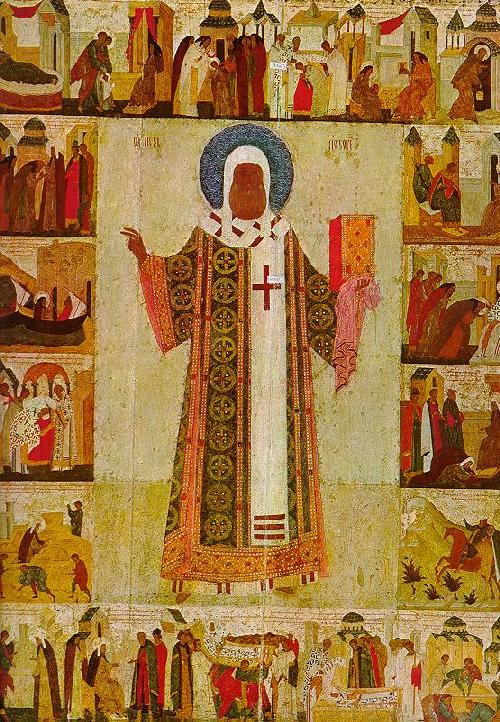
Peter is depicted as a hierarch in the white klobuk and the sakkos or phelonion of a metropolitan, the omophorion about his shoulders, blessing with his right hand and holding the Gospel; his face is that of an old man with a short, rounded grey beard. He appears constantly in the ranks of the Moscow hierarchs, beside Alexis, Jonah, Philip and Hermogenes, and in the deesis and sobor icons of the Russian saints. The stored image is the celebrated hagiographic ("vita") icon of the Metropolitan Peter with scenes from his life, painted by Dionisius in the 1480s for the Dormition Cathedral in the Moscow Kremlin — the shrine Peter himself had founded — one of the masterpieces of Muscovite painting.
Disputed questions
- Kiev, Vladimir, Moscow. Peter's title is Metropolitan of Kiev and All Russia; the see he actually governed sat at Vladimir, and his own act transferred its working residence to Moscow. Wikidata and the Greek usage style him "of Kiev"; the Russian tradition venerates him above all as the wonderworker of Moscow. The style used here reflects that history.
- Date of consecration. The passio places his consecration under Patriarch Athanasius I (whose two terms fell 1289–1293 and 1303–1309); the return to Rus' is dated 1308, so the consecration belongs to Athanasius's second patriarchate.
- One of the Moscow Hierarchs. The October 5 synaxis (established 1596 under Patriarch Job for Peter, Alexis and Jonah, later enlarged) is treated here as a synaxis commemoration; each hierarch is authored at his own principal feast.