
Theophanes the Branded
Our Father among the Saints Theophanes the Confessor, Bishop of Nicaea, the Poet and Branded (Graptos)
Confessor · Bishop · b. c. 778 — d. 845
Commemorated 11 October — Repose as Metropolitan of Nicaea
Theophanes the Branded (Graptos, c. 778–845) was a Palestinian monk of the Lavra of St. Sabbas, hymnographer, and confessor of the holy icons under the second iconoclasm. With his elder brother Theodore he carried the protest of the Church of Jerusalem to Constantinople, and under three iconoclast emperors endured imprisonment, exile, and torture; the emperor Theophilus had twelve mocking iambic verses branded onto the brothers' faces with hot irons, whence their surname "the Branded." Theodore died of his sufferings in prison; Theophanes lived to see Orthodoxy restored in 843 and was made Metropolitan of Nicaea, dying in 845. The Church sings his own words back to him: he wrote some 150 canons, which fill the service books to this day.

Origins and formation at the Lavra
Theophanes was born about 778 in Palestine, under the caliphate, the younger of two sons of the devout presbyter Jonah, called the Sabbaite (commemorated September 21), who after the death of his wife himself ended his days as a monk of the Great Lavra of St. Sabbas. Both boys were given young to that Lavra in the Judaean desert, received an excellent education there — the sources note their particular grounding in philosophy — and were tonsured; Theophanes was in time ordained hieromonk. Their formation was guided by Michael the Synkellos of Jerusalem, the scholar-monk with whom their whole confessing career would be intertwined. From the desert school of John of Damascus and Cosmas the Melodist, the two brothers inherited both the theology of the icon and the craft of liturgical poetry.
Mission to Constantinople and the long confession
When Leo V the Armenian (813–820) renewed the iconoclast persecution, the Patriarch of Jerusalem sent Michael the Synkellos with the two brothers to Constantinople to contend for the veneration of the icons. There Theodore and Theophanes boldly denounced the emperor to his face, and the pattern of the next thirty years was set: under Leo V, and again under Michael II (820–829), they endured interrogation, prison, hunger, and banishment, returning to the confession each time the throne changed hands.
The cruelest invention was reserved for Theophilus (829–842). In 836, after a final refusal to communicate with the iconoclasts, the emperor ordered twelve iambic verses — lines composed to deride them as vagabonds "vessels of superstitious error" — cut and burned into the skin of the brothers' faces with hot needles. The operation took two days. The brothers' recorded answer to the emperor became one of the treasured sayings of the persecution: "Write what you wish; at the Last Judgment you shall read your own writing." From this disfigurement they are called Graptoi — "the Written-upon," "the Branded" — the only saints of the calendar surnamed from the text inscribed on their bodies. Theodore was thereafter held in prison at Apamea in Bithynia, where he died of his sufferings (the OCA gives 833, the Greek tradition c. 840/841); Theophanes was sent into exile.
Metropolitan of Nicaea and repose
With the death of Theophilus and the restoration of the icons under the empress Theodora and the Patriarch Methodius (the Triumph of Orthodoxy, 843), Theophanes was recalled from exile, and Methodius consecrated him Metropolitan of Nicaea — the branded confessor set upon the see of the First and Seventh Councils' city. He served barely two years, dying in peace in 845 (some calendars give "about 850"); the Church he had defended was singing his canons before he died.
Hymnographic and literary legacy
Theophanes is, after John of Damascus and Cosmas, among the most prolific hymnographers the Church has known: the tradition credits him with about 150 canons, and the Menaia, Octoechos, and Triodion carry them under the simple ascription "of Theophanes" — canons for apostles, prophets, hierarchs, and martyrs, many canons of the Paraklitiki's weekday cycle, and above all the canon for the restoration of the holy icons sung on the Sunday of Orthodoxy, in which the confessor's own cause became the Church's perpetual feast. He also composed a canon in memory of his brother Theodore. The sticheron of his feast calls him "a self-moved organ sounded by the breath of the Holy Spirit," and the canon of the day hails him as "harmonious lyre of the all-holy Spirit, sweet-singing nightingale, pillar and foundation of Orthodoxy."
Feast and commemoration
October 11 (church date; Old Calendar civil October 24), kept universally, with a full proper service in the Menaion shared with the Apostle Philip the Deacon; the Greek books title him "our venerable Father and Confessor Theophanes, brother of St. Theodore the Graptos, Bishop of Nicaea, the Poet." The Russian calendar styles him "venerable confessor, composer of canons, Bishop of Nicaea." His brother Theodore is kept on December 27, their father Jonah the Presbyter on September 21 — a whole household on the calendar. In years when the Sunday of the Fathers of the Seventh Ecumenical Council falls on October 11, his service is combined with or yields to that of the Fathers — a fitting coincidence, since the council whose faith the Sunday celebrates (Nicaea II, 787) sat in the very city of his later see, and his canons defend its definition.
Hymns
Troparion — Tone 8
Guide of Orthodoxy, teacher of piety and holiness, luminary of the whole world, God-inspired adornment of hierarchs, O wise Theophanes, by thy teachings thou hast enlightened all, O harp of the Spirit: intercede with Christ God that our souls may be saved.
Original translation from the Greek
Kontakion — Tone 4
Thou didst dawn upon the Church as another sun, O venerable one, enlightening her with the lightning-flashes of thy teachings, O Theophanes, as a sacred minister of Christ our God.
Original translation from the Greek
Iconography
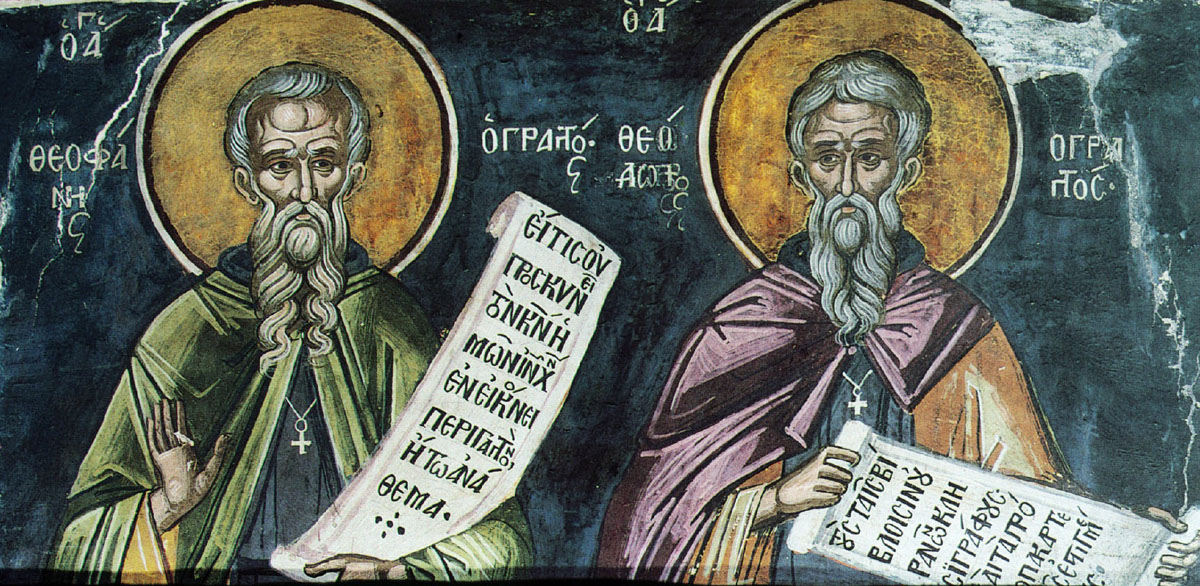
Theophanes is depicted as an aged monk in the great schema or, from his last years, in a bishop's polystavrion, with a long grey beard, holding a scroll — often inscribed with a verse of his own canons; the finest images pair him with his brother Theodore, the two Graptoi shown together with the scrolls of their confession. The stored image is the wall painting of 1547 in the katholikon of Dionysiou Monastery on Mount Athos: the two brothers side by side, each named by inscription ("Theophanes ho Graptos," "Theodore ho Graptos"), each holding an unfurled scroll. A twelfth-century fresco at St. Panteleimon, Nerezi (Macedonia), gives Theophanes alone among the holy monks, and a medallion of c. 1192 in the church of Panagia tou Arakos at Lagoudera, Cyprus, labels him "the hymn-writer."
Disputed questions
- Year of death. The Greek synaxaristes and most modern Greek calendars give October 11, 845; the OCA and Slavic tradition say "about 850." Both are recorded here; 845 is followed in the entry's record as the better attested.
- Year of birth. Given variously as c. 775 and c. 778.
- Not to be confused with his namesakes: Theophanes the Confessor of Sigriane, the chronicler (†818, commemorated March 12), a distinct confessor of the first iconoclasm with whom he is perennially conflated in catalogues; the venerable Theophanes the Faster of the Kiev Near Caves (twelfth century), whom the Slavic calendars keep on this same October 11 (entry pending); and the repository's other Theophaneses (of Mount Diabenos, September 9; the Merciful, of Gaza, September 29).
- His brother. Theodore the Branded is commemorated separately on December 27; his future entry will carry the reciprocal cross-reference to this one and to their father Jonah.