
Philip the Deacon
The Holy Apostle Philip of the Seventy, One of the Seven Deacons, the Evangelist
Apostle of the Seventy · Apostle · Deacon · Bishop · d. late 1st century, at Tralles
Commemorated 4 January — Synaxis of the Seventy Apostles, 11 October — Repose at Tralles
Philip the Deacon (first century), counted among the Seventy Apostles, was one of the Seven chosen by the apostles to serve tables in Jerusalem (Acts 6). When persecution scattered the Church he became its first great missionary: he evangelised Samaria, where even Simon Magus believed and was baptised, and on the Gaza road he baptised the Ethiopian eunuch — the first Gentile fruit of Africa. Settled at Caesarea, he was called "the evangelist" and had four virgin daughters who prophesied, among them Hermione of Ephesus. The tradition makes him at last bishop of Tralles in Asia Minor, where he reposed in old age. He is not to be confused with Philip the Apostle, of the Twelve (November 14).

One of the Seven
Philip belonged to the first Christian community of Jerusalem. The Slavic tradition adds that he was a Palestinian by birth, married and the father of children. When the Greek-speaking widows of the community were being overlooked in the daily distribution, the Twelve directed the brethren to choose "seven men of honest report, full of the Holy Spirit and wisdom" to serve tables; Philip was named second, after Stephen, and the apostles ordained the Seven by prayer and the laying on of hands (Acts 6:1–6) — the event the Church has always read as the institution of the diaconate. From this office he is called "the Deacon," and the sticheron of his feast praises him as "numbered among the seven Deacons, as one full of wisdom and divine grace, anointed to minister with Stephen to the needs of the saints."
The Samaria mission and Simon Magus
The stoning of Stephen the Protomartyr opened a persecution that scattered the Jerusalem church, "except the apostles" — and it was the scattered who first carried the word abroad. Philip went down to a city of Samaria and preached Christ there, confirming the word with signs: unclean spirits came out crying with loud voice, the paralysed and lame were healed, "and there was great joy in that city" (Acts 8:5–8). Among the converts was Simon, the magician who had long amazed Samaria with his sorceries and let himself be called "the great power of God": seeing genuine miracles beside which his arts were tricks, Simon believed, was baptised, and attached himself to Philip. When the apostles at Jerusalem heard that Samaria had received the word of God, they sent Peter and John, who laid hands on the baptised that they might receive the Holy Spirit — whereupon Simon offered the apostles money for the power of conferring the Spirit, and received Peter's condemnation that gave the sin of buying holy things its enduring name, simony (Acts 8:9–24). The episode fixes the shape of Philip's ministry: a deacon-evangelist who baptises, while the apostolic laying on of hands completes his work.
The Ethiopian eunuch
An angel of the Lord then directed Philip to the desert road going down from Jerusalem to Gaza. There he met the treasurer of Candace, queen of the Ethiopians — a eunuch "of great authority" returning from worship in Jerusalem, reading the prophet Isaiah in his chariot. Prompted by the Spirit, Philip ran to the chariot and asked, "Understandest thou what thou readest?"; beginning from the passage the eunuch could not fathom — "He was led as a sheep to the slaughter" — he preached Jesus to him. At water by the roadside the eunuch asked for baptism and Philip baptised him; and when they came up out of the water, "the Spirit of the Lord caught away Philip," and the eunuch went on his way rejoicing, while Philip was found at Azotus (Acts 8:26–39). The Church has always seen in this baptism the firstfruits of Ethiopia promised in the Psalm ("Ethiopia shall soon stretch out her hands unto God"), and the exapostilarion of the feast celebrates the eunuch sent home as "a herald of the Godhead of Jesus to all Ethiopia"; the tradition counts him among the first martyrs of that land.
Caesarea, the evangelist, and the four daughters
From Azotus Philip preached through all the coastal cities until he came to Caesarea (Acts 8:40), where he settled. Some two decades later the Book of Acts finds him still there: Paul and his companions, going up to Jerusalem for the last time, "entered into the house of Philip the evangelist, which was one of the seven, and abode with him. And the same man had four daughters, virgins, which did prophesy" (Acts 21:8–9). The title "the evangelist" — a preacher of the good news, borne before the word narrowed to the four Gospel-writers — is Scripture's own summary of his life's work. Of the four prophesying daughters the synaxarion tradition transmits the names of two who went to Ephesus, Hermione (commemorated September 4), a physician who healed without payment and was martyred under Hadrian, and her sister Eutychis; Polycrates of Ephesus, writing at the end of the second century, still knew the graves of Philip and his daughters in Asia as "great luminaries."
Bishop of Tralles and repose
Beyond the New Testament, the received tradition — carried by the synaxaria and woven through the canon of his feast — relates that Philip continued to preach through the lands adjoining Palestine, and that the apostles at Jerusalem consecrated him bishop and sent him to Tralles in Asia Minor (in the Maeander valley, near Ephesus), where he baptised many and shepherded the church until he died in deep old age, in peace. The ninth-century canon of Joseph the Hymnographer is explicit and local: "Thou wast shown a glorious star, greatest Philip, and the adornment of Tralles, in which thy venerable body lies, working wonders of healing for the enlightenment of them that call thee blessed." His memory is thus that rarest thing among the Seventy — an apostle whose end was neither martyrdom nor obscurity, but a bishop's peaceful death among his flock.
Feast and commemoration
October 11 (church date; Old Calendar civil October 24) is his principal feast in all the Byzantine calendars, Greek, Slavic, and Antiochian alike, with a full proper service in the Menaion shared with Theophanes the Branded (theophanes-the-branded). He is also commemorated with all the Seventy at their synaxis on January 4. The Greek books style him Apostle "one of the seven Deacons"; the Russian calendar, "Apostle of the Seventy Philip, one of the seven deacons." The Fathers of the Seventh Ecumenical Council are commemorated on the Sunday nearest this day, so that in parish practice his service frequently yields to or is combined with that of the Fathers.
Hymns
Troparion — Tone 3
O holy Apostle Philip, intercede with the merciful God, that He may grant unto our souls the forgiveness of offences.
Original translation from the Greek
Iconography
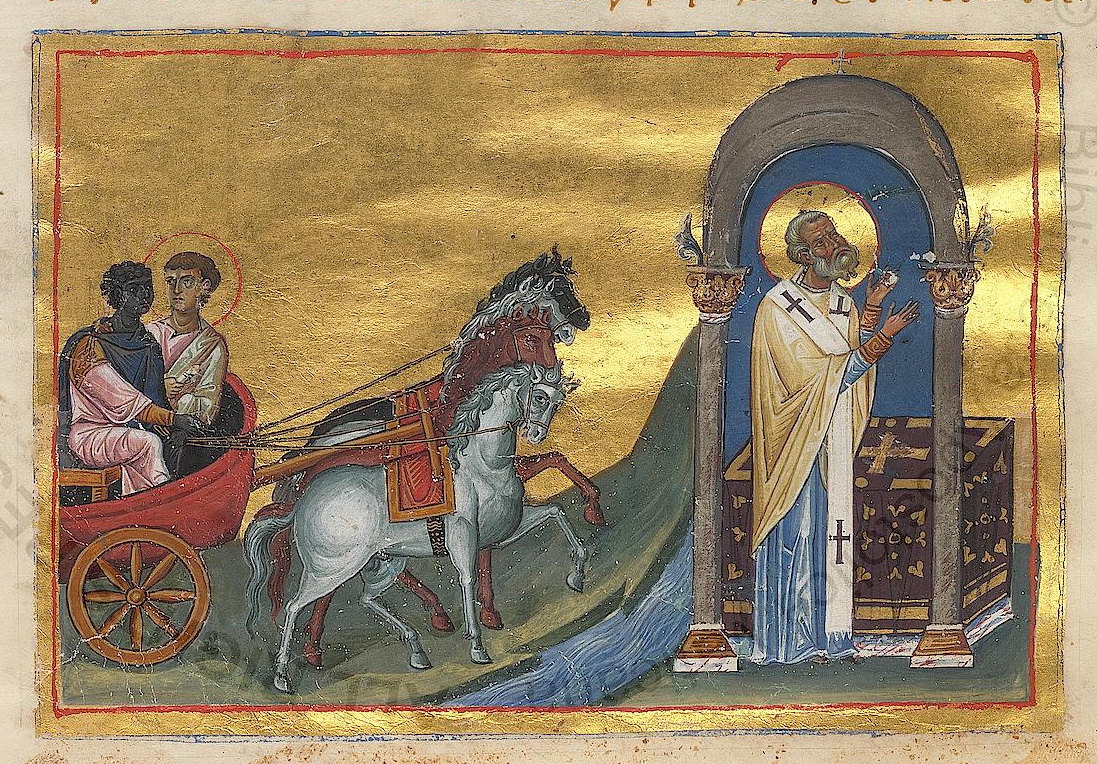
Philip is painted as a young, beardless (or lightly bearded) apostle in tunic and himation, often with the deacon's orarion, holding the Gospel book or a scroll; narrative icons show the scene that made him famous, the baptism of the Ethiopian eunuch beside the chariot. The stored image is the miniature of the Menologion of Basil II (Constantinople, c. 985; Vat. gr. 1613, fol. 107, attributed to the painter Georgios), which compresses his whole life into one frame: at the left Philip sits in the chariot expounding the Scriptures to the dark-skinned eunuch, the team of horses pressing forward; at the right he stands again as an aged bishop at the altar of Tralles, hand raised in prayer — the deacon-evangelist become hierarch. A sixteenth-century Muscovite icon of "the Apostle Philip the Deacon" also survives (Wikimedia Commons), showing him full-length as a deacon with censer rights reserved to his order.
Disputed questions
- Not to be confused with Philip the Apostle, of the Twelve, of Bethsaida (commemorated November 14). The confusion is ancient: already in the second century Papias and Polycrates of Ephesus speak of Philip "the apostle" buried at Hierapolis with his prophesying virgin daughters, while Acts 21:8–9 ties the four prophesying daughters to Philip the evangelist and deacon of Caesarea; Eusebius, quoting both, conflates the two men. The calendars keep them cleanly apart — October 11 for the deacon, November 14 for the apostle of the Twelve — but the traditions of the daughters and of Hierapolis versus Tralles cannot now be fully disentangled, and the entry for Hermione records the same ambiguity from her side.
- Place of repose. The Byzantine tradition of the Menaion places his death at Tralles; the Hierapolis traditions just named, if they belong to him rather than to his namesake of the Twelve, would place a Philip with virgin daughters there instead. This entry follows the Menaion.
- Not to be confused, further, with the sixteenth-century Russian hierarch-martyr Philip of Moscow, Metropolitan of Moscow and All Russia (†1569, kept January 9), a saint of a wholly different age who shares only the English name.
- The eunuch's name. Later tradition names the Ethiopian eunuch Simeon Bachos or (in the Ethiopian church) Bachos; the synaxaria of the Byzantine rite leave him unnamed.