
Therapon of Sardis
The Holy Hieromartyr Therapon, Bishop of Sardis
Hieromartyr · Bishop · d. c. 259
Commemorated 27 May — Martyrdom by scourging on the river Astala
Therapon, bishop of Sardis in Lydia, was a hieromartyr of the third century who converted and baptised great numbers of the pagan Greeks of Asia and was put to death for it, about the year 259, under a governor whom the passion names Julian. He was dragged from prison to prison across Asia Minor — Sardis, Sinaon in Phrygia, Ancyra in Galatia — and was killed at last on the bank of a river called the Astala, stretched naked on the ground between four stakes and flogged to death. The most memorable thing transmitted about him is what followed: the stakes, soaked with the martyr's blood, put out green shoots and grew into tall trees, and the leaves of those trees healed the sick who came to them. His memory is the second commemoration of May 27 in the Greek Menaion and the first in the Slavonic and OCA calendars.
_-_икона_09271_Ферапонт_Сардийский.png)
Bishop of Sardis
Sardis, once the capital of Lydia and of the Lydian kings, was in the Roman period a metropolis of the province of Asia and one of the seven churches addressed in the Apocalypse — the church told to "be watchful, and strengthen the things that remain" (Rev. 3:2). Therapon held its see in the middle of the third century, in the generation of the persecutions of Decius and Valerian. The synaxarion says nothing of his origins and everything of his work: that he enlightened many of the pagan Greeks with the light of the faith of Christ and baptised them. It is the ordinary formula of a missionary bishop's notice, but it is also the reason he was arrested: mass conversions in a city of the old cults were a public matter, and the magistrate's business.
Arrest and the journey of tortures
Brought before the governor Julian, Therapon did not equivocate. He declared himself a Christian and a bishop of the Christians, and was thrown into prison and left to starve. The passion then describes a peculiarly Roman cruelty: rather than being tried and executed in his own city, he was made to travel. He was taken under guard to Sinaon in Phrygia and tortured there, and thence to Ancyra in Galatia, where he was tortured again — beaten, hung up, his flesh torn. The itinerary has the effect of parading a confessor bishop through the interior of Asia Minor as an example, and the account notes that the effect was the opposite of the one intended: those who saw him endure believed.
Martyrdom on the Astala
At the last he was brought to a river called the Astala and, in the territory described in the Greek notice as the diocese or district of Satalia, was killed. The manner is given exactly: he was stripped, laid flat on the ground, and bound by the hands and feet to four stakes driven into the earth, and beaten with such violence that he died under the blows, about the year 259.
The Christians who came for his body found, according to the tradition, that the four stakes — soaked through with his blood — had taken root and put out green leaves, and in time grew into large trees. The place became a shrine, and the leaves of those trees were gathered as a remedy: those who took them, the synaxarion says, were healed of their diseases. This detail is the most persistent element of his dossier and the one by which he is remembered; it belongs to a small family of hagiographic traditions in which the instrument of a martyrdom becomes a living thing (compare the tree that grew from the pillar at which the other Therapon, of Cyprus, was scourged).
Relics and cultus
His relics were afterwards, the tradition holds, translated to Constantinople, where a church was raised in his honour and his memory was kept with some solemnity; it is the Constantinopolitan cult that carried his name into the great synaxaria and so into every Orthodox calendar. In the Slavonic books he is Ферапонт Сардийский and heads the day. He is not, so far as the record shows, the patron of any surviving local church in Lydia; his veneration is a calendar veneration, kept by the whole Church because Constantinople kept it.
Feast and commemoration
May 27 (church date; Old Calendar civil June 9). In the Greek Menaion the day is headed by Helladius the Hieromartyr and Therapon follows in the same notice with the formula "on the same day, the memory of the holy hieromartyr Therapon"; in the Slavonic and OCA calendars Therapon stands first and Helladius is transferred to May 28. He has no proper canon in the printed books and is served from the common of a hieromartyr.
Hymns
Apolytikion — Tone 4
As a sharer in the ways and a successor to the thrones of the Apostles, O divinely-inspired one, thou didst find in contemplation the means to ascend to divine heights; rightly dividing the word of truth, thou didst struggle for the faith even unto blood, O hieromartyr Therapon: intercede with Christ God that our souls may be saved.
Kontakion — Tone 4
Bound upon the wood and beaten unto death, O wise Therapon, thou didst water the earth with thy blood; and the dry stakes of thy torment put forth living leaves for the healing of the sick. Wherefore we honour thee as a priest of the Mysteries and a martyr of Christ, and glorify the Lord who is wondrous in His saints.
Original translation from the Greek
Iconography
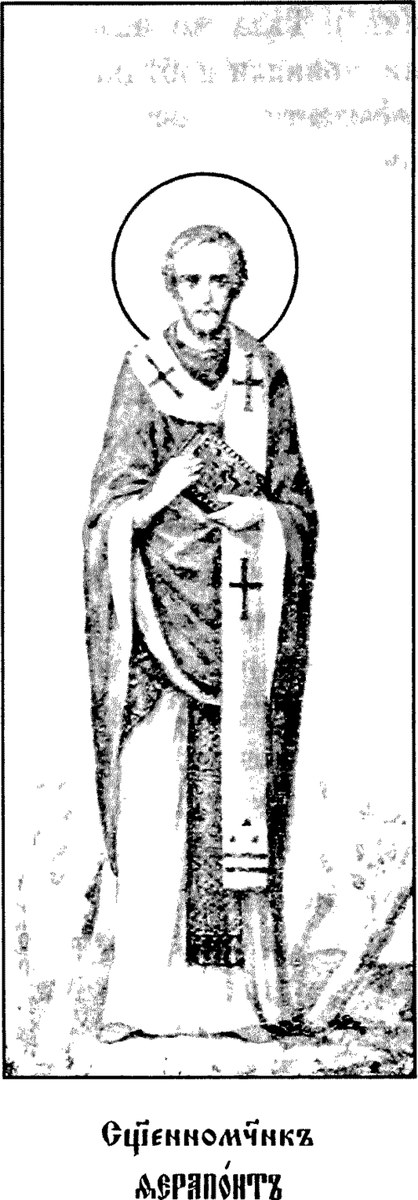
Therapon is painted strictly as a hierarch-martyr: an elderly bishop of middle years with a short, greying beard, in phelonion and omophorion, holding the Gospel book at his breast and often a cross in his right hand, standing full-length. Because his passion gives no portable attribute he carries none; where his martyrdom is depicted in a narrative scene, the four stakes and the flogging are shown, and sometimes the trees in leaf behind them — the one iconographically distinctive element of his dossier. In the printed Russian menologies he is placed beside the abbot Therapon of White Lake under the same day, and the inscriptions (Сщенномученикъ for the one, Преподобный for the other) are the reader's only guide.
The stored image is the plate for May 27 from the illustrated Russian Lives of the Saints published between 1903 and 1911, inscribed Сщенномчникъ Ѳерапонтъ ("Hieromartyr Therapon"): the saint stands full-length in bishop's vesture with the crossed omophorion, holding the Gospel in both hands, a cross-staff at his side.
Disputed questions
- Two Therapons, one dossier. The relic-translation to Constantinople and the tree that grew from the wood of the martyrdom are both told, in slightly different forms, of Therapon of Cyprus, bishop of Kition, whose relics also came to the capital and from whose scourging-pillar a tree is said to have sprung. The two are distinct saints of distinct centuries and sees, but their dossiers have clearly influenced one another in transmission, and it is not possible to say with confidence which tradition is original to which. Both are recorded here as their own sources give them, with the parallel noted.
- The topography. Neither Astala nor Satalia can be identified with certainty. Satalia has been read as Satala in Armenia Minor, which is a very long way from Sardis, and as a corruption of a Lydian or Phrygian place-name; the wandering itinerary of the passion may itself be a conflation of separate traditions.
- The date of death. The Greek notice gives no year; "third century" is the synaxarion's own indication, and the year 259 found in some calendars (and in OrthodoxWiki) is an inference from the Valerianic persecution rather than a transmitted date.
- Not to be confused with the other saints of the name, all of them commemorated in the second half of May: Therapon of Cyprus, bishop of Kition, slain at the altar (May 14 in Greek and Antiochian usage, May 25 in the Russian books); Therapon of White Lake, the Russian abbot and founder of the Ferapontov and Luzhetsky monasteries (†1426, also May 27); and Therapon of Monza (†1597, December 12 and also listed on May 27). The Russian Lives of the Saints plates for May 27 illustrate the Sardian hieromartyr and the White Lake abbot side by side, which is a fair measure of how easily the two are exchanged.