
Therapon of Cyprus
The Holy Hieromartyr Therapon, Bishop of Kition in Cyprus
Hieromartyr · Bishop · Wonderworker · d. 7th–early 8th century (before 740), slain at the altar in Cyprus
Commemorated 14 May — Martyrdom at the altar; Greek, Antiochian and OCA usage, 25 May — Slavonic usage (Russian menologion)
Therapon of Cyprus is the bishop-martyr of Kition (Larnaca) who was cut down upon the holy table while celebrating the Liturgy by raiders from the sea. A monk before he was a bishop, and by tradition a sojourner in Jerusalem before he came to Cyprus, he is honoured as bearing a double crown — the ascetic's and the martyr's — and the Greek proper of his feast turns upon exactly that. His relics were carried to Constantinople, first to the Theotokos at Blachernae and then to a church of his own name where myrrh flowed from his tomb; portions rest today on Mount Athos at Zographou, in Athens, and on Lesbos, where his cult is especially strong. Andrew of Crete (†740) preached an encomium in his honour, which fixes the latest possible date for his life.
.jpg)
Origins: an open question from the first
The synaxarion is candid that his homeland is not known with certainty. One strand of the tradition, resting on the panegyric of Andrew of Crete, makes him a man "of the East" (ἐκ τῆς Ἑῴας); another, later, makes him a westerner "from the country of the Alamanni" — that is, from what is now Germany. Nothing certain is transmitted of his parentage, and the year of his birth is entirely unknown. What the tradition does assert consistently is that he belonged to the monastic order before he was a hierarch — one of those, in the words of his encomiast, who genuinely renounce their own will and carry the Lord's Cross gladly.
Jerusalem and the see of Kition
Therapon is said to have lived for a time at Jerusalem, and there the collections place the best-known of his miracles: that he met a Jewish woman weeping inconsolably on the road, and by his prayer restored to her what she had lost, so that she came to faith. From Palestine he passed to Cyprus, and was made bishop of Kition, the ancient see on the island's southern coast that is the modern Larnaca. There he shepherded his people, and there — the sources agree in this — he continued to work healings and to cast out demons, so that he was known as a wonderworker in his lifetime.
Slain at the altar
His end came from the sea. While he was celebrating the Divine Liturgy, raiders — the Greek sources name them Arab pirates, the seaborne Saracens whose raids fell on Cyprus repeatedly from the middle of the seventh century — broke into the church and butchered him upon the holy table itself. The image of a bishop slaughtered at the altar in the middle of the offering is what fixed his memory: he is the priest who became the victim, and the synaxarion couplet plays on his very name — Therapon means "servant," and the verses say he was seen to be a servant both as the Word's sacrificer and through his blood.
Relics and the Constantinopolitan shrine
The martyr's body was taken from Cyprus to Constantinople — the sources set the removal in the context of the Arab pressure on the island — and laid first in the church of the Theotokos at Blachernae, and afterwards in a church that bore his own name. From his tomb there myrrh was said to flow, and the shrine drew the sick; a small chapel-shrine within the walls of the city is still shown as his, and is still reported to give out myrrh to those who come with faith.
Portions of his relics are venerated today at the coenobitic monastery of Zographou on Mount Athos, at the church of Saint Therapon in the Athenian suburb of Zografou, and in his church on Lesbos, at Mytilene, where he is one of the most popular saints of the island and is invoked especially for healing.
Hymnographic and literary legacy
Two witnesses carry his cult. The first is the encomium of Andrew of Crete, the Jerusalemite, who was archbishop of Gortyna and died in 740: a homily of praise in Therapon's honour, most probably delivered late in Andrew's life. The second is the service of the saint composed by Nikodemos the Hagiorite and revised in 1785 by Archdeacon Agapios of Paros — a late but full liturgical provision, from which the proper apolytikion of the double crown is generally taken.
Feast and commemoration
May 14 (church date; Old Calendar civil May 27), where the Greek synaxarion and the Antiochian calendar place him second on the day after Isidore of Chios; the Slavonic books transfer him to May 25. Depending on the year the date falls late in the Paschal season or after Pentecost, so no fixed seasonal note applies. He is kept with special solemnity on Lesbos and at Zographou on the Holy Mountain, and in Cyprus at Larnaca, the ancient Kition of his see.
Hymns
Apolytikion — Tone 1
Shining first in the labours of asceticism, O venerable one, thou didst put to rout every phalanx of the demons; and excelling afterwards in the contest of martyrdom, thou didst despise the threatenings of tyrants. Wherefore, having received a twofold crown from God, thou dost rejoice with the choirs of the angels and take thy delight, O Therapon the martyr, together with the venerable and the hieromartyrs. Glory to Christ who glorified thee; glory to Him who crowned thee; glory to Him who through thee worketh healings for all.
Kontakion — Tone 4 (common of a hieromartyr)
A priest of Christ and a most honoured martyr, thou wast offered upon the holy table as the sacrifice thou didst thyself offer; wherefore, O Therapon, thou pourest out healings upon those who honour thee, and we glorify the Lord who crowned thee.
Original translation from the Greek
Iconography
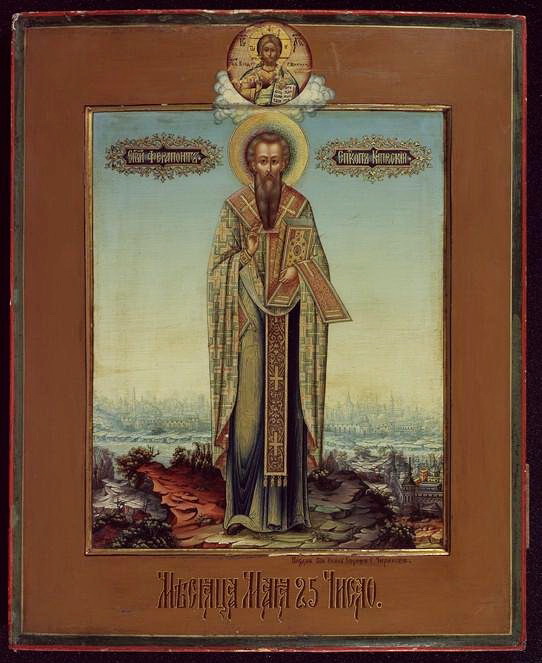
Therapon is painted as a hierarch: middle-aged, with a full brown or greying beard, in the phelonion (in Russian panels the jewelled sakkos and mitre) and the crossed omophorion, blessing with his right hand and holding the Gospel in his left. As a martyr he may hold the cross instead. The scene proper to him — shown in the fuller cycles and in modern Greek and Cypriot churches — is his slaughter at the holy table: the bishop in vestments before the altar, the raiders with drawn swords, the paten and chalice standing. Because his relics gave out myrrh, later Greek panels sometimes show a vessel of myrrh at his feet.
The stored image is a nineteenth-century Russian monthly-menaion panel by Osip Semyonovich Chirikov, the noted Moscow icon-painter, now in the State Museum of the History of Religion in St Petersburg. It is inscribed in Slavonic "Saint Therapon, Bishop of Cyprus," and at the foot "Month of May, the 25th day" — the Russian calendar placement discussed above. The saint stands full length in a brocaded sakkos and mitre, blessing and holding the Gospel, before a wide landscape of city and monastery; the Christ Emmanuel blesses from a cloud above.
Disputed questions
- Date. The Greek tradition reasons from the encomium of Andrew of Crete (†740), together with references in some synaxaria to Therapon's opposition to theopaschism and to iconoclasm, that he lived in the seventh or the early eighth century and certainly not after 740. The Russian menologion, by contrast, labels him a saint of the fourth century. The two datings cannot be reconciled, and this entry follows the Greek reasoning while recording the Slavonic position; the iconoclast reference in particular would place him at the very end of the possible range, and may be an intrusion from a later hand.
- Calendar date. Greek, Antiochian and OCA usage keeps him on May 14; the Russian Church keeps "the hieromartyr Therapon, bishop of Cyprus" on May 25, and the stored nineteenth-century Russian icon of him is inscribed for that day. The disagreement is of long standing and is not resolved here.
- Not to be confused with Therapon of Sardis, hieromartyr (May 27), whose relics likewise came to Constantinople and from whose scourging-post a tree is said to have sprouted — the two Therapons of the second half of May are conflated constantly, and details of the one migrate into accounts of the other. Nor with the Russian saints of the name: Therapon of White Lake (Belozersk) and Mozhaisk (†1426, May 27) and Therapon of Monza (†1597, December 12).