
Therapon of White Lake
Our Venerable Father Therapon, Abbot of White Lake and Archimandrite of Mozhaisk
Venerable · b. 1337, at Volokolamsk (baptised Feodor, of the Poskochin family) — d. 27 May 1426, at the Luzhetsky monastery near Mozhaisk
Commemorated 27 May — Repose at Mozhaisk (1426)
Therapon of White Lake (1337–1426) was a Russian nobleman of Volokolamsk who took the monastic habit at forty in the Simonov monastery at Moscow, went north into the wilderness of Beloozero with St Cyril of White Lake, and founded there — between two small lakes in the Vologda forests — the monastery that bears his name, the Ferapontov, whose Nativity cathedral would later be covered with the frescoes of Dionysius. Called south again in 1408 by Prince Andrew of Mozhaisk, son of Dmitri Donskoy, he founded a second house, the Luzhetsky monastery on the Moscow river, and governed it as archimandrite for eighteen years until his death at the age of ninety. He is one of the founding fathers of the "Northern Thebaid," and one of four saints of the name Therapon whose commemorations crowd the second half of May.

Feodor Poskochin of Volokolamsk
He was born in 1337 at Volokolamsk, of the boyar family of the Poskochins, and was baptised Feodor. The Life says only that he was brought up in faith and piety, and that these were the marks of his whole life. He remained in the world into middle age, and it was not until he was forty years old, about 1377, that he came to Moscow and asked for the habit at the Simonov monastery, then newly founded on the Moscow river below the city. He was tonsured there with the name Therapon — "servant," or in Greek usage "healer" — by the abbot St Theodore, a kinsman and disciple of St Sergius of Radonezh, who came himself to instruct the brotherhood. Simonov in those years was one of the chief nurseries of the Sergian monastic revival, and Therapon's whole later work is an extension of it.
The journey north and the Ferapontov monastery
Sent north on the business of the monastery — the errand is remembered as an obedience to visit the lands about Beloozero, White Lake — Therapon saw the great forests and the silence of the region and wished to remain in them. He found there, or was joined by, his fellow-monk of Simonov Cyril of White Lake (Kirill Belozersky), who settled by the lake in 1397; and for a time the two laboured together. But Therapon sought a stricter solitude and withdrew some fifteen versts away, to the neck of land between the little lakes Borodava and Pava, where he cleared a cell for himself in the forest.
Others came, as they always did. In 1398 Therapon built for the gathering brotherhood a wooden church of the Nativity of the Most Holy Theotokos, and thus began the monastery afterwards called the Ferapontov after him. He was unwilling to be its abbot and long resisted, and the community was formed on the pattern he had learnt at Simonov and from Cyril: poverty, labour, and the coenobitic rule.
The house he had begun became, in the century after him, one of the ornaments of the Russian Church. Its wooden church was replaced by a stone cathedral of the Nativity of the Theotokos at the end of the fifteenth century, and in 1500–1502 the walls of that cathedral were painted by Dionysius and his sons — the most complete surviving fresco cycle of the Moscow school, and the reason the monastery is now a monument of world heritage. The Ferapontov was also a house of learning, and in the sixteenth and seventeenth centuries a place of honourable exile for hierarchs.
Mozhaisk and the Luzhetsky monastery
In 1408 Prince Andrew Dmitrievich of Mozhaisk and Beloozero, a son of Dmitri Donskoy in whose appanage the Ferapontov lay, asked Therapon to come south and found a monastery near his own city. Therapon, then over seventy, obeyed. At Luzhki — "the little meadows" — on the bank of the Moscow river below Mozhaisk, he founded his second house, again under the dedication of the Nativity of the Theotokos: the Luzhetsky monastery. The prince endowed it generously, and Therapon was made archimandrite, governing it for eighteen years.
Repose and relics
He died at Luzhetsky on 27 May 1426, at about ninety years of age, and was buried in the monastery he had founded. His relics were uncovered incorrupt in 1514, and miracles at the tomb were recorded; his formal glorification followed the great Moscow Council of 1547, which regularised the veneration of the Russian saints. He was thereafter honoured as patron of Mozhaisk and of both his monasteries. The Luzhetsky monastery, closed in the Soviet period and returned to the Church in the 1990s, again keeps his relics.
Feast and commemoration
May 27 (church date; Old Calendar civil June 9), the day of his repose. His veneration is Russian, kept also by the Orthodox Church in America; he is not in the general Byzantine Menaion. He is honoured with particular solemnity at Mozhaisk, where his relics lie, and at the Ferapontov monastery in the Vologda region. He is also commemorated among the assembly of the saints of Vologda and among the saints of the Moscow region in the local synaxes.
Hymns
Troparion — Tone 4
Enlightened by the purity of thy life, O father Therapon, thou wast shown to be a good branch of the wilderness, fruitful in prayers and fastings; and gathering brethren about thee in two houses of the Mother of God, thou didst lead them by thine own example to the life that has no evening. Pray to Christ God that our souls may be saved.
Original translation from the Slavonic
Kontakion — Tone 4
Christ our most gracious Saviour has multiplied His mercy upon us, granting us in our venerable father Therapon a protector and a healer; wherefore, coming to the shrine of his relics, we cry out: Rejoice, O adornment of Mozhaisk and boast of the northern wilderness.
Original translation from the Slavonic
Iconography
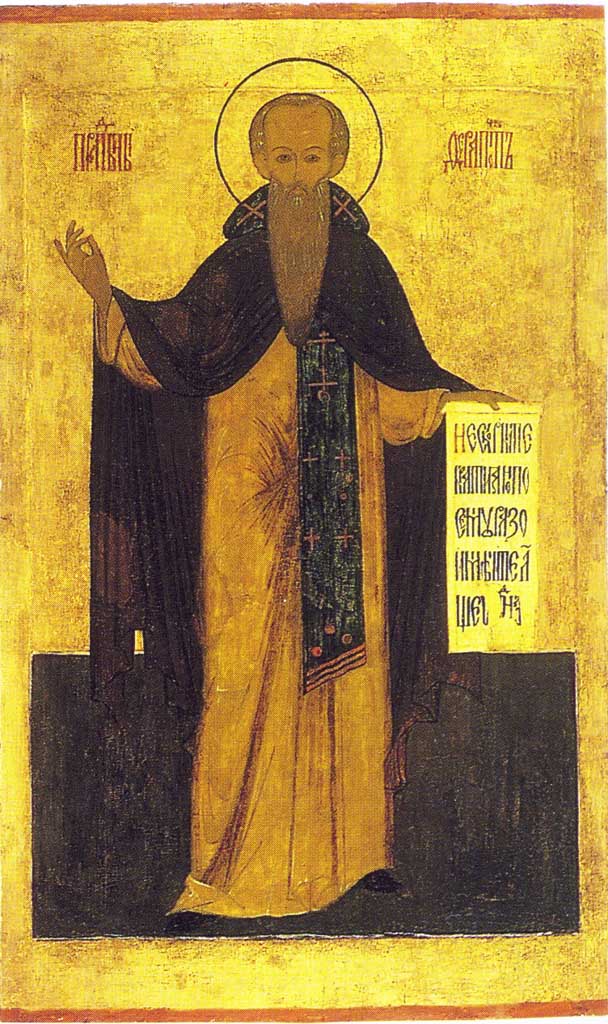
Therapon is painted as an aged monk with a long, pointed grey-white beard, in the full monastic schema — the dark mantle over the ochre or brown ryasa, the analavos with its crosses laid over the breast — standing full-length, the right hand raised in blessing or in prayer and the left holding an open scroll with a saying of monastic counsel. As a founder he is also shown holding, or standing beside, a small church or a model of his monastery, and in the Vologda icons he appears in company with Cyril of White Lake and Martinian, the three of them ranged before the walls of their houses. On the Mozhaisk side of his cult he is paired with the wonderworking carved figure of St Nicholas of Mozhaisk, the city's other patron.
The stored icon is a mid-seventeenth-century Russian panel (c. 1650) from the collection of the Kirillo-Belozersky monastery museum, inscribed Прпбнъ Ѳерапонтъ ("Venerable Therapon"): the saint stands full-length on a gold ground in the schema, blessing with his right hand and steadying with his left an open scroll of Slavonic text.
Disputed questions
- Two monasteries, two names. He is styled indifferently of White Lake (Belozersky), from his first foundation, and of Mozhaisk or Luzhetsky, from his second and his burial-place. Both are correct and refer to one man; the Russian books usually prefer Belozersky.
- His relations with Cyril of White Lake. The Lives make Therapon Cyril's companion on the journey north, but they were tonsured at Simonov at different times and Cyril's own Life gives Therapon a subordinate part. It is safest to say that the two were brethren of the same monastery who went north in the same movement and settled a short distance apart, and that the Ferapontov and the Kirillov houses grew up as neighbours.
- Not to be confused with the other saints of the name: the hieromartyr Therapon of Sardis, bishop and martyr of the third century, who shares this very day and is illustrated beside him in the Russian menologies; the hieromartyr Therapon of Cyprus, bishop of Kition (May 14 in Greek and Antiochian usage, May 25 in the Russian books); and the venerable Therapon of Monza (†1597, December 12 and also listed on May 27), a Kostroma ascetic with whom this Therapon is most often conflated.