
Tikhon of Amathus
Our Father among the Saints Tychon the Wonderworker, Bishop of Amathus in Cyprus
Bishop · Wonderworker · d. 425, at Amathus in Cyprus
Commemorated 16 June — Repose at Amathus; the day on which the grapes of his vine are gathered
Tychon — Tikhon in the Slavonic and Russian books — was bishop of Amathus on the south coast of Cyprus in the last years of the fourth century and the first quarter of the fifth, and reposed in 425. Born in the city he would afterwards govern, he was known for wonders from boyhood: his Life tells how the bread he gave away out of his father's bakery was repaid with a granary filled to the roof, and how a dry vine-cutting he planted and prayed over took root and bore grapes of extraordinary sweetness, from which wine was pressed for the Eucharist in his lifetime and long after. Reader and deacon under Bishop Mnemonios, he was chosen bishop by the whole city and consecrated by Epiphanius of Cyprus; as hierarch he threw down what was left of the island's idolatry, pulling down the temple at Amathus and turning its people to Christ. He is honoured as a wonderworker throughout the Orthodox world, with a particular cultus in Cyprus, where the village of Agios Tychonas by Limassol still bears his name, and in Russia, where his name passed to a whole line of saints.

Amathus and the bakery
Amathus was one of the ancient royal cities of Cyprus, standing on the coast a few miles east of the modern Limassol, with a sanctuary of Aphrodite — the "Amathusian" goddess — on its acropolis and a long, obstinate pagan memory. It was also, by the fourth century, a bishopric of the Church of Cyprus. Tychon was born there of Christian parents who taught him letters and the reading of the Scriptures, and the Life reports that the gift of wonderworking appeared in him while he was still a boy.
His father kept a bakery, and the first miracle told of him belongs to it. The boy gave bread away freely to those who came hungry, and when his father reproached him for squandering the stock, Tychon answered with the Lord's promise that what is lent to God is repaid a hundredfold, and told him to go and look in the storeroom. The father went, and found the granary — empty, as he well knew — heaped and overflowing with wheat. From that day he let the boy give what he pleased.
Reader, deacon, bishop
Tychon was enrolled among the readers of the church of Amathus and set to read the Scriptures aloud in the assembly; Mnemonios, the bishop of the city, afterwards ordained him deacon. On Mnemonios's death the clergy and people of Amathus chose Tychon in his place by common consent, and he was consecrated by Epiphanius, the great bishop of Constantia (Salamis) and metropolitan of the island, the author of the Panarion, who reposed in 403 — which fixes Tychon's consecration in the closing years of the fourth century and gives him an episcopate of some two or three decades.
The war on the idols
The Life makes the destruction of idolatry the work of his episcopate. Cyprus had been Christian since the Apostles Paul and Barnabas crossed it, but in the cities of the coast the old sanctuaries were still standing and still frequented late into the fourth century, and at Amathus the cult in question was the immemorial worship of Aphrodite. Tychon preached against it, brought many of the pagans of the city to baptism, and at length threw down the idol-temple itself. This is why the Cypriot tradition remembers him as the bishop who ended the last public idolatry of the island — a claim to be read as the memory of a local and decisive victory rather than as a statement about the whole of Cyprus, where pagan practice lingered in places for another generation.
With this he joined the works of mercy learned in his father's shop: the Life dwells on his generosity to the poor, his hospitality, and his fearlessness before the powerful.
The dry vine-branch
The wonder for which he is chiefly remembered, and which fixes his place in the Cypriot year, is the miracle of the vine. Tychon gathered up the prunings that the vinedressers had cut away and thrown out — dead wood, dried and sapless — and planted them in the ground, asking God that they might take root and bear. They rooted, budded, and grew into a vine whose grapes were of a sweetness unlike any other, and the wine pressed from them was used for the Divine Liturgy during the saint's life and, the Life says, after his death as well.
To this is attached the tradition that made his feast famous in Cyprus: that the fruit of his vine ripens out of season, at his own commemoration on June 16, when the vintage of the island is still two or three months away, so that grapes could be gathered and pressed at Amathus on the very day of his memory. The blessing of the first grapes on his feast is kept in Cypriot usage, and the sign is read in the same key as the miracle itself: the dead branch made to live and to yield the wine of the Mysteries.
Repose, relics and the shrine at Amathus
Tychon reposed in peace in 425, having governed Amathus into old age, and was buried in his own city. A basilica rose over his tomb on the site — the ruins of an early Christian church stand among the remains of Amathus to this day — and his shrine was a place of healing and pilgrimage through the Byzantine centuries. The city itself was destroyed in the Arab raids and finally abandoned in the twelfth century, and the see was absorbed into Limassol; but the saint's name held the ground. The village that grew up beside the ruins is called Agios Tychonas, and its church of St Tychon, with the neighbouring monastery site, remains the centre of his veneration.
Veneration and later cultus
His name travelled. In Cyprus he is one of the two or three most-invoked native hierarchs, and in Byzantine church decoration he takes his place in the row of concelebrating bishops in the sanctuary apse — at Lagoudera (1192) he stands next to St Nicholas, scroll in hand. In the Slavonic world "Tikhon" became a favourite baptismal and monastic name precisely from this saint's commemoration, and the Russian Church came to keep a succession of Tikhons who bear his name: Tikhon of Kaluga, Tikhon of Lukhov and Tikhon of Krestogorsk, all on this same June 16; and afterwards Tikhon of Zadonsk, bishop of Voronezh (†1783), and Tikhon (Bellavin), Patriarch of Moscow (†1925). Churches were dedicated to the Cypriot Tychon in Moscow, Nizhny Novgorod and Kazan, and three successive bishops of Voronezh bore his name.
Feast and commemoration
June 16 (church date; Old Calendar civil June 29), his repose. He is the head of the day in every tradition: the Greek Menaion, the Slavonic books, the Antiochian and Cypriot calendars all give him first place, with the other commemorations of the day following in synaxarial notice. In Cyprus his feast is kept with local solemnity at Agios Tychonas and in the diocese of Limassol, and it is the occasion of the blessing of the first grapes from his vine. In the Russian books he is joined on this day by the three monastic Tikhons who carry his name, and by the translation of the relics of St Theophan the Recluse; in the Greek books by Mnemonios his predecessor, Mark of Apollonias, the five martyrs of Nicomedia, the forty martyrs of Rome, and the martyr Elappas.
Hymns
Apolytikion — Tone 4
The truth of thy deeds has shown thee to thy flock as a rule of faith, an image of meekness and a teacher of self-restraint; therefore thou hast gained the heights by humility and riches by poverty, O Father and hierarch Tychon. Intercede with Christ God that our souls may be saved.
Kontakion — Tone 4
The dead branch took root at thy prayer and gave its wine to the holy Table, O wonderworker Tychon; and thou didst root out the idols from thy city and plant the faith in her. Wherefore we keep thy memory, and glorify Christ who works wonders in his saints.
Original translation from the Greek
Iconography
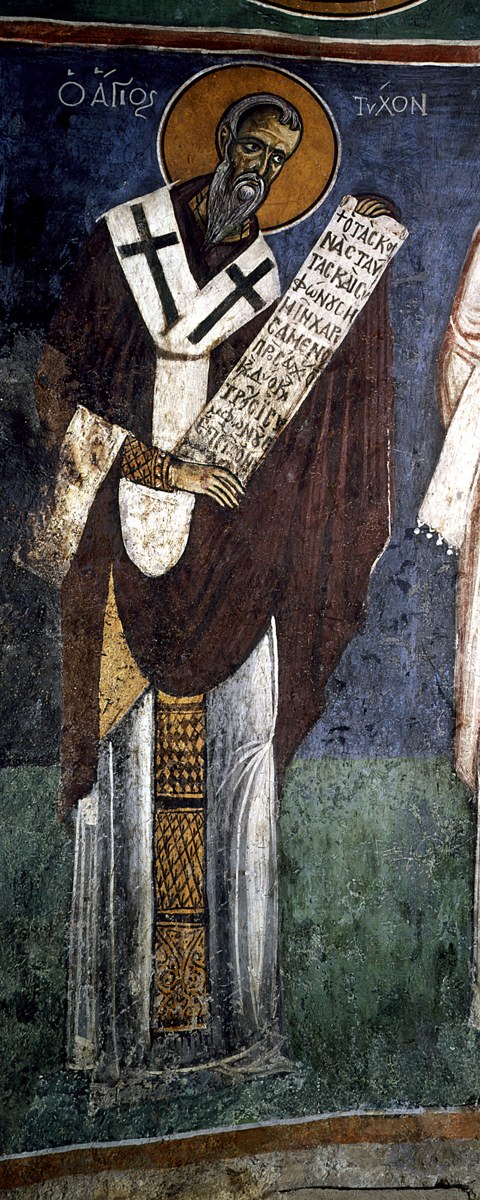
Tychon is painted as a hierarch: a bishop of middle age, dark-haired and with a pointed dark beard in the Cypriot images, vested in sticharion, epitrachelion and phelonion with the white omophorion crossed over the breast, and either blessing with the Gospel or holding an unrolled scroll inscribed with a liturgical text. Because his cultus is Cypriot and episcopal, his commonest place in a painted church is the sanctuary apse, among the concelebrating hierarchs who stand in the lower zone below the Theotokos — the row that usually includes Basil, Chrysostom, Nicholas, Epiphanius of Cyprus and Spyridon of Trimythous. Where a narrative image is wanted, the vine is his attribute: the grape-laden branch, or the scene of the saint planting the dry prunings. Russian engraved menologia of the eighteenth and nineteenth centuries show him as a bishop with the Gospel, captioned "Тихон Амафунтский".
The stored image is a detail of the wall-paintings of 1192 in the church of the Panagia tou Arakos at Lagoudera in the Troodos — one of the great monuments of Comnenian painting in Cyprus — photographed for the Byzantine Institute and released by Dumbarton Oaks. The figure is inscribed Ο ΑΓΙΟΣ ΤΥΧΟΝ and stands on the north side of the apse wall, immediately beside Ο ΑΓΙΟΣ ΝΙΚΟΛΑΟΣ: a hierarch in a dark red-brown phelonion and a white omophorion marked with black crosses, holding an open scroll of a liturgical prayer.
Disputed questions
- The sources. No contemporary account of Tychon survives. Everything narrated above — the bakery, the granary, the vine, the temple — comes from a Greek Life written in Cyprus considerably later than the saint, out of which the synaxarion notices and all later retellings are drawn. The framework it gives is nonetheless consistent and checkable at its edges: a bishop Mnemonios of Amathus, a consecration by Epiphanius of Constantia (†403), a repose in 425.
- Not to be confused with the Russian Tikhons. Four saints named Tikhon are kept on June 16 alone; the other three are Russian monastics of the fifteenth to seventeenth centuries — Tikhon of Kaluga (†1492), Tikhon of Lukhov (†1503) and Tikhon of Krestogorsk (17th c.). This Tychon is the source of their name and the reason their commemorations were placed on his day; he alone is a bishop of the fifth century and a saint of the universal calendar. Distinguish him further from Tikhon of Zadonsk, bishop of Voronezh (August 13, †1783), and from Tikhon (Bellavin), Patriarch of Moscow (†1925), the confessor-patriarch, neither of whom is commemorated on this day.
- Mnemonios. His predecessor Mnemonios is himself commemorated on June 16, and is known only from Tychon's Life; the Greek books keep them together, the Slavonic books generally keep Tychon alone.
- Amathus, Antioch and the autocephaly of Cyprus. Tychon's episcopate falls in exactly the years when the see of Antioch was pressing its claim to ordain the bishops of Cyprus. The claim was rejected and the island's autocephaly upheld at the Third Ecumenical Council at Ephesus in 431, six years after Tychon's repose — so that his tenure at Amathus belongs to the last generation of the dispute, under the metropolitans of Constantia who fought it. The Life is silent on the question, as synaxarial Lives usually are, but it is the political frame of his episcopate and worth stating where, as in this corpus, the Antiochian tradition is the vantage point.