
Tikhon of Kaluga
Our Venerable Father Tikhon of Medyn and Kaluga, the Wonderworker
Venerable · Wonderworker · d. 1492, at his hermitage on the Vepreika
Commemorated 16 June — Repose at the Dormition hermitage he founded (Tikhonova Pustyn)
Tikhon of Medyn and Kaluga (†1492) was a monk of the Chudov monastery in Moscow who left it for the forests of the upper Oka and lived as a hermit in the hollow of a great oak by the little river Vepreika, drinking from a spring he dug himself. Discovered there by Prince Vasily Yaroslavich of Borovsk, whose hunting grounds he had settled on, he was ordered off the land and threatened with the whip — and the raised arm withered on the spot. The prince begged forgiveness, was healed at the saint's prayer, and became the founder's patron: Tikhon built a wooden church of the Dormition of the Theotokos on the site and was first abbot of the community that grew round it, the house known ever since as Tikhonova Pustyn. He reposed in extreme old age in 1492, having received the great schema, and was given all-Russian veneration by the council of 1584. His oak stood for three centuries after him and his well is a place of pilgrimage still.
.jpg)
From Moscow to the Vepreika
The tradition makes Tikhon a native of Kiev who came north as a young man to Moscow and there received the monastic habit, by the received account at the Chudov monastery in the Kremlin, the house of the Miracle of the Archangel Michael where so many Muscovite monastics began. Neither his family nor his baptismal name is recorded.
Drawn to solitude, he went out from Moscow into the wooded country of the upper Oka, and settled in the dense forest on the bank of the Vepreika, a stream that runs into the Ugra — a place equidistant, in the old reckoning, from Kaluga and Medyn, whence both his surnames. He made his cell in the hollow trunk of a giant oak, ate what the forest gave him, and dug out at the head of the stream the spring that came to be called the well of the venerable Tikhon and was reputed healing.
The prince and the withered arm
The land was the patrimony of Prince Vasily Yaroslavich of Borovsk, grandson of Vladimir the Brave of Serpukhov. Hunting in his own forest, the prince came upon the hermit and, finding a stranger squatting on his ground, ordered him to leave it at once. Tikhon answered that he had come there for God and would not go; the prince raised his whip to strike him — and the arm stiffened where it was raised and would not come down. The prince understood the judgement, asked the monk's pardon, and at his prayer was restored.
From that hour Vasily Yaroslavich was the hermit's benefactor. He urged him not merely to stay but to gather disciples and found a monastery, promising to maintain it; Tikhon consented, and raised the first wooden church, dedicated to the Dormition of the Most Holy Theotokos. He became the first superior of the house.
Abbot and wonderworker
The Life describes his rule as gentle: he governed without anger, fed the hungry and gave drink to the thirsty, took in travellers and defended those who were wronged, and was distinguished among the fathers of the Russian north for the gift of tears and for a remarkable habitual silence. His severity fell on himself alone. Disciples gathered, the wilderness became a working monastery, and while he was still alive his reputation as a wonderworker had spread beyond the Kaluga forests.
He reposed in 1492, very old, having taken the great schema shortly before the end.
Relics and the shrine
Until the Time of Troubles his relics lay openly in the wooden Dormition church; when that church was destroyed they were moved to the church of the Three Hierarchs. After the monastery was rebuilt in the seventeenth century, the Three Hierarchs church was carried out in 1677 to the monastery's village settlement and a stone cathedral of the Transfiguration was raised in its place, the relics being laid beneath the floor at the right choir, where they rested.
The oak that had been his cell was still standing four centuries later; it was brought down by a storm in the 1830s, and pieces of it were kept as blessings. The spring remained the centre of the pilgrimage, and through the nineteenth century the monastery's records accumulated healings ascribed to the saint — of eye diseases, of children's illnesses, and notably of the mentally afflicted, for whom he came to be especially invoked.
Veneration
The council of 1584 established the all-Russian veneration of St Tikhon of Kaluga, raising what had been a local cultus of the Kaluga and Medyn country to the general calendar of the Russian Church. Tikhonova Pustyn became one of the significant monasteries of the Kaluga diocese — the diocese which, three centuries later, would also hold Optina — and remains the home of his cultus.
Feast and commemoration
June 16 (church date; Old Calendar civil June 29), his repose. Russian usage and the OCA; not in the Greek or Antiochian menaia. He is second in the Russian enumeration of the day, after Tychon of Amathus, and is kept with especial solemnity at Tikhonova Pustyn in the Kaluga diocese.
Hymns
Apolytikion — Tone 4 (common of a monastic saint)
A dweller of the wilderness and an angel in the body wast thou shown to be, O God-bearing Father Tikhon: by fasting, vigil and prayer thou didst receive heavenly gifts, and thou healest the sick and the souls of them that run to thee with faith. Glory to him who gave thee strength, glory to him who crowned thee, glory to him who works healings through thee for all.
Iconography
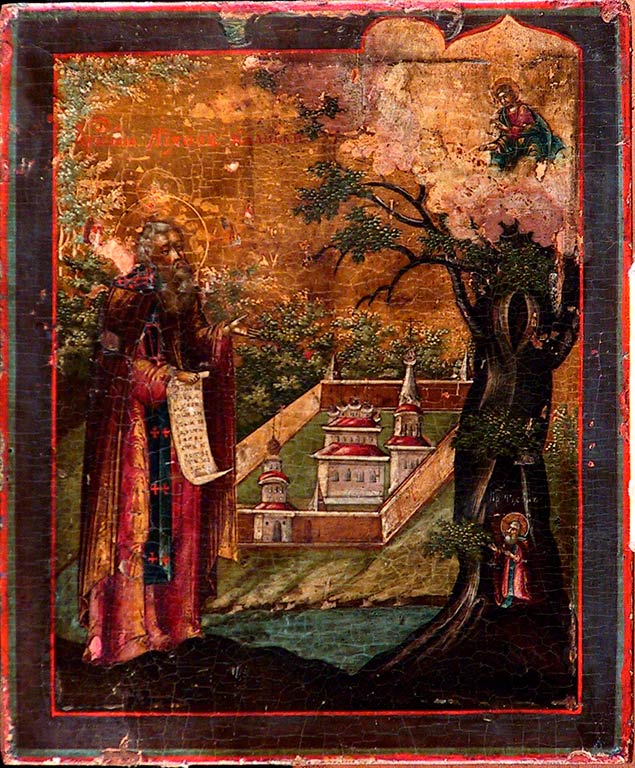
Tikhon of Kaluga is painted as a Russian monastic elder: long grey beard, in the great schema — the black mantle with the analavos bearing the cross, the lance and the sponge — his head sometimes covered, sometimes bare, blessing with the right hand and holding an unrolled scroll with a monastic exhortation. His two proper attributes are local and unmistakable: the hollow oak in which he lived, drawn as a great riven trunk with the small figure of the saint inside it, and the monastery he founded, shown as a walled group of white churches. Later Kaluga icons frequently combine both — the elder in the foreground, the oak at one side, the Dormition monastery behind — and add the blessing figure of Christ or the Theotokos in the clouds above.
The stored image is an eighteenth-century Russian icon on panel from the collection of the Kaluga Art Museum, which shows exactly this composition: the schema-monk standing with his scroll, the walled monastery on its slope behind him, the great oak at the right with the saint's own small figure in the hollow of the trunk, and a blessing figure in the cloud above.
Disputed questions
- The Chudov tonsure. That he was tonsured at the Chudov monastery in Moscow is given by the tradition "according to tradition", not by any document of the period; the same is true of his Kievan birth. The historically firm points are the foundation on the Vepreika, the patronage of Vasily Yaroslavich of Borovsk (whose dates fit the middle of the fifteenth century), the year of repose, and the council of 1584.
- Which Tikhon on this day. Three Russian monastic Tikhons are commemorated together on June 16 — this one, Tikhon of Lukhov (†1503, Kostroma country) and Tikhon of Krestogorsk (17th c., Vologda country) — because all three bear the name of Tychon of Amathus, the fifth-century Cypriot bishop whose day it is. They are three distinct persons of three different centuries and regions. Distinguish them further from Tikhon of Zadonsk, bishop of Voronezh (August 13, †1783), and from Tikhon (Bellavin), Patriarch of Moscow (†1925).
- "Of Kaluga" or "of Medyn". Both epithets are in use and both are geographical: the hermitage lies between the two towns. The Russian books usually give both; the OCA uses "Tikhon of Kaluga or Medin".