
Tikhon of Lukhov
Our Venerable Father Tikhon of Lukhov, Wonderworker of Kostroma
Venerable · Wonderworker · b. Lithuania, mid-15th century, baptised Timothy — d. 16 June 1503, at his hermitage near Lukh
Commemorated 16 June — Repose at the hermitage that became the Nikolo-Tikhonov monastery, 26 June — Uncovering of his relics, 1569
Tikhon of Lukhov (†16 June 1503), called Timothy in the world, was a nobleman in military service in the Grand Duchy of Lithuania who in 1482 left his country rather than accept the union with Rome, crossing into Muscovy in the train of Prince Feodor Belsky. He refused the rewards of his new service, gave away what he had, took the habit with the name Tikhon, and settled in the forest of the Lukh country on the border of the Kostroma land. There he lived by the work of his hands — a skilled copyist of books and a turner of wooden vessels — refused ordination to the priesthood out of humility, and formed with two companions, Photius and Gerasim, the community that became the Nikolo-Tikhonov monastery. He died so poor that his disciples had nothing to bury him in until the bishop of Suzdal sent a vestment. His relics were found incorrupt in 1569, and the healings that followed established the veneration of one of the most-loved wonderworkers of the Kostroma and Ivanovo country.
_-_%D0%B8%D0%BA%D0%BE%D0%BD%D0%B0_10162_%D0%A2%D0%B8%D1%85%D0%BE%D0%BD_%D0%9B%D1%83%D1%85%D0%BE%D0%B2%D1%81%D0%BA%D0%BE%D0%B9.png)
A Lithuanian nobleman
He was born in the lands of the Grand Duchy of Lithuania in the middle of the fifteenth century and baptised Timothy; he was of the gentry and served as a soldier. The Orthodox of the Grand Duchy in those decades were under mounting pressure to accept the Florentine union, and Timothy's Life makes his refusal of it the hinge of his story: rather than submit, he left the country.
In 1482 Prince Feodor Ivanovich Belsky, whose conspiracy against Casimir IV had been discovered, fled to Moscow and entered the service of Ivan III, who granted him estates — among them, by the tradition, the volost of Lukh. Timothy went with him. Offered the rank and lands that went with such service, he refused them all, stripped himself of his possessions, and received the monastic habit with the name Tikhon.
The hermitage in the Lukh forest
He looked for solitude, and after a period of wandering settled in the forest of the Lukh country, at a place called Kopytovo on the river bank, where he built a cell. Two monks, Photius and Gerasim, came to him; and when three were living where one had been, he moved the settlement some three versts to a site better suited to a community. There the brotherhood grew.
They lived strictly by their own labour, taking nothing from the villages round about. Tikhon himself was a skilled copyist of manuscripts — an accomplishment which places him among the working scribes of the northern monasteries — and a turner of wooden vessels, and the sale of his work fed the brethren. Out of humility he would not be ordained priest, and remained to the end a simple monk, though he was in fact the founder and head of the house.
Repose in poverty
He reposed on 16 June 1503, at a great age. The poverty in which he had held himself is the detail the tradition preserves most insistently: there was nothing in the monastery in which to bury him, and the vestment for his burial had to be sent by the bishop of Suzdal, in whose diocese the house then lay.
Relics, veneration and the monastery
In 1569 his relics were found incorrupt at his grave, and healings began there; from this the veneration dates. The community he founded became the Nikolo-Tikhonov monastery — St Nicholas's and St Tikhon's — at what is now the village of Timiryazevo in the Lukh district of the Ivanovo region, and it kept his relics and the local icons associated with him, including the one that the local tradition calls "the icon that could not be cut", famous for having survived an attempt to destroy it.
Because the Lukh country belonged first to the Suzdal diocese and afterwards to the Kostroma land, his epithets vary: he is "of Lukhov", "of Lukh", or "of Kostroma", all of the same saint.
Feast and commemoration
June 16 (church date; Old Calendar civil June 29), his repose. Russian usage and the OCA; not in the Greek or Antiochian menaia. He is kept with especial honour in the Ivanovo and Kostroma dioceses and at the Nikolo-Tikhonov monastery, and is named in the synaxis of the saints of Kostroma.
Hymns
Apolytikion — Tone 4 (common of a monastic saint)
A dweller of the wilderness and an angel in the body wast thou shown to be, O God-bearing Father Tikhon: by fasting, vigil and prayer thou didst receive heavenly gifts, and thou healest the sick and the souls of them that run to thee with faith. Glory to him who gave thee strength, glory to him who crowned thee, glory to him who works healings through thee for all.
Iconography
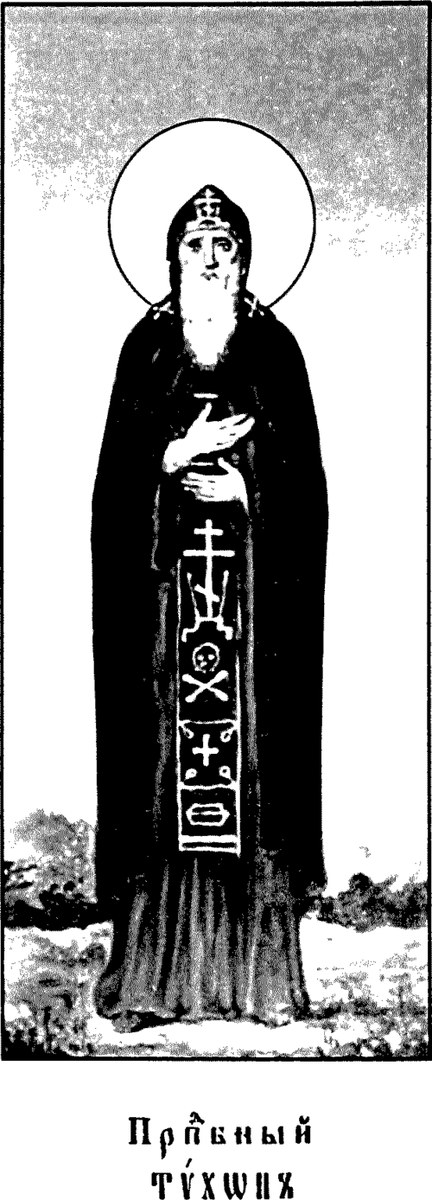
Tikhon of Lukhov is painted as a Russian monastic founder of the great schema: a long-bearded elder, the head covered with the pointed koukoulion or bare, wrapped in the black mantle over the analavos with its cross, skull, lance and sponge; one hand at the breast in prayer or blessing, the other holding a scroll. Local Lukh and Kostroma icons add the monastery — the white churches of the Nikolo-Tikhonov house behind him — and pair him with St Nicholas, to whom the monastery's principal church is dedicated; some show the tools of his trade, the turner's bowl or the book he copied.
The stored image is the plate for this saint from the Russian synodal Lives of the Saints (1903–1911), in the June volume of the series based on the Menologion of St Dimitri of Rostov: a full-length schema-monk with the analavos displayed, standing in a landscape, captioned in Slavonic simply Прпбный Тѵхѡнъ — "the Venerable Tikhon". The plate is identified as Tikhon of Lukhov by its place and number in the volume's sequence of June illustrations, immediately after the plate of Tychon of Amathus; the caption itself does not distinguish him, and readers should note that limitation.
Disputed questions
- Refusal of union, or simple emigration? The Life makes his crossing into Muscovy an act of confession — a refusal of the union with Rome — while the political record shows Prince Belsky's flight to have been the collapse of a conspiracy against the Lithuanian crown. The two need not conflict: Orthodox gentry did leave the Grand Duchy in this period for confessional reasons, and Timothy travelled in the retinue of a man leaving for other ones. The tradition's emphasis is recorded, and so is the frame around it.
- The date of glorification. The uncovering of the relics in 1569 and the healings at the tomb are the foundation of the cultus; a formal all-Russian glorification is not securely dated in the sources consulted, and the veneration is best described as local, established by the events of 1569 and later general in the Russian calendar.
- Which Tikhon on this day. He is one of three Russian monastic Tikhons kept on June 16, with Tikhon of Kaluga (†1492) and Tikhon of Krestogorsk (17th c.), all three bearing the name of Tychon of Amathus, the Cypriot bishop whose feast the day is. He is neither Tikhon of Zadonsk (August 13, †1783) nor Tikhon (Bellavin), Patriarch of Moscow (†1925).