
Victorinus and his Companions
The Holy Martyrs Victorinus, Victor, Nicephorus, Claudius, Diodorus, Serapion and Papias of Corinth
Martyr · d. c. 251
Commemorated 31 January — Martyrdom at Corinth under Decius
Victorinus, Victor, Nicephorus, Claudius, Diodorus, Serapion and Papias were seven Christians who suffered together at Corinth about the year 251, in the persecution of the emperor Decius. Brought before the governor and refusing to sacrifice, they were put to death by a variety of savage torments: Victorinus, Victor and Nicephorus were crushed in a great stone mortar; Claudius had his hands and feet struck off; Diodorus was cast into the fire; Serapion was beheaded; and Papias was drowned in the sea. They are commemorated on January 31.
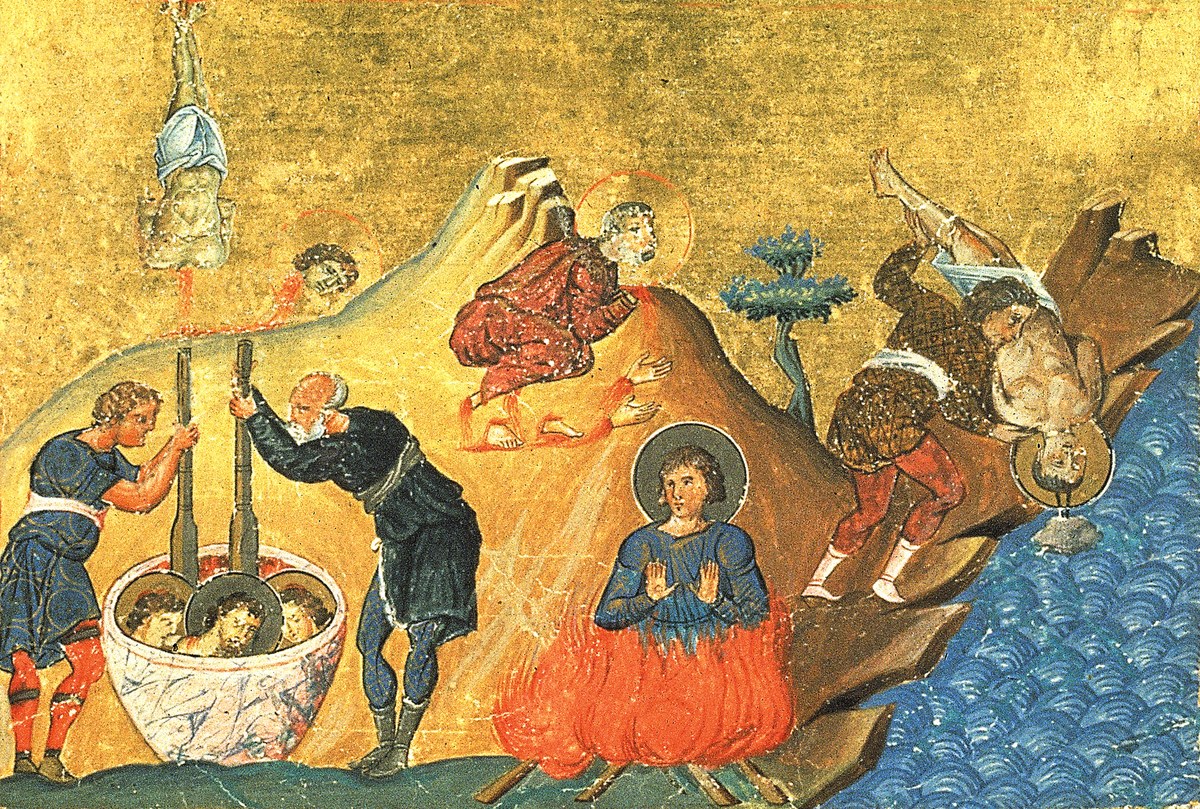

The seven belong to the martyrs of the Decian persecution (249–251), the first empire-wide persecution of the Church, which fell with special force on the cities of Greece. At Corinth — the great city of the Isthmus, the see to which Saint Paul had written — these seven Christians were seized and brought before the governor and commanded to sacrifice to the gods. All seven confessed Christ and refused, and neither promises nor threats could move them; so the judge condemned each to death, and the tradition preserves the manner of every one:
- Victorinus, Victor and Nicephorus were thrown into a great stone mortar and crushed with a heavy pestle — the torment the synaxarion lingers on, the three ground together as if in a mill.
- Claudius had his hands and feet cut off.
- Diodorus was cast into a fire and burned.
- Serapion was beheaded with the sword.
- Papias was drowned in the sea.
So the seven received their crowns together, about the year 251. (Some accounts place the martyrdom a little later, in the persecution of Valerian, about 258; the received date is under Decius.) They are numbered among the martyrs of Corinth and kept on January 31.
Feast and commemoration
January 31 (church date; Old Calendar civil February 13). The received Menaion gives the seven a synaxarion notice with verses rather than a proper service; the common office of several martyrs serves them where one is required. The day's offices belong chiefly to the unmercenaries Cyrus and John.
The Claudius of this company is not to be confused with Claudius the tribune, martyred at Rome with Chrysanthus and Daria (kept March 19) — a different martyr of a different city and reign.
Iconography
The seven are depicted as a company of martyrs, and — in the narrative type — in the several manners of their deaths, the three in the mortar being the distinguishing scene. The stored image is exactly the anticipated source: the miniature of the Menologion of Basil II (Constantinople, 985), which spreads the company's deaths across one frame — the three crushed in the great mortar, one burned, one hung head-down, one cast from the rocks, one beheaded at the sea's edge — the fullest of the manuscript's multi-scene martyrdoms.