
Chrysanthus and Daria
The Holy Martyrs Chrysanthus and Daria and those with them at Rome
Martyr · Virgin · Hieromartyr · Priest · Deacon · d. c. 283, at Rome
Commemorated 19 March — Martyrdom at Rome under Numerian — buried alive in the sandpit
Chrysanthus and Daria (†c. 283) were a young married couple martyred at Rome in the reign of the emperor Numerian. Chrysanthus was the son of a wealthy Roman senator of Alexandrian descent who, coming upon the writings of the Christians, sought out a teacher and was baptised; when his father tried to break his resolve by marrying him to Daria, a beautiful and learned priestess of Athena, Chrysanthus instead converted her, and the two lived together in unbroken virginity, devoting their marriage to the winning of others to Christ — he among the men, she among the women. Their preaching drew a persecution that only multiplied martyrs: the tribune Claudius sent to torture Chrysanthus was himself converted with his wife Hilaria, their sons Jason and Maurus, and his soldiers, and all were put to death. Daria, sent to a brothel, was guarded by a lion; and at the last the couple were thrown into a sandpit on the Via Salaria and buried alive under earth and stones. When Christians afterward gathered at the pit to keep their memory, the pagans sealed them in too — the Martyrs of the Pit, led by the presbyter Diodorus and the deacon Marianus. They are commemorated on March 19.

The sources and the shape of the account
The martyrdom of Chrysanthus and Daria is transmitted in a Latin passio of some antiquity, echoed in the Greek and Slavic synaxaria and, in the West, in the Martyrologium tradition and the verses of the poet-bishop Venantius Fortunatus (sixth century), who already knew and praised the two saints. The narrative is a hagiographic composition rather than a court record, and it carries the marks of its genre — miraculous deliverances from torture, a chastity-guarding lion, the wholesale conversion of persecutors — but its core is early and its cultus continuous: an Alexandrian convert and his converted pagan bride, put to death together at Rome, around whose tomb on the Via Salaria a company of the faithful was itself martyred. The entry follows that received account, marking where the tradition itself varies.
Chrysanthus, the Alexandrian convert
Chrysanthus (Χρύσανθος, "golden-flower") was, the passio relates, the son of Polemius, a man of senatorial rank who had come to Rome from Alexandria and settled in the City with wealth and honour. He gave his son the fullest education of the age — grammar, rhetoric, philosophy — and it was in the course of that study, coming upon the Acts of the Apostles and the letters of Paul, that the young man's heart was seized by a longing the pagan books could not answer. Troubled and searching, he sought out a Christian teacher and found the presbyter Carpophorus, who instructed him in the faith and baptised him. Chrysanthus began at once to confess Christ openly.
His father, alarmed for the family's standing and hoping to turn him back to the world, first shut him up — the account says — in a chamber with courtesans, that pleasure might do what argument had not; but Chrysanthus, praying, remained untouched and unmoved. Polemius then resolved on marriage, and chose for his son a bride whose learning and beauty seemed sure to bind him to the old religion: Daria.
Daria, the priestess converted
Daria (Δαρεία) is remembered as a woman of great beauty and cultivation, a priestess of Athena — in some tellings a consecrated virgin of the goddess, which the Latin tradition renders as a vestal — versed in philosophy and rhetoric as Chrysanthus was. The marriage meant to reclaim him became instead the occasion of her own conversion: in the long discourse the passio stages between them, Chrysanthus laid before her the emptiness of the idols and the truth of Christ, and Daria believed and was baptised. Then the two made together the resolve that is the heart of their memory — to preserve their virginity within their marriage, to be husband and wife before the world and brother and sister before God, and to spend the freedom of a shared household on the Gospel. Daria drew women to the faith; Chrysanthus drew men; and their house became a centre of conversions that could not long stay hidden.
The tribune Claudius and his household
Denounced to the authorities under the city prefect Celerinus, Chrysanthus was handed over to the tribune Claudius to be tortured into sacrificing. The passio recounts a succession of torments miraculously undone — bonds that fell away, instruments that lost their force — until Claudius, persuaded that a power greater than Rome's was at work, was converted with all his house. He, his wife Hilaria, their two sons Jason and Maurus, and the soldiers under his command received baptism.
The emperor — Numerian (283–284) in the received account — on learning of it, ordered the new Christians destroyed. Claudius was drowned in the sea with a stone bound to his neck; Jason and Maurus and the soldiers were beheaded; and Hilaria, seized as she prayed at the tomb where her sons were laid, gave up her spirit before her captors could touch her, and was buried beside them. So the tribune's whole household passed together to their crowns.
The lion, the sandpit, and the martyrdom
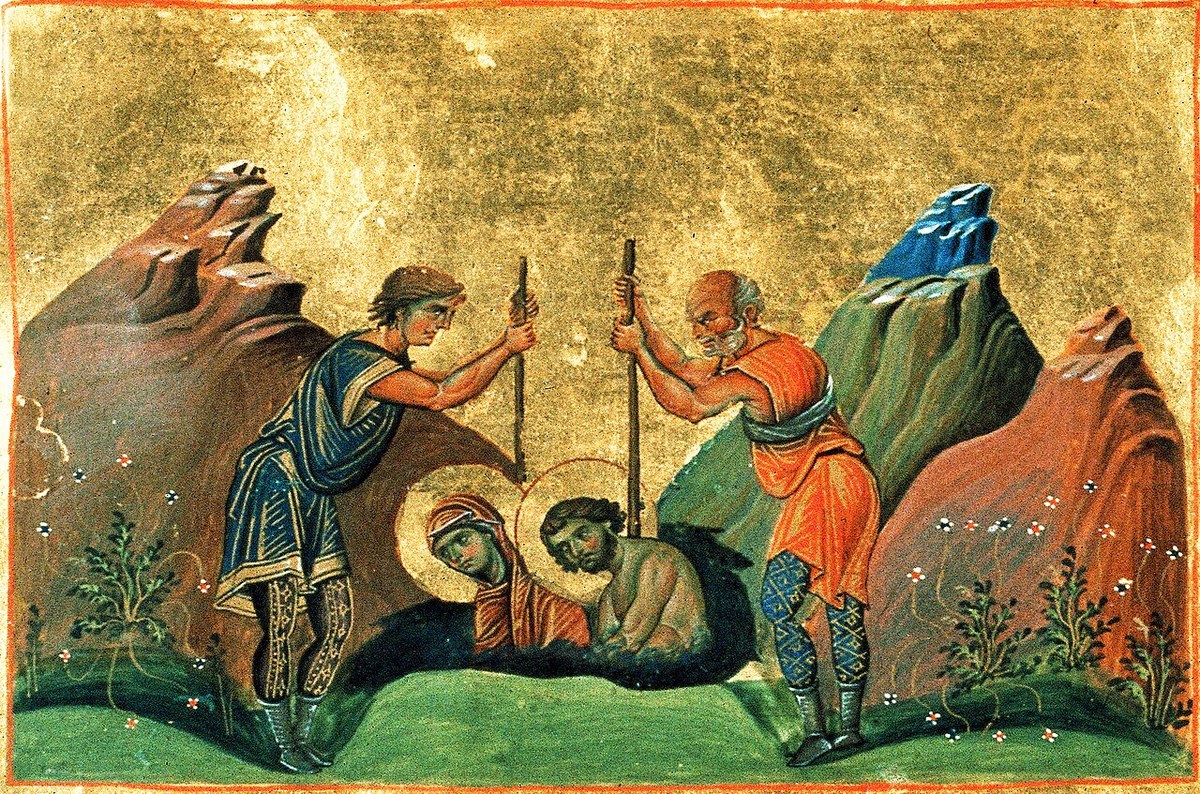
Chrysanthus was scourged and imprisoned; Daria, to shame her, was sent to a brothel. But — the tradition holds — a lion, loosed or escaped from the amphitheatre, took its place at the door of her chamber and guarded her, subduing without harming every man who approached, so that her virginity was kept untouched; and when the persecutors tried to burn the place, Daria came out unharmed. Neither torture nor shame nor fire prevailing, the two were condemned together to death. They were taken to a sandpit — an arenarium on the Via Salaria outside the walls — cast in, and buried alive under a heap of earth and stones, about the year 283. So Chrysanthus and Daria, who had lived as one in virginity, were made one in their grave and their glory.
The Martyrs of the Pit
To the martyrdom the passio joins a second, which the calendars keep with them. When the anniversary came round, a company of Christians gathered at the pit where the two lay, to celebrate the Eucharist and honour the martyrs. The pagans, discovering them at their prayers, sealed the entrance of the cave and heaped it over, entombing the whole assembly alive as Chrysanthus and Daria had been entombed — among them a presbyter, Diodorus, and a deacon, Marianus, who had led the gathering. These are the Martyrs of the Pit ("those at the Pit"), commemorated on the same day as the couple whose tomb became their own.
Feast and commemoration
Chrysanthus and Daria are kept on March 19 (church date; Old Calendar civil April 1), universally in the East, with their companions named in the synaxarion of the day — Claudius the tribune, Hilaria, Jason and Maurus, the presbyter Diodorus and the deacon Marianus, and (in the Greek books, listed on the same day) the martyr Pancharius. The Greek Menaion and the Slavic and American calendars agree on the day. In the West the same two saints are honoured (the Roman calendar long kept them on October 25, and their relics were carried north — to Reims and thence, from the ninth century, to Bad Münstereifel in the Rhineland, where the church of SS. Chrysanthus and Daria guards them still and the couple are the town's patrons).
Because March 19 (church date) falls always within Great Lent — whose bounds are movable — the full Liturgy is not served on the fast's weekdays, and the day's readings follow the Lenten cycle; no proper festal Epistle and Gospel are appointed to the martyrs. Where the day falls on a Saturday or Sunday of the fast, the Liturgy is served and the readings of a martyr or the ferial cycle are used.
Not to be confused with
The company's members bear names borne by other martyrs of the calendar; the distinctions should be kept in view:
- Claudius the tribune, drowned at Rome with his household here, is not Claudius of Corinth, one of the seven martyrs of Corinth under Decius (kept January 31), whose hands and feet were struck off — a different man, of a different city and reign.
- Jason, son of the tribune Claudius, is not the Apostle Jason of the Seventy (Tarsus; kept April 28), nor the persecuting governor Jason of the acts of Quadratus of Corinth — the one a child of martyrs, the others an apostle and a magistrate.
- Maurus, his brother, is not the disciple Maurus of Benedict of Nursia, the young monk who ran out over the water — a Western monastic of the sixth century, not a martyr of Rome.
- Daria here is the sole saint of that name in the fixed calendar; the modern Russian New Martyr Daria Zaitseva (of the company kept March 1 O.S.) is a twentieth-century sufferer, unconnected with the priestess-convert of Rome.
Hymns
Troparion — Tone 4
Your martyrs, O Lord, in their contest received from you, our God, crowns of incorruption; for, armed with your strength, they cast down the tyrants and shattered the powerless insolence of the demons. By their supplications, O Christ our God, save our souls.
Original translation from the Greek
Iconography
Chrysanthus and Daria are depicted together as a young married pair of martyrs — he a beardless youth, she a young woman, each robed and bearing the martyr's cross — and, in the narrative type, at the moment of their common martyrdom, cast into the pit. The company of their household (Claudius, Hilaria, Jason and Maurus) and the Martyrs of the Pit appear where the fuller cycle is illustrated. In the West the lion that guarded Daria became her attribute, and the two saints are shown crowned together.
The stored image is a Byzantine menologion miniature of the two saints, robed and haloed, standing side by side — the settled portrait type of the martyr-couple (source, public domain, pd-old-work).
A note on the attribution. The Wikimedia Commons file names the Menologion of Basil II (Constantinople, c. 985; Vatican, Vat. gr. 1613) as its source. The surviving volume of that manuscript covers only September through February, so a March 19 miniature cannot in fact come from it; the attribution is the uploader's, repeated from a secondary host, and is not confirmed here. What is certain — and sufficient for storage under the faithful-reproduction doctrine — is that the image is a pre-modern Byzantine menologion illumination in the public domain, identity-verified as depicting Chrysanthus and Daria by its labelling and its martyr-couple type. It should be re-captioned, or replaced with a securely provenanced miniature, if the true manuscript is established.