
Vincent of Lérins
Our Venerable Father Vincent, Priest and Monk of Lérins
Venerable · Priest · d. c. 445
Commemorated 24 May — Repose at the monastery of Lérins in Gaul
Vincent of Lérins (†c. 445) was a Gallic monk and priest of the island monastery of Lérins off the coast of Provence, and the author of the Commonitorium — the short treatise, written about 434 under the pen-name Peregrinus, "the Pilgrim," which laid down the most famous of all rules for distinguishing the apostolic faith from innovation: what has been believed everywhere, always, and by all. With it he set out, no less importantly, the principle that the faith may genuinely grow while never changing — profectus, non permutatio. He wrote three years after the Council of Ephesus and in its defence, upholding the title Theotokos against Nestorius. The Orthodox Church commemorates him on May 24.

Origins and the island
Almost nothing of Vincent's life is known outside a single notice by Gennadius of Marseilles, written about 495, and the few autobiographical touches in his own book. He was a Gaul; Gennadius makes him a priest of the monastery of the island of Lérins. The tradition of his birth divides between Toulouse and Toul in the north-east, and he is with some probability identified as the brother of St Lupus, bishop of Troyes. He had lived in the world before he became a monk — the Commonitorium speaks of him as having been tossed in the "storms and tempests" of secular life, and the tradition understands this of military service — and he came at length to the island for the sake of quiet.
Lérins — the insula Lirinensis, today the Île Saint-Honorat off Cannes — had been founded early in the fifth century by St Honoratus, and in Vincent's lifetime it was the intellectual powerhouse of the Gallic Church, an eastern-style monastery on western soil which trained a whole generation of bishops. Its neighbour house at Marseilles was the home of John Cassian, whose Institutes and Conferences brought the ascetic theology of Egypt and of Syria into Latin. It is important for understanding Vincent that Lérins was a place where the monastic and theological traditions of the East were read and honoured; the culture of his book is much closer to the Greek fathers' habit of appeal to the consensus of the churches than to the Augustinian synthesis then dominant in Africa.
Contemporaries speak well of him. Eucherius of Lyons praises his eloquence and learning; Vincent himself, with the conventional but evidently sincere humility of the Lérins school, calls himself the least of all the servants of God.
The Commonitorium
About 434, three years after the Third Ecumenical Council at Ephesus had condemned Nestorius, Vincent wrote the two books of the Commonitorium — a "reminder," a memorandum for his own use, published under the pseudonym Peregrinus. Only the first book and a summary recapitulation of the second survive; the body of the second book was lost early.
His question is the practical one that every generation of the Church has had to answer: how, faced with a new teaching urged by learned and plausible men, is a Christian to know the Catholic faith from a heresy? His answer has two parts, and the second is usually forgotten in favour of the first.
First, the authority of Holy Scripture, which is complete and sufficient for all things — but which, precisely because it is profound, is read in contradictory ways, so that heretics too can quote it, as the devil quoted it to Christ. Scripture therefore must be understood according to the tradition and interpretation of the Church.
Second, that tradition is identified by three marks, which together form what has ever since been called the Vincentian canon:
that faith which has been believed everywhere, always, and by all — quod ubique, quod semper, quod ab omnibus creditum est
that is, universality (the consent of the churches across the world), antiquity (the faith held from the beginning, not lately introduced), and consent (the agreement of the fathers and of the councils). Where universality fails, one appeals to antiquity; where the ancients are divided, to the definitions of a council; where a council has not spoken, to the agreed judgement of the recognised teachers. He is candid that even great men may fall — he cites Origen and Tertullian as the cautionary instances, brilliant Christians whose gifts became a temptation to the Church — and that the sifting of heresy is God's way of proving his people.
But Vincent is not a mere antiquarian, and the second half of his argument matters as much as the first. To the objection that his rule would forbid all progress in Christian understanding he answers plainly that there is progress, and that there must be:
Let there be growth, and abundant growth… but let it truly be a growth of the faith, not a change of it — profectus fidei, non permutatio
and he develops the point with the two famous analogies: the human body, which grows from infancy to age while remaining the same body with the same members, and the seed, which becomes a tree without becoming a different plant. Doctrine may be unfolded, clarified, and defined more exactly; it may never be substituted.
The polemical target is Nestorianism. Vincent argues at length for the unity of the person of Christ and defends the title Theotokos, "Mother of God," as the necessary and traditional confession — putting the decision of Ephesus into the form of a rule of faith rather than a conciliar decree, and thereby making it portable.
The question of grace
Vincent has for centuries been drawn into the Latin dispute over grace and predestination. He is generally identified with the author of the Objectiones Vincentianae, a set of hostile propositions against the extreme predestinarian reading of Augustine, answered by Prosper of Aquitaine; and it is noticeable that his list of the great teachers of the Church omits Augustine altogether. Latin theology has therefore often labelled him a semi-Pelagian, and more careful modern scholarship prefers semi-Augustinian or simply describes him as a critic of the late Augustine.
From the standpoint of the Orthodox East the label is misleading, and this is the chief reason why Vincent is honoured in the Orthodox calendar without embarrassment. The so-called semi-Pelagianism of the Lérins–Marseilles school is in substance the patristic doctrine of synergy — that grace is sovereign and prior, and that the human will genuinely co-operates and is genuinely responsible — which is the common teaching of the Greek fathers and, with particular emphasis, of the Antiochene tradition. John Cassian, the principal figure of that school, is a saint of the Orthodox calendar; Vincent's refusal of absolute predestination is read in the East not as a deviation but as fidelity. The judgement that made him a semi-Pelagian is a judgement of the Latin West, delivered by a standard the East never adopted.
A florilegium of passages from Augustine on the Trinity and the Incarnation, the Excerpta Vincentiana, has been attributed to him by modern scholars; if the attribution is sound it complicates the picture of Vincent as an anti-Augustinian considerably, since it shows him excerpting Augustine as an authority on christology.
Repose and later influence
Vincent died about 445, in the reigns of Theodosius II and Valentinian III — the dating comes from Gennadius. His relics are kept at Lérins, where he lived.
His afterlife has been extraordinary for so slight a book. The Vincentian canon became a commonplace of Western theology, was a chief weapon of both sides in the Reformation controversies, and remains the standard short formulation of catholicity; Orthodox writers cite it constantly as a Latin father's statement of what the East means by the consciousness of the whole Church, and set his profectus, non permutatio against theories of doctrinal development that in fact substitute new doctrines for old.
Feast and commemoration
May 24 (church date; New Calendar civil May 24, Old Calendar civil June 6). Kept on this day in the Orthodox Church in America's calendar and in Orthodox usage for the Western fathers, and on the same day in the Roman and Anglican calendars. There is no proper Byzantine office; where he is commemorated liturgically, the common of a venerable father is used.
Hymns
Troparion — Tone 8 (common of a venerable father)
O guardian of the faith delivered to the saints, thou didst teach the Church to know her own voice: what is believed everywhere, from the beginning, and by all. Dwelling on the island of Lérins as a pilgrim and a stranger, thou didst confess the Word made flesh of the Theotokos. O Vincent, our venerable father, entreat Christ God that our souls may be saved.
Original translation from the Latin
Iconography
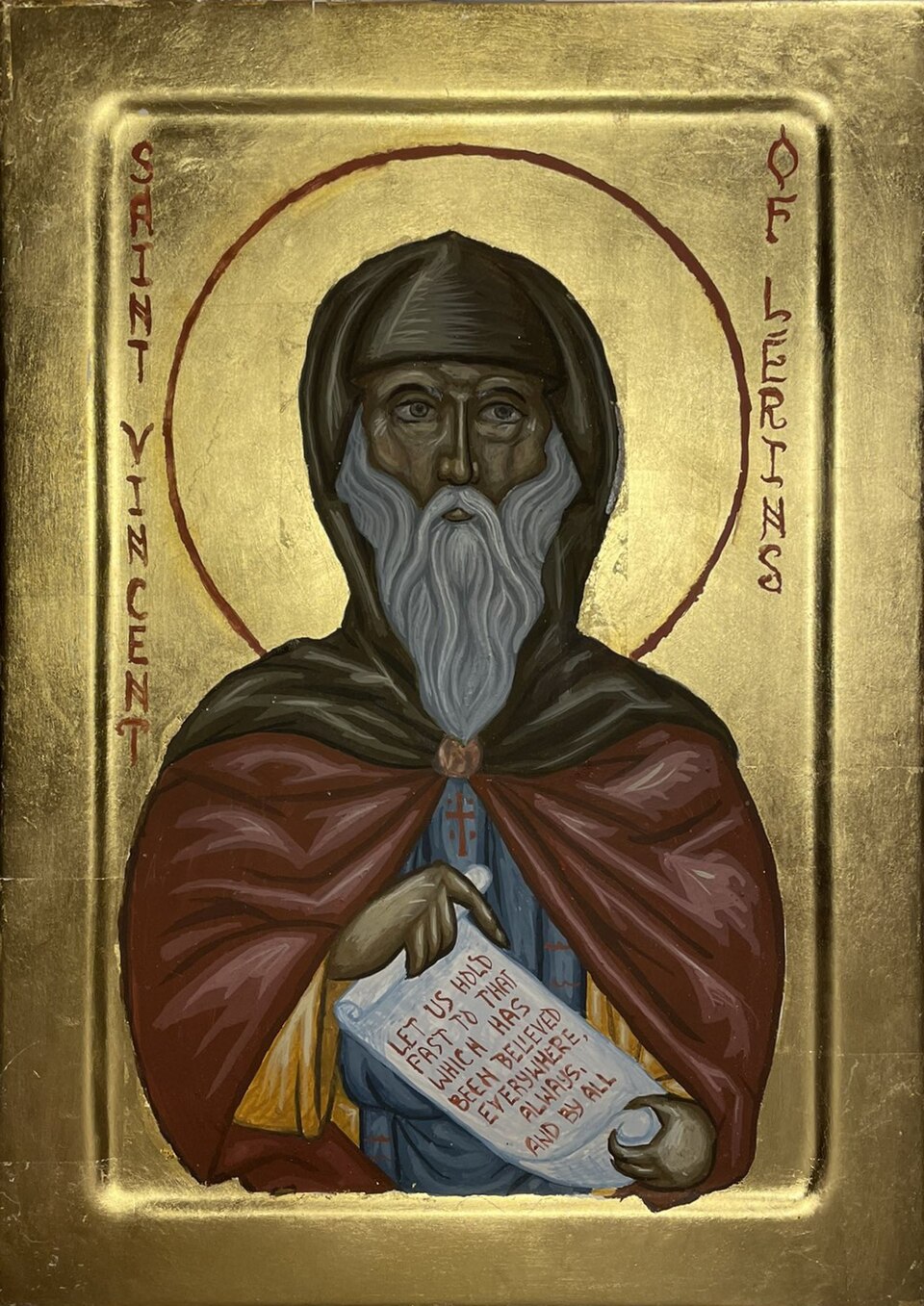
Vincent has no developed Byzantine iconographic type, his cult in the East being a modern reception. Where he is painted in Orthodox style he is given the type of the venerable priest and teacher: a monk of middle age in dark habit with the priest's stole, tonsured or with a short beard, holding an open scroll or codex — very often inscribed with his canon, quod ubique, quod semper, quod ab omnibus, or its English or Greek equivalent. The island of Lérins with its monastery may appear behind him. Western art shows him as a Cistercian-habited writer at a desk, which is anachronistic.
No pre-1900 image of Vincent has been located for this collection. The candidates found in the open image collections are all modern, and are rejected on licence grounds under this collection's policy: one is a contemporary panel painted in 2025 by a named living iconographer and released under a Creative Commons licence by the person who commissioned it, not by the painter, so that the iconographer's rights are untouched by the uploader's grant; the other is an undated modern icon uploaded as the uploader's "own work" with no evidence that the uploader painted it. Neither may be stored.
Disputed questions
- Orthodox attestation. Vincent is a Western father of the undivided Church, and his commemoration in Orthodox usage comes through the reception of the pre-schism saints of the West: he is carried in the Orthodox Church in America's calendar for May 24, the same day the Roman calendar keeps him, and in the Western-rite and Russian-diaspora calendars of the Orthodox West. He does not appear in the Greek or Antiochian synaxaria, whose May 24 is Symeon of the Wonderful Mountain and the martyrs of Galatia; no Byzantine liturgical propers exist for him. The commemoration is genuine but is not universal, and is recorded here as such.
- Toulouse or Toul? The place of birth is transmitted both ways in the modern literature; the identification with the family of St Lupus of Troyes favours the north-east, but neither is certain.
- Was he a semi-Pelagian? See above. The identification with the author of the Objectiones answered by Prosper is probable but not proved, and the theological verdict depends entirely on which tradition's standard is applied.
- The authorship of the Excerpta. The attribution rests on twentieth-century scholarship and is accepted by many but not all.
- Not to be confused with Vincent of Saragossa, the Spanish deacon and martyr (†304), a wholly different saint of a wholly different kind — the confusion is common in indexes, where "St Vincent" without qualification usually means the Spanish martyr.