
Zachariah the Prophet
The Holy Prophet Zachariah, the Sickle-seer
Prophet · d. 6th century BC (after 520 BC), in Judea
Commemorated 8 February — Commemoration among the Twelve Prophets
Zachariah (Hebrew Zekharyah, "the Lord has remembered") was the eleventh of the Twelve Minor Prophets and, with Haggai, one of the two prophets of the return from Babylon, active in Jerusalem from the second year of Darius (520 BC) as the exiles rebuilt the Temple. The son of Berechiah, son of Iddo, and by the Church's tradition of priestly (Levitical) descent, he received in a single night a sequence of eight symbolic visions — the horsemen, the four horns and the four smiths, the man with the measuring line, the cleansing of Joshua the high priest, the golden lampstand and the two olive trees, the flying scroll, the woman in the ephah, and the four chariots — and prophesied the coming of the Messiah with a clarity the Church reads at the heart of Holy Week: "Rejoice greatly, O daughter of Zion… behold, thy King cometh unto thee… lowly, and riding upon an ass" (9:9); the thirty pieces of silver (11:12–13); "they shall look upon me whom they have pierced" (12:10); and "smite the shepherd, and the sheep shall be scattered" (13:7). From a vision of a flying scroll curved like a sickle he is surnamed the Sickle-seer. He is commemorated on February 8.
.jpg)
Name, descent, and date
The prophet names himself in the opening verse of his book: "In the eighth month, in the second year of Darius, came the word of the Lord unto Zechariah, the son of Berechiah, the son of Iddo the prophet" (Zechariah 1:1). The heading fixes his time with precision — the second year of Darius I of Persia, that is 520 BC, some eighteen years after the first exiles had returned from Babylon under Zerubbabel and Joshua, and about two months after Haggai had begun to prophesy in the same year (Haggai 1:1). Zechariah is thus a prophet of the post-exilic restoration, the younger contemporary and companion of Haggai; where Haggai's blunt, brief oracles drove the discouraged community to resume the building of the Temple, Zechariah's larger and more visionary book gave that work its deeper meaning, setting the rebuilt house and its priesthood within the vast horizon of the coming of the Messiah and the Day of the Lord.
That he was young when he began is suggested by the book itself — the angel calls him "young man" (2:4) — and the tradition preserved in the synaxaria and in the pseudo-Epiphanian Lives of the Prophets holds that he returned from Babylon in his youth and was of the tribe of Levi, a priest as well as a prophet; the genealogy in Nehemiah 12:16, which lists "Zechariah" as head of the priestly house of Iddo in the days of the high priest Joiakim, is read in support. Ezra names him too, coupling him with Haggai as the two prophets whose preaching stirred Zerubbabel and Joshua to complete the Temple (Ezra 5:1; 6:14). His Hebrew name, borne by some thirty men of the Old Testament, means "the Lord has remembered" — fitting for the prophet of a people whom God had remembered in their captivity and brought home.
The eight night visions
The first and most distinctive part of the book (chapters 1–6) is a series of eight visions granted, the prophet says, in a single night — a form unlike the oracles of the earlier prophets, and a bridge toward the apocalyptic seer's manner that Daniel and the Revelation would carry further. An interpreting angel stands beside Zechariah throughout, explaining what he sees. He beholds, in turn: the horsemen among the myrtle trees, the Lord's patrols who report the earth at rest, and the promise that the Lord will yet return to Jerusalem in mercy; the four horns and four smiths, the powers that scattered Judah and the powers that will cast them down; the man with the measuring line going to measure a Jerusalem that shall overflow its walls, the Lord himself "a wall of fire round about her, and the glory in the midst"; the great vision of Joshua the high priest standing before the angel in filthy garments, with Satan at his right hand to accuse him, and the Lord rebuking the accuser — "is not this a brand plucked out of the fire?" — and clothing the priest in clean vestments and a fair mitre, with the promise of "my servant the Branch"; the golden lampstand fed by two olive trees, the two "sons of oil" (Zerubbabel and Joshua, prince and priest) who stand before the Lord of the whole earth, with the word that has never left the Church's memory, "Not by might, nor by power, but by my Spirit, saith the Lord" (4:6); the flying scroll, a great roll of curse going out over the land against the thief and the perjurer — from which vision, read in the Greek and Slavonic as a flying sickle, the prophet takes his surname the Sickle-seer (Σερποβίδης, Serpovidets); the woman in the ephah, Wickedness sealed under a weight of lead and carried away to Shinar; and the four chariots with their coloured horses, the four winds of heaven going forth from between two mountains of bronze. The night of visions closes with a symbolic crowning: silver and gold are taken from the returned exiles and set as a crown upon the head of Joshua the high priest, with the oracle of the Branch who "shall build the temple of the Lord… and he shall be a priest upon his throne" — the union of king and priest in one person that the Church reads of Christ.
The oracles of the King and the Passion
The book's second half (chapters 9–14), whether from the same years or gathered from the prophet's later ministry, turns from vision to oracle, and it is here that Zechariah becomes, after Isaiah, the most quoted of the prophets in the Gospels' account of the Passion. Its most radiant word the Church sings on Palm Sunday and reads of the Lord's entry into Jerusalem: "Rejoice greatly, O daughter of Zion; shout, O daughter of Jerusalem: behold, thy King cometh unto thee: he is just, and having salvation; lowly, and riding upon an ass, and upon a colt the foal of an ass" (9:9) — the very scene the Evangelists name as its fulfilment (Matthew 21:5; John 12:15). From the same chapters come the prophecies the Passion narratives take up one after another: the shepherd whose wage is weighed out at thirty pieces of silver, "a goodly price that I was prised at," cast to the potter in the house of the Lord (11:12–13; cf. Matthew 27:9–10); the pierced one whom Jerusalem shall mourn — "they shall look upon me whom they have pierced, and they shall mourn for him, as one mourneth for his only son" (12:10; cf. John 19:37); the smitten shepherd and the scattered sheep, "smite the shepherd, and the sheep shall be scattered" (13:7), which the Lord himself applied to his disciples on the night of the betrayal (Matthew 26:31); and the fountain "opened to the house of David… for sin and for uncleanness" (13:1). The book ends (chapter 14) with the Day of the Lord, the Mount of Olives cleft in two, the living waters going out from Jerusalem, and the Lord become "king over all the earth… and his name one" (14:9) — a vision of the final reign that the Church reads eschatologically, of the Kingdom that has no end.
Repose
Of the prophet's death the Scriptures say nothing. The tradition gathered in the Lives of the Prophets and repeated in the synaxaria holds that he prophesied for many years, lived to a great age, died in peace in his own land of Judea, and was buried near the prophet Haggai, his companion in the work of the restoration — the two prophets of the return laid, as they had laboured, side by side. As with most of the Twelve, no grave can be verified; the Church keeps his memory for the word of the Lord entrusted to him, and above all for the wealth of his witness to the coming and the Passion of Christ.
Feast and commemoration
Zachariah is commemorated on February 8 (church date; New Calendar civil February 8, Old Calendar civil February 21) in both the Greek and the Slavic service-books, his one universal feast, which in most years falls within the pre-Lenten weeks of the Triodion. He shares the day with the great-martyr Theodore Stratelates, who leads it in the calendars; the prophet's office is the lesser of the two but is proper to him, with the common apolytikion of a prophet sung by his name and a kontakion that hymns his Spirit-lit foresight. His prophecies are read by the Church far beyond his own day: "Rejoice greatly, O daughter of Zion" on the eve of Palm Sunday and through Holy Week, and the oracles of the pierced one and the thirty pieces of silver among the Passion prophecies of the Great and Holy Days.
Hymns
Troparion — Tone 2
As we celebrate the memory of thy prophet Zechariah, O Lord, through him we entreat thee: save our souls.
Original translation from the Greek
Kontakion — Tone 4
Thy pure heart, made radiant by the Spirit, became the dwelling-place of most luminous prophecy; for thou dost behold things far off as though they were near. Wherefore we honour thee, O blessed prophet Zechariah, glory of the Twelve.
Original translation from the Slavonic
Iconography
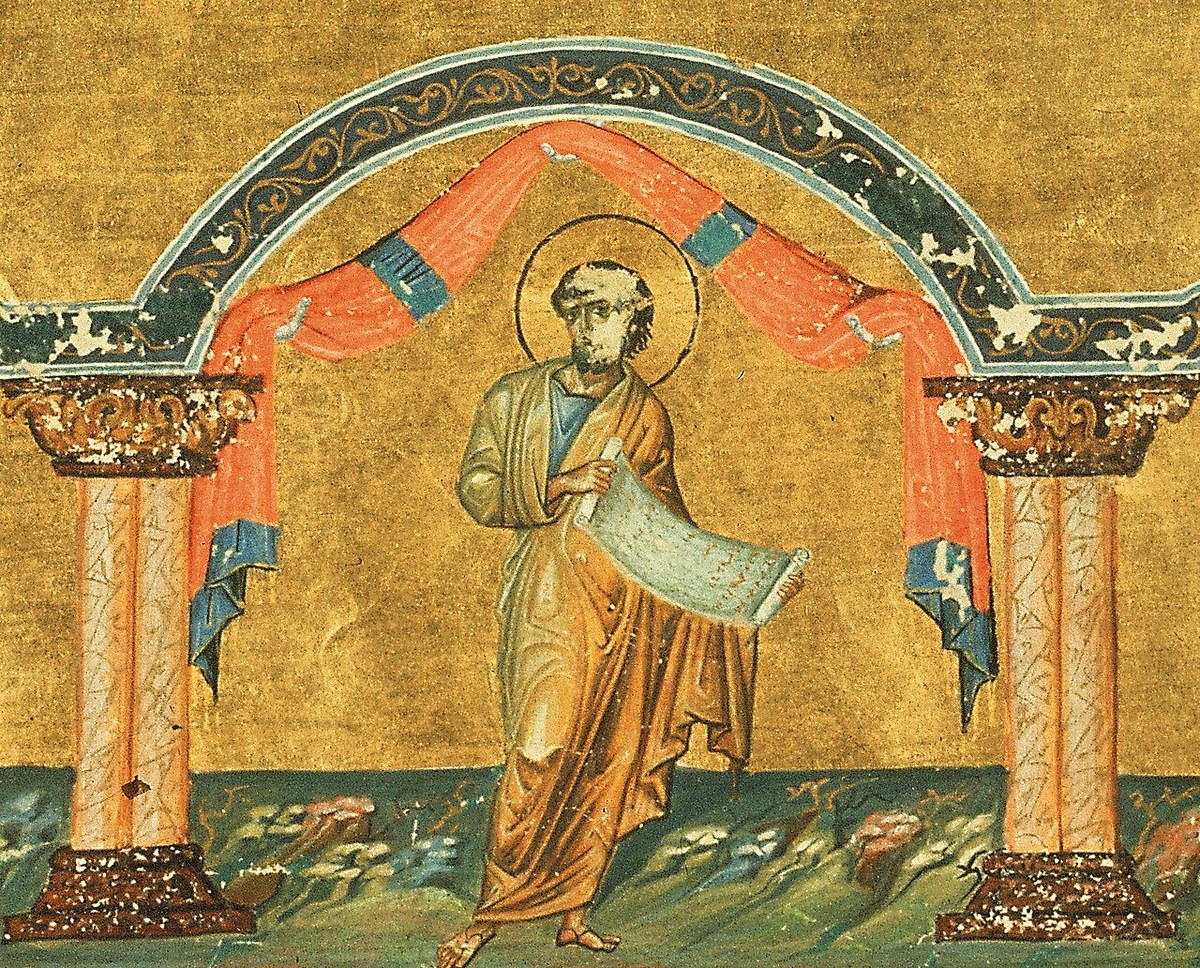
Zachariah is depicted in the settled manner of the Old Testament prophets: an elderly, bearded sage in tunic and mantle, holding an unrolled scroll of his prophecy — often opened to the words "Rejoice greatly, O daughter of Zion" or to "Behold, thy King cometh." He takes his place in the prophet-tier of the Byzantine and Russian iconostasis and in the drums and domes of church cycles among the prophets who foretold the Incarnation (as in the mosaics of Daphni). Where the tradition remembers his surname the Sickle-seer, the scroll or the vision of the flying sickle may be shown. He is to be distinguished in the programs from Zachariah the father of the Forerunner, the priest of Luke's Gospel, who is pictured rather in the priestly vestments and censer of the Aaronic order and in the narrative scenes of the annunciation at the altar and his murder in the temple.
The stored image is the miniature for February 8 from the Menologion of Basil II (Constantinople, c. 985; Vatican, Vat. gr. 1613), which names him "Zechariah the Sickle-seer, of the Twelve Minor Prophets": the prophet stands unrolling his scroll against the manuscript's gold ground (source, public domain, pd-old-work).