
Zeno the Faster of Antioch
Our Venerable Father Zeno the Faster, Hermit of Antioch
Venerable · d. c. 414, near Antioch
Commemorated 10 February — Repose in his tomb-cell near Antioch
Zeno the Faster (died c. 414) was a hermit of the region of Antioch, remembered as a disciple of Basil the Great and a model of extreme abstinence, from which he took his by-name. A man of rank and wealth who had served in the imperial courier-service, he was moved after Basil's death to renounce the world; he gave away all he possessed to the poor and shut himself in a rock-hewn tomb outside the walls of Antioch, where for some forty years he lived alone in the strictest asceticism — fasting, silence, and prayer — owning nothing, lighting no fire, fetching his own water from a distance, and admitting no one. His life is recorded by Theodoret of Cyrrhus, who knew the Antiochene ascetics at first hand. He is commemorated on February 10.

Zeno was, in his first estate, a man of the world's honours — well-born, wealthy, and holding a post in the imperial courier-service (the cursus publicus) under the emperor Valens. The tradition binds him to Basil the Great, whose disciple he is called, and it was after Basil's repose (379) that Zeno resolved to leave everything for Christ. Distributing his considerable fortune to the poor, he withdrew to the neighbourhood of Antioch and took up his abode in a tomb — a rock-cut sepulchre outside the city — which he made his hermit's cell.
There, by the account of Theodoret of Cyrrhus in the Religious History (Historia Religiosa), he lived for about forty years in an austerity that astonished even that land of ascetics. He kept no possessions — no bed, no lamp, no store of food, not even a book of his own — borrowing the Scriptures to read and returning them; he lit no fire, fetched his own water from a spring at some distance, and ground and ate the plainest fare, and that seldom, so that the name the Faster clung to him. He held himself apart from all company, giving his days to prayer and silence, and would go to the church of Antioch for the Sunday assembly, otherwise remaining hidden. When the Isaurian raids ravaged the region in the early fifth century and many fled, the old hermit is said to have remained at his prayer. He died, full of years, about 414 (some place his repose a little later, c. 416), and was numbered among the holy solitaries whose memory the Church of Antioch treasured.
(Not to be confused with the martyr Zeno kept with Eudoxius, Zeno and Macarius, nor with the Apostle Zenas of the Seventy — see Zenas of the Seventy; this Zeno is the ascetic "Faster" of Antioch described by Theodoret.)
Feast and commemoration
Zeno the Faster is commemorated on February 10 (church date; Old Calendar civil February 23), where the Greek Menaion keeps him among the day's saints as "Zeno the Ascetic." His is a minor commemoration without a proper office; he holds a particular place in the Antiochene record of the desert-fathers of Syria, being one of the solitaries of the region of Antioch whose lives Theodoret set down.
Hymns
Troparion — Tone 8
By a flood of tears thou didst make the desert to blossom, and by thy deep sighs thou didst bear fruit a hundredfold in labours; and thou becamest a luminary, shining upon the world by thy wonders, O Zeno our venerable father. Intercede with Christ our God, that our souls may be saved.
Original translation from the Greek
Iconography
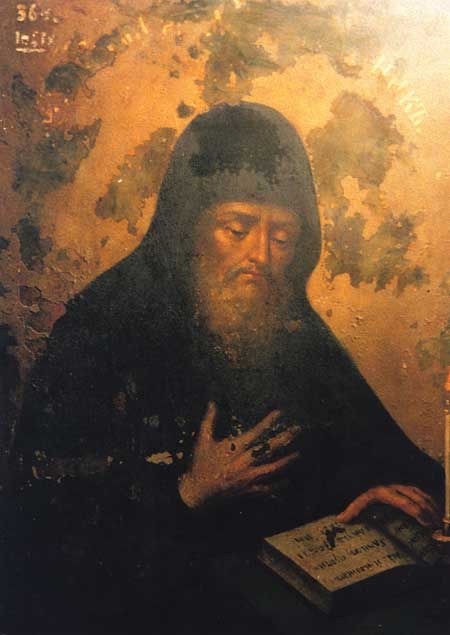
Zeno is depicted as an aged hermit-ascetic, thin and long-bearded, in the poor tunic of a solitary, often shown at the mouth of the rock-tomb that was his cell, holding a scroll or with hands raised in prayer. The stored image is a 19th-century Kiev Caves icon of the faster.