
Wednesday 29 January 2025
Trans. Rel. Ignatius the Godbearer
Wednesday of the 32nd week after Pentecost
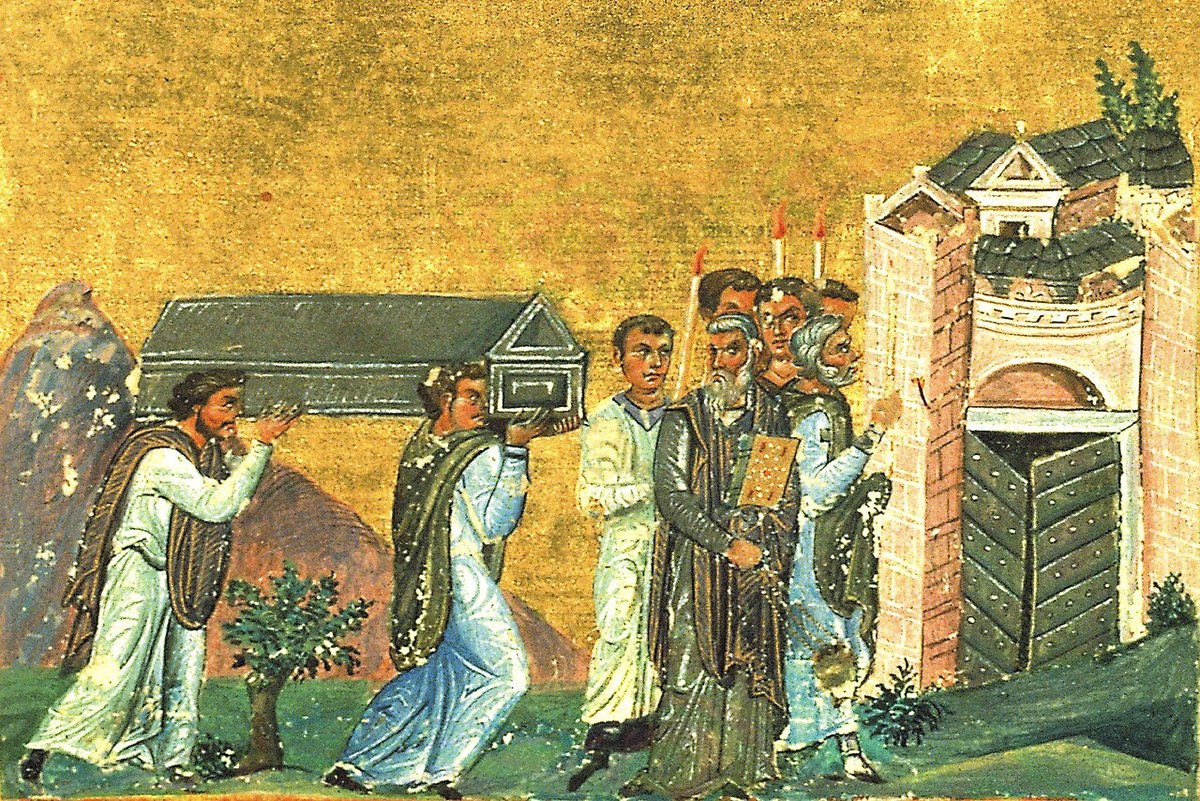
About Translation of the Relics of Ignatius the God-bearer →
.jpg)
Saints commemorated
-
Saint of the day
Trans. Rel. Ignatius the Godbearer
-
St Andrei Rublev, iconographer (1430)
-
Our Holy Father Aphrahat the Persian (4th c.)
Aphraates (†c. 370–380) was a Persian of noble birth who forsook the fire-worship of his fathers for Christ, left his own country, and became an anchorite — first near Edessa and then outside Antioch, in a small cell by the Orontes, where he gave himself to prayer, fasting, and the healing of the sick. He is remembered above all for the boldness with which, in the reign of the Arian emperor Valens, he broke his solitude to come into the city and strengthen the Orthodox faithful against the heresy — answering the emperor, who rebuked a monk for meddling, that a man whose house was ablaze could not stay shut in his room. His life and words are recorded by his younger contemporary Theodoret of Cyrrhus. He must be kept distinct from the Syriac writer Aphrahat "the Persian Sage," with whom his very similar name causes him to be confused. He is commemorated on January 29.
-
Repose of Blessed Father Dimitrios Gagastathis (1975)
-
Gerasimus, Pitirim and Jonah of Perm
Gerasimus, Pitirim and Jonah were three successive bishops of Great Perm, seated at Ust-Vym on the Vychegda, who in the fifteenth century carried forward the mission begun by Stephen of Perm among the Zyrians (Komi) and the pagan tribes of the far north-east of Russia. Gerasimus (†c. 1441) and Pitirim (†1455) were both martyred — the one strangled by a heathen of his own household, the other killed in a raid of the pagan Voguls (Mansi) — while Jonah (†1470) completed the conversion of Great Perm on the upper Kama and reposed in peace. Venerated together as the wonderworking hierarchs of Perm, their relics rest in the cathedral of Ust-Vym, and they are commemorated as a company on January 29.
-
Ignatius of Antioch
Ignatius the God-bearer (c. 35 – c. 107) was bishop of Antioch — the third to hold the see, after the Apostle Peter and Evodus — and, with Polycarp of Smyrna, a disciple of the Apostle and Evangelist John the Theologian. Tradition identifies him with the child whom Christ set in the midst of the disciples, and reads his name "Theophoros," God-bearer, in both its senses: one borne in the arms of God, and one who bore God in his heart. Arrested under the emperor Trajan and condemned to the beasts, he was sent under military guard across Asia Minor to Rome — a journey on which, chained to "ten leopards," he wrote the seven letters that are his enduring monument: a foundational witness to the bishop's office, to the Eucharist as "the medicine of immortality," and to a martyrdom he embraced with longing — "I am the wheat of God, and I am ground by the teeth of the wild beasts, that I may be found the pure bread of Christ." He was devoured by beasts in the amphitheatre at Rome about the year 107. His relics were carried back to Antioch — the first stage of their journey — and later translated to Rome, to the Basilica of San Clemente, where they rest. He is kept on December 20, and on January 29 for the translation of his relics.
-
Laurence of Turov
Laurence (†1194) was a monk of the Kiev Caves monastery who lived as a recluse in strict enclosure, was granted the gift of healing — especially of casting out unclean spirits — and was afterwards consecrated Bishop of Turov, a see of the Turov-Pinsk land in the west of the Kievan realm. He shepherded his diocese in the last years before the fragmentation of the Rus' and reposed in 1194; his incorrupt relics rest in the Near (Anthony's) Caves of the Kiev-Caves Lavra, where he is numbered among the venerable fathers who lie there. He is commemorated on January 29, and among the Fathers of the Near Caves. He is not to be confused with the later Laurence the Recluse of the Far Caves, a distinct Kiev-Caves saint.
-
Martyrs of Samosata
The seven Martyrs of Samosata — Romanus, James, Philotheus, Hyperechius, Abibus, Julian and Paregorius — suffered together about the year 297, in the persecution of Diocletian, at Samosata, the ancient capital of Commagene on the upper Euphrates. Christians of the city, they refused to join the pagan sacrifices offered for the emperor's victory and openly denounced the worship of idols. For this they were seized and subjected to prolonged and savage torture — their bodies scored with iron, heavy fetters hung about their necks, and long imprisonment — and at the last were nailed to crosses, iron nails being driven into their heads while they hung. They are commemorated as a company on January 29, and are listed among the martyrs of the Greek Menaion and the synaxaria.
-
Sarbelus of Edessa
Sarbelus (Syriac Sharbil) was the chief pagan priest of Edessa in Mesopotamia under the emperor Trajan (98–117), converted to Christ with his sister Bebaia by Barsimaeus, bishop of Edessa. Renouncing the idols whose most honoured servant he had been, he was arrested, subjected to prolonged and savage tortures, and put to death, his sister receiving the crown of martyrdom with him. He is commemorated on September 5, and again with Bebaia on October 15 and with Barsimaeus on January 29.
-
Silvanus of Emesa
Silvanus, Bishop of Emesa in Phoenicia Libanensis (modern Homs, in Syria), was an aged hierarch given to the wild beasts in the amphitheatre of his city together with two of his clergy — Luke the deacon and Mocius the reader — in the great persecution, about the year 312. His martyrdom is one of the few of its region attested by a contemporary historian: Eusebius of Caesarea names Silvanus, "bishop of the churches about Emesa," among the bishops thrown to the beasts as the persecution reached its height. The Byzantine calendars keep the three together on January 29. Because his name and death so closely resemble those of his exact contemporary Silvan of Gaza, the two are constantly confused in the sources; they are distinct saints of the same persecution.
British Isles and Ireland
- St. Gildas the Wise, abbot of Llanilltud and Brittany (c.570)
- St. Blath (Flora) of Kildare (523)
- St. Dallan Forgaill, martyr (598)
- St. Voloc, bishop in Scotland (c.724)
Troparia & kontakia
Apolytikion
Winged with divine longing for him who once held thee in his undefiled hands, thou wast shown to be a God-bearer, O Ignatius; having finished thy course in the West, thou hast pitched thy dwelling in the unwaning day of the heavens. Wherefore intercede with Christ our God, that our souls may be saved.
Apolytikion
Receiving today with gladness the myrrh-breathing shrine of thy relics as a treasury enriching her with gifts, the Church rejoiceth and is glad, and in faith crieth out to thee: O all-praised Ignatius, most sacred Father, cease not to intercede with Christ for those who in faith and love honour thy memory.
Kontakion — Tone 4
Having risen today from the East and illumined all creation with thy teachings, thou wast adorned with martyrdom, O God-bearing and divine Ignatius.
Kontakion — Tone 3
The radiant day of thy shining contests proclaims to all men Him who was born of the Virgin; for thirsting to delight in him out of love, thou didst hasten to be devoured by the wild beasts. Therefore wast thou called God-bearer, O glorious Ignatius.
Sticheron
A living pillar and a breathing icon — thy yearly feast is come, O God-bearer Ignatius, proclaiming thy hidden mysteries and thy noble deeds, thy standing for the faith even unto blood, and that blessed and famous cry of thine, which said: **"I am the wheat of God, and I am ground by the teeth of the wild beasts."** Wherefore, having become an imitator of Christ, intercede that our souls may be saved.
Troparion — Tone 8 (from the common of a venerable father)
In thee, O Father, was preserved unfailingly that which is according to the image; for taking up the Cross, thou didst follow after Christ, and by thy deeds thou didst teach us to despise the flesh, for it passeth away, but to care for the soul, a thing immortal. Wherefore, O venerable Aphraates, thy spirit rejoiceth with the Angels.
Troparion — Tone 4 (from the common of hierarchs)
O God of our fathers, who ever dealest with us according to thy gentleness, take not thy mercy from us, but by the prayers of thy holy hierarchs Gerasimus, Pitirim and Jonah, govern our life in peace.
Troparion — Tone 4
As one who shared in the ways of the Apostles and succeeded to their thrones, thou didst find in thy labours, O God-inspired one, an ascent to divine vision; wherefore, rightly dividing the word of truth, thou didst contend for the faith even unto blood, O Hieromartyr Ignatius. Intercede with Christ our God that our souls may be saved.
Troparion — Tone 8 (from the common of a venerable father)
In thee, O Father, was preserved unfailingly that which is according to the image; for taking up the Cross, thou didst follow after Christ, and by thy deeds thou didst teach us to despise the flesh, for it passeth away, but to care for the soul, a thing immortal. Wherefore, O venerable Laurence, thy spirit rejoiceth with the Angels.
Troparion — Tone 4 (from the common of martyrs)
Thy martyrs, O Lord, in their courageous contest received incorruptible crowns from thee our God; for possessed of thy might, they cast down the tyrants and shattered the feeble arrogance of the demons. By their prayers, O Christ God, save our souls.
Troparion — Tone 4 (from the common of martyrs)
Thy martyr, O Lord, in his contest received an incorruptible crown from Thee, our God; for possessing Thy strength he cast down the tyrants and shattered the feeble insolence of the demons. By his intercessions save our souls.
Troparion — Tone 4 (from the common of a hieromartyr)
Sharing in the ways of the Apostles and a successor of their thrones, thou didst find in thy labours, O inspired of God, an ascent to divine vision; wherefore, rightly dividing the word of truth, thou didst contend for the faith even unto blood, O Hieromartyr Silvanus. Intercede with Christ our God that our souls may be saved.
Readings
Epistle
James 3.11-4.6
11Doth a fountain send forth at the same place sweet water and bitter? 12Can the fig tree, my brethren, bear olive berries? either a vine, figs? so can no fountain both yield salt water and fresh. 13Who is a wise man and endued with knowledge among you? let him shew out of a good conversation his works with meekness of wisdom. 14But if ye have bitter envying and strife in your hearts, glory not, and lie not against the truth. 15This wisdom descendeth not from above, but is earthly, sensual, devilish. 16For where envying and strife is, there is confusion and every evil work. 17But the wisdom that is from above is first pure, then peaceable, gentle, and easy to be intreated, full of mercy and good fruits, without partiality, and without hypocrisy. 18And the fruit of righteousness is sown in peace of them that make peace. 1From whence come wars and fightings among you? come they not hence, even of your lusts that war in your members? 2Ye lust, and have not: ye kill, and desire to have, and cannot obtain: ye fight and war, yet ye have not, because ye ask not. 3Ye ask, and receive not, because ye ask amiss, that ye may consume it upon your lusts. 4Ye adulterers and adulteresses, know ye not that the friendship of the world is enmity with God? whosoever therefore will be a friend of the world is the enemy of God. 5Do ye think that the scripture saith in vain, The spirit that dwelleth in us lusteth to envy? 6But he giveth more grace. Wherefore he saith, God resisteth the proud, but giveth grace unto the humble.
Gospel
Mark 11.22-26
22And Jesus answering saith unto them, Have faith in God. 23For verily I say unto you, That whosoever shall say unto this mountain, Be thou removed, and be thou cast into the sea; and shall not doubt in his heart, but shall believe that those things which he saith shall come to pass; he shall have whatsoever he saith. 24Therefore I say unto you, What things soever ye desire, when ye pray, believe that ye receive them, and ye shall have them. 25And when ye stand praying, forgive, if ye have ought against any: that your Father also which is in heaven may forgive you your trespasses. 26But if ye do not forgive, neither will your Father which is in heaven forgive your trespasses.