
About Placing of the Precious Cincture of the Theotokos → · About Restoration of the Church of the Theotokos at Neorion →

Saints commemorated
-
Antiochian commemoration
St Gennadius, Patriarch of Constantinople (471)
Gennadius was Ecumenical Patriarch of Constantinople from 458 to 471, in the reign of Leo I the Great, in the difficult generation after Chalcedon when the settlement of 451 was being contested across the East. A learned exegete before he was a bishop — a commentator on Daniel, on Genesis and on the Pauline epistles, of the Antiochene school — he is remembered chiefly as a pastor and a disciplinarian of extraordinary mildness and extraordinary firmness together: he held a synod at Constantinople that condemned simony, refused to ordain any man who did not know the Psalter by heart, and left a reputation for gentleness that survives in the anecdotes John Moschus gathered a century and a half later. He received the Robe of the Theotokos into the shrine at Blachernae, climbed the ladder of Daniel the Stylite to ordain him priest on top of his pillar, and died in 471 having warned that the Church would be troubled after him — as, under his successor Acacius, it was.
-
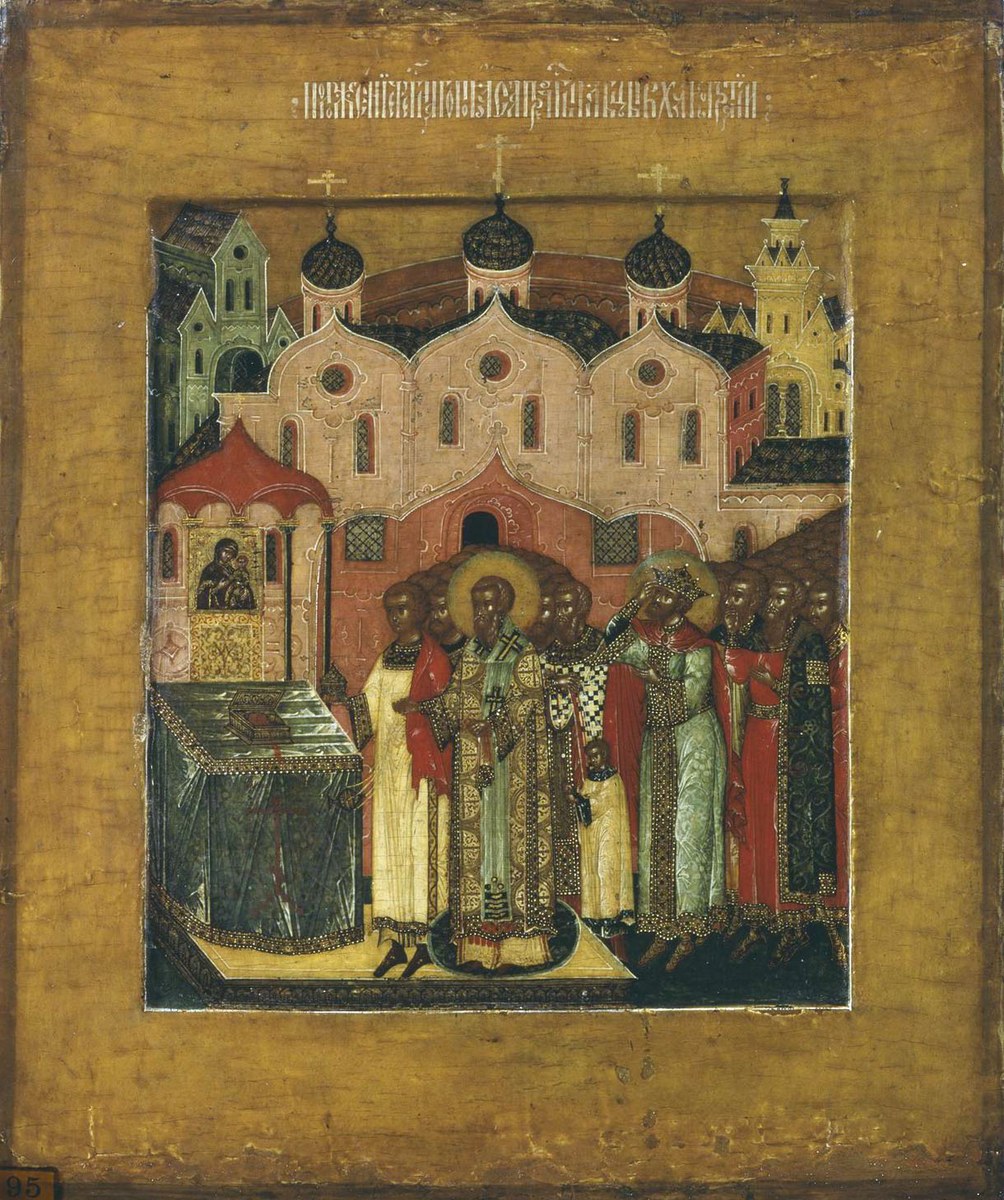
Sash of the Theotokos
-
The Placing of the Sash of the Most Holy Theotokos (395-408? 886- 912?)
-
Hieromartyr Cyprian, bishop of Carthage (258)
Cyprian, bishop of Carthage from 248/249 until his beheading on 14 September 258, is the greatest Latin churchman of the age before Constantine and the first bishop of the West to die a martyr with his acts recorded. A rich pagan rhetorician converted in middle life, he governed the African church through the Decian persecution, the plague of 252 and the schisms that followed both, and he thought out, under that pressure, the doctrine of the Church that the Latin world would carry ever afterwards: one Church, one episcopate held undivided by all bishops together, and outside it no salvation. His treatise On the Unity of the Catholic Church and his eighty-odd surviving letters are the earliest large body of Latin Christian correspondence. He quarrelled famously with Stephen of Rome over the baptism of heretics and was not reconciled; and when Valerian's edict came he refused exile a second time, came back to his city to die among his own people, and answered the sentence of death with two words — "Thanks be to God." The Byzantine calendar keeps him on August 31, the last day of the church year.
-
Saint Aidan of Lindisfarne (651)
Aidan was an Irish monk of Iona sent in 635 at the request of King Oswald of Northumbria to convert the English of the north, who made his see on the tidal island of Lindisfarne off the Northumbrian coast and governed it for sixteen years until his death on 31 August 651. He is the founder of the Northumbrian Church and, through the disciples he trained, of a good deal of the Christianity of England. Our knowledge of him comes almost entirely from Bede, who disapproved of his Easter reckoning and admired everything else about him without reserve: that he travelled on foot so as to be able to speak with everyone he met, that he gave away whatever the rich gave him, that he bought slaves out of slavery and educated some of them for the priesthood, and that he told a king to his face that a poor man mattered more than a horse. On the night he died, a shepherd boy on the hills saw a soul carried up by angels, and went and became a monk: that boy was Cuthbert.
-
Eanswythe of Folkestone
Eanswythe was a princess of Kent, granddaughter of Æthelberht, the first Christian king of the English, and daughter of King Eadbald; and she is remembered as the founder, about the year 630, of the community at Folkestone on the Kentish coast — by long tradition the first monastic house for women in England, and Eanswythe as the first English abbess. She refused a marriage offered her by a pagan Northumbrian prince, took the veil with her father's support, and died young. Almost nothing is transmitted of her life beyond that outline: she is a saint known from a cultus rather than from a biography. But in 1885 a leaden reliquary containing the bones of a young woman was found walled up in the parish church that bears her name, and in 2020 those bones were radiocarbon-dated to the middle of the seventh century and identified as those of a woman who died between about seventeen and twenty-two years of age — which makes Eanswythe one of the very few Anglo-Saxon saints whose relics can be shown to be plausibly her own.
British Isles and Ireland
- SS Cuthburgh (c.725) and Cwenburgh (c.735), abbesses of Wimborne
Troparia & kontakia
Apolytikion — Tone 8 (plagal of the fourth)
O Theotokos ever-virgin, shelter of mankind, thou hast bestowed upon thy city, for a mighty rampart, the Robe and the Girdle of thine undefiled body, which by thy seedless childbearing have remained incorrupt; for in thee both nature and time are made new. Wherefore we entreat thee: grant peace to the world, and to our souls the great mercy.
Kontakion — Tone 6 (plagal of the second)
Thy precious Girdle, which encompassed thy God-receiving womb, O Theotokos, is unto thy city a might unassailable and a treasury of good things that never faileth, O thou alone ever-virgin.
Kontakion — Tone 4 (common)
Thou didst leave the island of Columba for a harder island, and wouldst not ride where thou couldst walk and speak with the poor; the wealth of kings thou didst turn into the freedom of slaves, O father Aidan: entreat Christ God that our souls may be saved.
Kontakion — Tone 4 (common of a hieromartyr)
Having shone forth as a lamp of the Church of Africa, thou didst gather the scattered into one and didst seal thy teaching with thy blood, O most wise Cyprian; wherefore, having received the crown of martyrdom, entreat Christ God for us who honour thee.
Kontakion — Tone 2 (common)
Refusing an earthly bridegroom, thou didst take the Bridegroom who dieth not, and on the cliff above the sea thou wast the first mother of the daughters of the English: O venerable Eanswythe, entreat Christ God for our souls.
Kontakion — Tone 4 (common of a hierarch)
Thou wast shown a shepherd of the flock of Christ, meek to the penitent and unbending to the corrupt, and thou didst drive the traffic in holy things from the sanctuary, O father Gennadius; wherefore we honour thee as a true hierarch of the Church of Christ.
Synaxarion
As a golden colophon, O august Virgin, I set thy Girdle at the ending of the year. On the thirty-first they laid the All-pure one's Girdle in the reliquary.
Troparion — Tone 8 (common of a hierarch and ascetic)
In thee, O father, was preserved unimpaired that which is according to the image: for taking up thy cross, thou didst follow Christ; and by thy deeds thou didst teach us to despise the flesh, for it passeth away, and to care for the soul, which is a thing immortal. Wherefore, O holy Aidan, thy spirit rejoiceth with the angels.
Troparion — Tone 4 (common of a hieromartyr)
Sharing in the ways of the Apostles and a successor upon their throne, thou didst find thy practice of virtue an ascent to the vision of God, O inspired of God; wherefore, rightly dividing the word of truth, thou didst suffer for the faith even unto blood, O hieromartyr Cyprian: intercede with Christ God that our souls may be saved.
Troparion — Tone 8 (common of a venerable woman)
In thee, O mother, was preserved unimpaired that which is according to the image: for taking up thy cross, thou didst follow Christ; and by thy deeds thou didst teach us to despise the flesh, for it passeth away, and to care for the soul, which is a thing immortal. Wherefore, O venerable Eanswythe, thy spirit rejoiceth with the angels.
Troparion — Tone 4 (common of a hierarch)
O God of our fathers, who dealest with us ever according to thy gentleness: take not thy mercy from us, but by the prayers of thy hierarch Gennadius guide our life in peace.
Readings
1st Matins Gospel
Matthew 28.16-20
16Then the eleven disciples went away into Galilee, into a mountain where Jesus had appointed them. 17And when they saw him, they worshipped him: but some doubted. 18And Jesus came and spake unto them, saying, All power is given unto me in heaven and in earth. 19Go ye therefore, and teach all nations, baptizing them in the name of the Father, and of the Son, and of the Holy Ghost: 20Teaching them to observe all things whatsoever I have commanded you: and, lo, I am with you alway, even unto the end of the world. Amen.
Epistle
1 Corinthians 15.1-11
1Moreover, brethren, I declare unto you the gospel which I preached unto you, which also ye have received, and wherein ye stand; 2By which also ye are saved, if ye keep in memory what I preached unto you, unless ye have believed in vain. 3For I delivered unto you first of all that which I also received, how that Christ died for our sins according to the scriptures; 4And that he was buried, and that he rose again the third day according to the scriptures: 5And that he was seen of Cephas, then of the twelve: 6After that, he was seen of above five hundred brethren at once; of whom the greater part remain unto this present, but some are fallen asleep. 7After that, he was seen of James; then of all the apostles. 8And last of all he was seen of me also, as of one born out of due time. 9For I am the least of the apostles, that am not meet to be called an apostle, because I persecuted the church of God. 10But by the grace of God I am what I am: and his grace which was bestowed upon me was not in vain; but I laboured more abundantly than they all: yet not I, but the grace of God which was with me. 11Therefore whether it were I or they, so we preach, and so ye believed.
Gospel
Matthew 19.16-26
16And, behold, one came and said unto him, Good Master, what good thing shall I do, that I may have eternal life? 17And he said unto him, Why callest thou me good? there is none good but one, that is, God: but if thou wilt enter into life, keep the commandments. 18He saith unto him, Which? Jesus said, Thou shalt do no murder, Thou shalt not commit adultery, Thou shalt not steal, Thou shalt not bear false witness, 19Honour thy father and thy mother: and, Thou shalt love thy neighbour as thyself. 20The young man saith unto him, All these things have I kept from my youth up: what lack I yet? 21Jesus said unto him, If thou wilt be perfect, go and sell that thou hast, and give to the poor, and thou shalt have treasure in heaven: and come and follow me. 22But when the young man heard that saying, he went away sorrowful: for he had great possessions. 23Then said Jesus unto his disciples, Verily I say unto you, That a rich man shall hardly enter into the kingdom of heaven. 24And again I say unto you, It is easier for a camel to go through the eye of a needle, than for a rich man to enter into the kingdom of God. 25When his disciples heard it, they were exceedingly amazed, saying, Who then can be saved? 26But Jesus beheld them, and said unto them, With men this is impossible; but with God all things are possible.