
Placing of the Precious Cincture of the Theotokos
On August 31, the last day of the church year, the Church keeps the laying-up of the precious Cincture — the Zone, Girdle, Sash or Belt — of the Most Holy Theotokos in the Holy Reliquary of her church at the Chalkoprateia in Constantinople. The tradition holds that the Mother of God, at her Dormition, let down her girdle to the Apostle Thomas, who had come late and found the tomb empty; the relic was kept by Christians in Jerusalem, brought to the imperial city in the fifth century, and there enshrined. Under Leo VI the Wise (886–912) the sealed coffer was opened and the Cincture laid upon the empress Zoe, who was healed; the belt was found whole, and the feast keeps both the first deposition and this second. The relic passed at last to the Great Monastery of Vatopedi on Mount Athos, where it is venerated to this day. The Greek synaxarion verses catch exactly what the day is: "As a golden colophon, O august Virgin, I set thy Girdle at the ending of the year."

The girdle and Thomas
The Cincture belongs, in the tradition, to the last hour of the Mother of God's earthly life. The Dormition narratives tell how the apostles were gathered from the ends of the earth to her bedside, and how Thomas alone came late — three days late — and asked that the tomb at Gethsemane be opened, so that he might venerate the body. It was found to hold only the burial cloths. In the developed form of the story, borne on his cloud above the Mount of Olives, Thomas saw the Theotokos carried up in glory and received from her hands her girdle, let down to him as the pledge and proof of what he had seen — the one visible thing left below from her passage.
The reader will see at once what the tradition is doing. The apostle who would not believe the resurrection of the Lord without touching him is made the one witness of the Mother's assumption, and he is given something to hold. What the wounded side is to Thomas Sunday, the girdle is to August 15 and to this day. The narrative is not scriptural and the Church does not present it as such; it is the Church's confession of the Dormition put into the form of a story, and the relic is its material remainder. See the Dormition of the Theotokos for the fuller account and its sources.
The Cincture itself is described in the Byzantine notices as a band woven of camel's hair — an ordinary Palestinian woman's belt, and nothing more, which is precisely the point the sources want made about the Mother of God.
To Constantinople: Arcadius, or Justinian, or Theodosius?
Where the sources disagree they disagree flatly, and the disagreement is worth recording rather than smoothing.
The Greek synaxarion printed at August 31 says that the precious Girdle was laid up in the Holy Reliquary (ἡ ἁγία σορός) of the venerable church of the Theotokos at the Chalkoprateia, having been translated from the bishopric of Zela — Zela in Pontus, the old temple-city of Pontic Comana's neighbourhood — in the reign of Justinian (527–565).
The Slavonic and Russian tradition, followed by the OCA synaxarion, places the deposition earlier and elsewhere in the imperial house: the belt was carried to Constantinople from Jerusalem in the reign of Arcadius (395–408), the son of Theodosius the Great, and enshrined in the Chalkoprateia; the Russian service books date the event to those years, while the OCA notice names Theodosius the Younger (408–450), Arcadius' son, as the emperor of the deposition.
A third strand, running through the Blachernae literature, brings the Robe and the Girdle to the City together in the fifth century and lodges both at Blachernae at the first.
These are not so much rival chronicles as successive layers of Constantinopolitan memory. What is common to all of them, and what the topography supports, is that by the sixth century the City possessed the Girdle; that its proper home was the church of the Theotokos at the Chalkoprateia — the "brass-market" quarter just west of Hagia Sophia, a foundation of the fifth century which held its own Holy Reliquary and became, with Blachernae, one of the two poles of Marian liturgy in the capital; and that the deposition there was kept on the last day of August. Where the sources conflict this entry states the conflict. The safest form of the tradition is: brought from the Holy Land, enshrined at the Chalkoprateia, its deposition kept on August 31.
The empress Zoe and the second placing
The event that gave the feast its enduring content is later and better dated.
Leo VI the Wise (886–912) married, as his fourth wife, Zoe Karbonopsina — "of the coal-black eyes" — the marriage that convulsed the Church of Constantinople in the affair of the tetragamy. The received account of the feast, however, concerns not the canonical scandal but an illness: the empress was tormented by an unclean spirit, and no help was found for her. A vision was granted her — in the Greek notice, to the empress herself; in others, to a person of the court — that she would be healed if the Girdle of the Mother of God were laid upon her.
The emperor petitioned the patriarch. The reliquary was brought out and the seal broken — a seal, the account says, that had been set by the emperor Leo I four centuries before, with the date written upon it — and the Girdle was found whole and undamaged by time, as though newly woven. The patriarch took it with his own hands and laid it upon the empress, and she was healed at once. The Church gave thanks; the relic was replaced in its coffer and sealed again; and a second commemoration of its placing was joined to the first on the same day.
Zoe, in gratitude, is said to have embroidered the Cincture with gold thread, and it is in that state — a dark band shot through with gold — that it is described by later visitors and shown at Vatopedi today. The gold thread is thus itself a relic of the healing, and the empress's needle is why the belt does not now look like a camel-hair rope.
The commemoration seems to have been given its settled festal shape in the twelfth century: the establishment of the feast on August 31 as a public solemnity is credited to Manuel I Komnenos (1143–1180).
The relic at Vatopedi
The Girdle survived the catastrophe of 1204 that scattered the Blachernae treasures, and its later history runs east rather than west. The tradition of the Holy Mountain is that the relic came to the Great Monastery of Vatopedi on Mount Athos as an imperial gift of John VI Kantakouzenos (emperor 1347–1354, and afterwards the monk Ioasaph, who ended his life in the monastic state and knew Athos well); a parallel Athonite tradition brings it by way of the Serbian prince Lazar, who is said to have received it and given it to Vatopedi in the same century. Both accounts agree on the destination, and it is the destination that matters: the Timia Zoni has been kept at Vatopedi ever since, divided into three pieces, in a silver reliquary casket, and shown to pilgrims in the katholikon.
It is, by a considerable margin, the most famous relic on the Holy Mountain and one of the very few that leaves it. The monastery has carried the Cincture out to Greek cities in times of plague and drought within living memory, and in the autumn of 2011 it was taken to Russia for a month, where it was venerated at St Petersburg, Yekaterinburg, Norilsk, Vladivostok and finally Moscow by queues of hundreds of thousands — one of the largest public venerations of a relic in modern history, and a striking datum about the state of Russian religion twenty years after the Soviet Union. Portions or claimed portions of the Girdle are also shown at Prato in Tuscany (the Sacra Cintola, brought from the Holy Land in the twelfth century and honoured there with its own chapel and its own feast), at Trier, and in Georgia.
Because the relic is on Athos, the feast is kept at Vatopedi with the full solemn office and an all-night vigil, and August 31 is the monastery's own patronal day of the Girdle — the fixed year in the Byzantine rite therefore ends on a feast that a living monastery still keeps as its own.
The two relic-feasts of Constantinople
August 31 is the twin of July 2. The Deposition of the Robe of the Theotokos keeps the Esthes (ἐσθής, Slavonic riza) at Blachernae; this day keeps the Zone (ζώνη, Slavonic pojas) at the Chalkoprateia. The two are constantly confused in English writing, and there is a reason beyond carelessness: the apolytikion appointed for both days is the same hymn, and it names both relics in one breath — "the Robe and the Girdle of thine undefiled body." A Byzantine congregation heard the two shrines as one treasury. The distinction this collection keeps is the one the service books keep: July 2, Robe, Blachernae; August 31, Girdle, Chalkoprateia.
The maphorion — the Virgin's veil or outer head-covering — has no separate feast and is counted with the Robe. The Robe of the Lord (the seamless tunic) is another matter again, kept in Russian usage on July 10. And the Protection of the Theotokos on October 1, though it is set at Blachernae and turns on the Mother of God spreading her veil, is a vision-feast and not a relic-feast.
The end of the year
The last thing to say about the day is what the Greek verses say. The Byzantine church year runs from the Indiction on September 1 to the last of August, and the compiler of the synaxarion knew what he was doing when he came to this notice:
Χρυσῆν κορωνίδ᾽ οἷα, σεμνὴ Παρθένε, / Τῷ τοῦ χρόνου τίθημι σὴν Ζώνην τέλει.
"As a golden colophon, O august Virgin, I set thy Girdle at the ending of the year." The κορωνίς is the flourish a scribe drew at the foot of the last column of a manuscript to mark that the book was finished. The year of the Church is a book; the Girdle of the Mother of God is the flourish at the end of it. And a girdle is the right figure for an ending, being the thing that binds and closes — so the year is bound up, and on the morrow the Indiction opens another.
The symmetry is exact and surely deliberate: the fixed year begins with the Indiction and Symeon the Stylite, and ends with the Mother of God; the first great feast of the new year will be her Nativity on September 8 and the last will be her Dormition on August 15, so that the whole cycle is framed by her. Byzantine preachers made much of this, and it is the standing answer to the question why so ordinary-seeming a relic-feast is set in so conspicuous a place.
Feast and commemoration
August 31 (church date; New Calendar civil August 31, Old Calendar civil September 13). The feast is universal — Greek, Slavonic, Antiochian, Georgian, Romanian — and is everywhere the principal commemoration of the day, joined by the hieromartyr Cyprian of Carthage and Gennadius, Patriarch of Constantinople, neither of whom displaces it. In Russian usage the day carries a polyeleos and a magnification and is vested in blue; Greek practice knows no fixed system of colours. The day falls outside every fasting season, in the short interval between the Dormition Fast (which ends August 15) and the new year.
It is the last day of the church year, and in the Byzantine rite that fact is liturgical, not merely calendrical: the Menaion closes here, and the September volume opens on the morrow with the Indiction. Where a jurisdiction keeps a special office for the close of the year — the Greek practice of a doxology of thanksgiving on August 31, and the Russian rite of thanksgiving for the year past — it is served on this day.
At Vatopedi on Mount Athos the feast is kept with a vigil as the monastery's own, the reliquary of the Girdle being brought out for veneration.
The commemoration must not be confused with July 2 (the Robe, at Blachernae), and the Cincture must not be confused with the relic of Prato, whose Latin feast is September 8.
Hymns
Apolytikion — Tone 8 (plagal of the fourth)
O Theotokos ever-virgin, shelter of mankind, thou hast bestowed upon thy city, for a mighty rampart, the Robe and the Girdle of thine undefiled body, which by thy seedless childbearing have remained incorrupt; for in thee both nature and time are made new. Wherefore we entreat thee: grant peace to the world, and to our souls the great mercy.
Kontakion — Tone 6 (plagal of the second)
Thy precious Girdle, which encompassed thy God-receiving womb, O Theotokos, is unto thy city a might unassailable and a treasury of good things that never faileth, O thou alone ever-virgin.
Original translation from the Greek
Synaxarion
As a golden colophon, O august Virgin, I set thy Girdle at the ending of the year. On the thirty-first they laid the All-pure one's Girdle in the reliquary.
Appointed readings
Epistle — Hebrews 9:1–7
1Then verily the first covenant had also ordinances of divine service, and a worldly sanctuary. 2For there was a tabernacle made; the first, wherein was the candlestick, and the table, and the shewbread; which is called the sanctuary. 3And after the second veil, the tabernacle which is called the Holiest of all; 4Which had the golden censer, and the ark of the covenant overlaid round about with gold, wherein was the golden pot that had manna, and Aaron’s rod that budded, and the tables of the covenant; 5And over it the cherubims of glory shadowing the mercyseat; of which we cannot now speak particularly. 6Now when these things were thus ordained, the priests went always into the first tabernacle, accomplishing the service of God. 7But into the second went the high priest alone once every year, not without blood, which he offered for himself, and for the errors of the people:
Gospel — Luke 10:38–42; 11:27–28
38Now it came to pass, as they went, that he entered into a certain village: and a certain woman named Martha received him into her house. 39And she had a sister called Mary, which also sat at Jesus’ feet, and heard his word. 40But Martha was cumbered about much serving, and came to him, and said, Lord, dost thou not care that my sister hath left me to serve alone? bid her therefore that she help me. 41And Jesus answered and said unto her, Martha, Martha, thou art careful and troubled about many things: 42But one thing is needful: and Mary hath chosen that good part, which shall not be taken away from her. 27And it came to pass, as he spake these things, a certain woman of the company lifted up her voice, and said unto him, Blessed is the womb that bare thee, and the paps which thou hast sucked. 28But he said, Yea rather, blessed are they that hear the word of God, and keep it.
Iconography
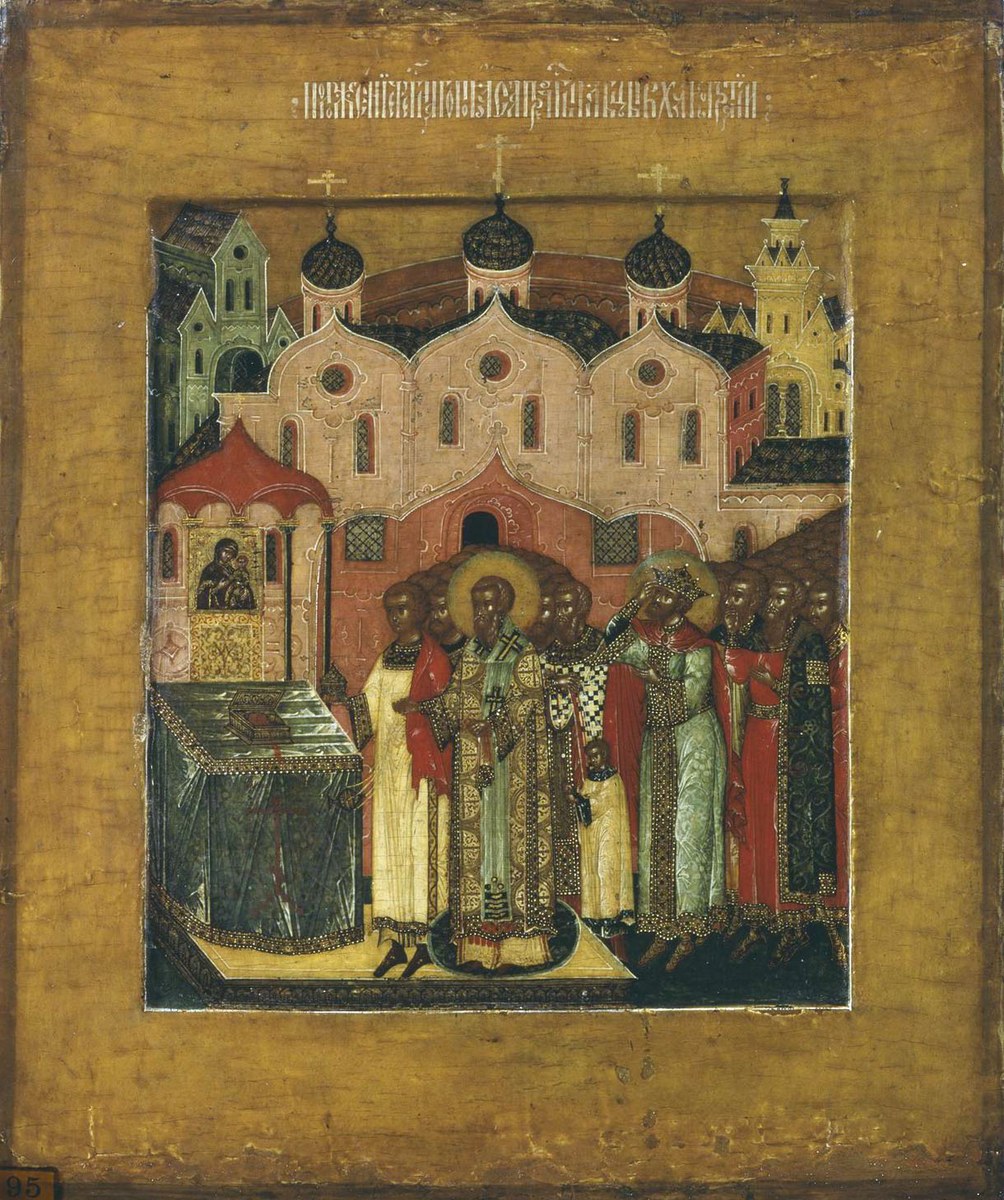
The icon of the feast is a liturgical scene. Within a domed church — often rendered, in Russian recensions, as a many-cupolaed Muscovite cathedral — the patriarch stands before the Holy Reliquary, a low casket or sarcophagus with its lid raised, and lays the Girdle within it, or lifts it out; deacons and clergy attend with books and censers, the crowned emperor and empress stand by with their court, and above the altar or in a canopy at the side an icon of the Mother of God presides over what is done for her. The relic is small and dark, and is the hardest thing in the composition to see — which is a fair description of the feast.
A second and more dramatic recension shows the healing of the empress Zoe: the hierarch bends over the open coffer and reaches with the Girdle to the empress, who is held up by her women, while the emperor kneels crowned in the foreground and the Theotokos enthroned with the Child fills the apse above.
Because the feast is one of the two "placing" feasts, its image is regularly mislabelled as the Deposition of the Robe (July 2). The rule of thumb is the object: at Blachernae a folded cloth, usually deep red, is laid down; at the Chalkoprateia a belt, dark and narrow, is laid in or lifted from the coffer.
The primary image stored here is a seventeenth-century Russian panel icon of the feast, inscribed across the top with the title of the day: the hierarch in polystavrion at the raised lid of the reliquary, the crowned emperor with his hand lifted, deacons and courtiers ranged behind, an icon of the Mother of God beneath a red canopy at the left, and the domes of the church filling the ground above.
The second image is the Miracle of the Holy Girdle by Emmanuel Tzanes (second half of the seventeenth century, Cretan school; Benaki Museum, Athens), signed at the lower left ΧΕΙΡ ΕΜΜΑΝΟΥΗΛ ΙΕΡΕΩΣ ΤΟΥ ΤΖΑΝΕ: the patriarch lays the Girdle upon the swooning empress over the open coffer, which is inscribed Η ΑΓΙΑ ΚΑΙ ΣΕΒΑΣΜΙΑ ΣΟΡΟΣ — "the holy and venerable reliquary" — while the emperor kneels in the foreground and the Platytera with angels fills the apse above, under the inscription naming the place the house of the Most Holy Theotokos. The panel is out of copyright as a seventeenth-century work; the photograph on Wikimedia Commons is separately tagged CC BY-SA 3.0 by its uploader, which licenses the photograph and not the painting.