
Gennadius I of Constantinople
Our Father among the Saints Gennadius I, Archbishop of Constantinople and Ecumenical Patriarch
Patriarch · Bishop · d. 471, at Constantinople
Commemorated 31 August — Commemoration of the Patriarch Gennadius, 17 November — Kept in Greek usage with Maximus, Patriarch of Constantinople, on the day of Gregory the Wonderworker
Gennadius was Ecumenical Patriarch of Constantinople from 458 to 471, in the reign of Leo I the Great, in the difficult generation after Chalcedon when the settlement of 451 was being contested across the East. A learned exegete before he was a bishop — a commentator on Daniel, on Genesis and on the Pauline epistles, of the Antiochene school — he is remembered chiefly as a pastor and a disciplinarian of extraordinary mildness and extraordinary firmness together: he held a synod at Constantinople that condemned simony, refused to ordain any man who did not know the Psalter by heart, and left a reputation for gentleness that survives in the anecdotes John Moschus gathered a century and a half later. He received the Robe of the Theotokos into the shrine at Blachernae, climbed the ladder of Daniel the Stylite to ordain him priest on top of his pillar, and died in 471 having warned that the Church would be troubled after him — as, under his successor Acacius, it was.
_-_икона_12312_Геннадий.png)
Presbyter and exegete
Nothing is transmitted of Gennadius' birth, family or country. He appears first as a presbyter of the church of Constantinople, and as a writer: Jerome's Latin continuator Gennadius of Marseilles, who catalogued the ecclesiastical authors of the fifth century, describes him as "a man of exact and polished speech" and lists his works. He wrote a commentary on Daniel, a commentary on Genesis, homilies and expositions on the Epistles of St Paul — of which substantial fragments survive in the Greek catenae, enough to show a sober, grammatical, Antiochene manner of reading, close to the text and impatient of allegory.
To that period also belongs a treatise against the Twelve Anathemas of Cyril of Alexandria. The fact is worth stating plainly rather than suppressing: in the years after Ephesus a great many Eastern churchmen of the Antiochene formation thought Cyril's anathemas Apollinarian in tendency, and said so; the reconciliation of 433 and then the definition of Chalcedon absorbed the dispute. Gennadius was in that company as a young man and was, as patriarch, an unwavering Chalcedonian. It is a useful reminder that the theological positions of the fifth century were still being sorted out inside the party that won.
Patriarch of Constantinople
He was raised to the throne of Constantinople in 458, succeeding Anatolius, in the first year but one of the emperor Leo I (457–474). His thirteen years fall in the hard interval between the Council of Chalcedon and the Henotikon: Egypt was in the hands of the anti-Chalcedonians after the murder of the patriarch Proterius at Alexandria, Palestine had been convulsed by the monk Theodosius, and Antioch was unquiet. Gennadius held the capital steady for Chalcedon without the violence that marked the settlement elsewhere, and Leo's famous canvass of the Eastern episcopate on the Alexandrian question — the Codex Encyclius of 458 — was conducted under his patriarchate.
His domestic government is what the Church remembered. He convened at Constantinople a local synod — usually dated to 459 — which condemned the remains of Eutychianism and, more consequentially, forbade simony: the ordination of any man for money, and the exaction of money for ordination. The synod's encyclical against simony, addressed to the metropolitans of the East and to the bishop of Rome, survives, and is one of the earliest formal conciliar acts against a corruption that would trouble the Church for the next thousand years. Its logic is Petrine and brutal: the gift of God is not purchased with money, and the man who buys it has bought the portion of Simon Magus.
He was equally strict about competence. The tradition is unanimous that he refused to ordain any candidate who could not recite the Psalter by heart, and that he required a working knowledge of the Scriptures besides. In a century when ordination was often a matter of patronage this was a reform of substance, and it is remembered as such.
The manner of the man
The stories that carried his name down to later ages are not stories of administration.
The cleric Charisius. John Moschus, in the Spiritual Meadow, has the account from monks of the monastery of Salamis: a certain Charisius, attached to the church of the holy martyr Eleutherius at Constantinople, was a man of disgraceful life and would not amend for any warning. Gennadius admonished him repeatedly, and was ignored. At last the patriarch sent one of his clergy to the shrine, to stand before the martyr's tomb and say — in the patriarch's name — "Martyr Eleutherius, your soldier is doing badly. Either correct him or cut him off." In the morning Charisius was found dead. Moschus tells it as an instance not of vindictiveness but of the reach of a bishop's prayer, and of a man who had exhausted every gentler means.
The painter and the image of Zeus. Theodore Lector transmits the second story. A painter, commissioned to write an image of Christ, gave the Saviour the features of Zeus — the long hair, the heavy brow, the frontal majesty of the pagan god. His hand at once withered. He came in terror to Gennadius, confessed what he had done, and the patriarch prayed over him and the hand was restored. The anecdote is more interesting than it looks. The Christ-type that became universal in Christian art — long-haired, bearded, frontal — is in fact descended from images of Zeus and Serapis, and the fifth century knew it and was uneasy. The story is the Church's memory of a real controversy about the sources of the sacred image, told in the only genre available to it; and it stands a long way behind the eighth-century arguments about icons.
Both anecdotes agree in their estimate of the man: mild by preference, immovable at need. The synaxarion praises him for "gentleness, forbearance, purity and abstinence," and adds the detail that his admonitions were given privately and his discipline publicly, which is the right way round.
The Robe at Blachernae, and Daniel on his pillar
Two of the great Constantinopolitan traditions of the age run through his patriarchate.
The narrative of the Deposition of the Robe of the Theotokos makes Gennadius the patriarch who, with the emperor Leo, received the relic brought from Palestine by the patricians Galbius and Candidus, examined its authenticity, and laid it up with all solemnity in the Holy Reliquary at Blachernae. The July 2 feast is the sequel; and it is a pleasing symmetry that Gennadius' own commemoration falls on August 31, the feast of the other great Marian relic of the City, the Cincture at the Chalkoprateia.
Daniel the Stylite, the Syrian who had taken up the life of Symeon on a pillar at Anaplous outside the capital, had refused all ordination. Gennadius, wishing that the stylite might offer the Eucharist where he stood, came out to the column, mounted the ladder and ordained him priest on the top of the pillar. It is one of the most memorable scenes in Byzantine hagiography, and it is characteristic of Gennadius that the accommodation was made by the patriarch and not demanded of the monk.
He is likewise named as the hierarch who set Elizabeth the Wonderworker over the convent at Constantinople in which she spent her life, and Marcian the Oikonomos, the great church-builder and steward of the Great Church, served under him.
Repose
Gennadius governed thirteen years and died in 471. The tradition — again from the Spiritual Meadow — is that toward the end he kept vigil alone in the sanctuary of the Great Church and was met there by an apparition, which told him that after his death the Church would be sorely troubled; when he asked that the trouble be spared, he was answered that it could not be, and he prayed instead to be taken before it came. He died shortly after. He was succeeded by Acacius, under whom the emperor Zeno issued the Henotikon (482) and the Church of Constantinople fell into the thirty-five-year Acacian schism with Rome — so that the warning, whatever its origin, was accurate.
Feast and commemoration
August 31 (church date; New Calendar civil August 31, Old Calendar civil September 13), the last day of the church year. Gennadius is the third commemoration of the day, after the Placing of the Cincture of the Theotokos and the hieromartyr Cyprian of Carthage; the festal office belongs to the Theotokos, and Gennadius has no proper canon in the Menaion for the day, being sung from the common of a hierarch. In Greek usage he is kept a second time on November 17 with the Patriarch Maximus.
Hymns
Troparion — Tone 4 (common of a hierarch)
O God of our fathers, who dealest with us ever according to thy gentleness: take not thy mercy from us, but by the prayers of thy hierarch Gennadius guide our life in peace.
Original translation from the Greek
Kontakion — Tone 4 (common of a hierarch)
Thou wast shown a shepherd of the flock of Christ, meek to the penitent and unbending to the corrupt, and thou didst drive the traffic in holy things from the sanctuary, O father Gennadius; wherefore we honour thee as a true hierarch of the Church of Christ.
Iconography
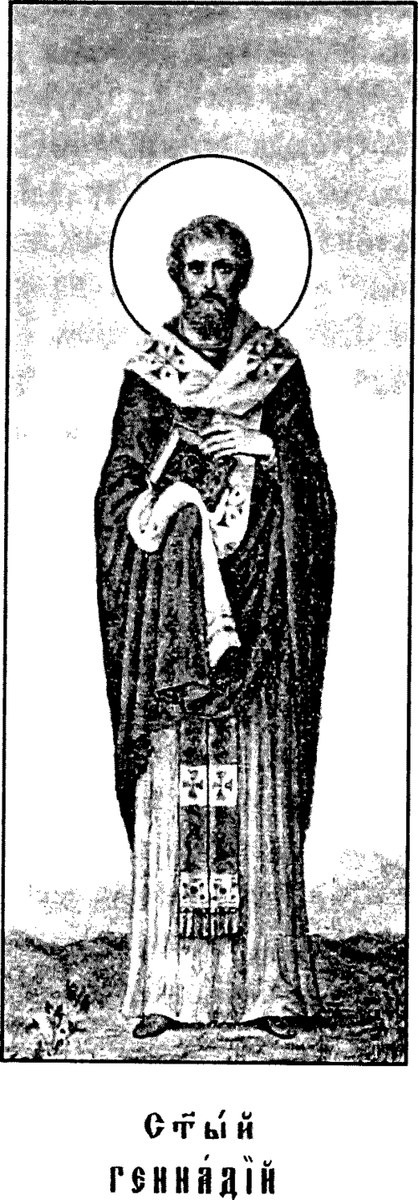
Gennadius is written as a Byzantine hierarch of the fifth century: of middle years, with a short pointed dark beard and receding hair, in the phelonion — in Russian recensions the dark polystavrion over a light sticharion — with the omophorion crossed on his breast and the epitrachelion falling to the feet. He holds a scroll rather than the Gospel book in the commonest type, the scroll being the attribute of a hierarch who is remembered as a teacher and a legislator; where the Gospel is given him he blesses with the right hand. Narrative scenes are rare, but two subjects appear in extended cycles: the patriarch ordaining Daniel the Stylite at the top of his column, mounting the ladder in his vestments — one of the more striking images in Byzantine art — and the healing of the painter's withered hand.
The image stored here is the engraved plate for August 31 from the Russian illustrated Lives of the Saints after St Dimitry of Rostov (1903–1911), plate 12312 of the August volume, inscribed СТЫЙ ГЕННАДІЙ — "Saint Gennadius": the hierarch full-length, holding a partly unrolled scroll, in omophorion and epitrachelion, standing on open ground. Its identity is secured by its place in the August volume immediately after the plate of Cyprian, the two saints of this day in their calendar order.
Disputed questions
- Not to be confused with Gennadius II Scholarius, the theologian and first Ecumenical Patriarch after the fall of Constantinople in 1453 — a different man, a thousand years later, and not commemorated on this day. Nor with Gennadius, Archbishop of Novgorod (†1505), of the Russian Bible and the campaign against the Judaizers; nor with Gennadius of Kostroma (†1565).
- The commentary against Cyril's anathemas. Its attribution to this Gennadius rests on Gennadius of Marseilles and on the catena fragments, and is generally accepted; a minority has doubted it precisely because a Chalcedonian patriarch is an awkward author for such a work. The doubt is not well founded — such treatises were common in the 430s — but it exists.
- The date of the synod against simony. The acts are usually placed in 459; the year is inferred rather than transmitted, and 458–460 is the safe range.
- A second feast. The Greek books also commemorate Gennadius, together with the Patriarch Maximus of Constantinople, on November 17, the day of Gregory the Wonderworker; this is Greek local usage and does not displace August 31, which is his day in the Slavonic and Antiochian books alike.