
Procopius the Great Martyr
The Holy and Glorious Great Martyr Procopius of Caesarea in Palestine
Great Martyr · d. 303
Commemorated 8 July — Beheading at Caesarea in Palestine, with his mother Theodosia and the twelve women
Procopius (†303) is the most celebrated of the soldier-martyrs of Palestine and one of the great martyrs of the Eastern Church. The developed passion knows him first as Neanias, a young officer of a Roman senatorial family of Jerusalem, whom Diocletian appointed to Alexandria with a commission to break the Christians there. On the road he was arrested by a vision of the Cross and the voice of the crucified Christ — a deliberate re-telling of the conversion of St Paul on the Damascus road — and returned a Christian. He was tried and tortured at Caesarea in Palestine, and in the course of his passion his pagan mother Theodosia and twelve women of senatorial rank were converted by his constancy and beheaded before him; he himself was beheaded on July 8, 303. Behind the legend stands the sober notice of Eusebius, who names a Procopius as the first to die at Caesarea in the Great Persecution; the Byzantine calendar keeps that man separately, as Procopius the Reader, on November 22.

Neanias of Jerusalem
The passion gives the great martyr's baptismal name as Procopius and his name in the world as Neanias (Νεανίας, "the young man"). He was born at Jerusalem — the Roman colony of Aelia Capitolina — into a family of the senatorial order. His father, called Christopher, was a Christian, and died while his son was still a boy; his mother Theodosia was a convinced pagan, and it was she who saw to the boy's education in the Hellenic religion and letters, at Jerusalem and then at Antioch. He grew up handsome, disciplined and ambitious, and was presented at court.
Diocletian took to him. In the year the general edicts against the Christians went out, the emperor made the young man duke of Alexandria — some recensions say proconsul — and gave him a commission with the appointment: to hunt down the Christians of Egypt, seize their assemblies, and send back to the capital those who would not sacrifice. Neanias accepted, and set out from Antioch with his troop.
The vision of the Cross
The turning point of the whole legend is placed on the road, near Apamea in Syria, at the sixth hour of the night. An earthquake shook the ground and threw down the horsemen; a light broke over them, and a voice called, "Neanias, where art thou going, and against whom dost thou lift thy hand?" When he asked who spoke, the answer came: "I am Jesus, the crucified Son of God." A cross of crystal appeared in the air before him, and out of it the voice promised that by this sign he would conquer.
The dependence on the ninth chapter of Acts is exact and evidently intended: the persecutor riding under imperial commission, the light, the fall, the reproachful question — why persecutest thou me? — and the reversal of the mission. The hagiographer has also drawn on the vision of Constantine before the Milvian Bridge, for the cross in this account is not only a call but a standard, and it is with a cross that Neanias afterwards fights. In this the passion of Procopius stands with the passions of the other soldier-martyrs, in which the imperial ideology of victory-by-the-Cross is turned back upon the empire that persecuted.
The cross of gold and silver, and the campaign
Neanias turned aside to Scythopolis and there ordered a goldsmith to make him a cross of gold and silver after the pattern of the one he had seen. When the work was done, the account relates, three names appeared engraved upon it that no hand had cut — Emmanuel at the head and Michael and Gabriel upon the arms. The goldsmith, until then a pagan, was converted by the wonder; and Neanias, still not baptised, kept the cross as his own standard.
He was then sent, or went, against a raid of Agarenes — the Arab tribes of the desert frontier — who were harrying the Palestinian countryside. Carrying his cross before the column he defeated them, and afterwards refused to give the victory to the gods of the city. Going up to Jerusalem, he told his mother plainly that he was a Christian, and would not enter the temple with her to sacrifice. It was Theodosia who denounced her own son to the emperor, and on her denunciation he was arrested and sent to Caesarea in Palestine, the provincial capital and the seat of the governor.
Trial, imprisonment and baptism
Before the governor — named in the Greek recensions Ulcian (Οὐλκίων) and in others Justus — Neanias was ordered to sacrifice. He answered by throwing down and breaking the idols that had been set before him, and was scourged, racked and burned, and thrown into the prison of the praetorium. There, the passion says, Christ appeared to him and baptised him, giving him the name Procopius — a name the hagiographer reads as progress, advance (προκοπή), the man who "goes forward" in the faith. It is at this point in the narrative that he ceases to be Neanias.
Theodosia and the twelve women
The martyrdom of the companions is the most distinctive feature of the July 8 commemoration. Twelve women of senatorial rank at Caesarea, hearing of Procopius's sufferings and seeing his constancy, came of their own accord to the gates of the praetorium and confessed themselves Christians. They were tortured and beheaded, and are kept in the synaxaria as the twelve women martyrs of Caesarea. His mother Theodosia, who had come to see her son's punishment and instead saw the women die, was converted on the spot, confessed Christ before the tribunal, and was beheaded with them. The reversal is the point of the story: the accuser becomes a martyr by the same constancy she had denounced. Some recensions add the conversion of the tribunes and part of the guard, and multiply the numbers; the twelve women and the mother are the constant core.
Martyrdom
The governor Ulcian died — struck down, the passion says, in the middle of the process — and a new governor, Flavian, took up the case. Procopius was brought out again, refused again, and was condemned to the sword. He was beheaded at Caesarea on July 8 in the year 303, the first year of the Diocletianic persecution. Christians of the city took up his body by night and buried it, and his tomb at Caesarea became a place of pilgrimage.
Relics and later cultus
The cult at Caesarea Maritima was established early and grew large; the emperor Zeno built a church over the martyr's memorial there in 484, and the sixth-century sources treat the shrine as one of the principal sanctuaries of the province. From Palestine the veneration travelled fast and far. A basilica at Gerasa (Jerash) in the Decapolis was dedicated to him in the sixth century; churches and monasteries bore his name at Antioch, in Constantinople, in Cappadocia and on Cyprus; and in the Balkans his name is fixed in the toponymy — the Serbian town of Prokuplje grew about a church of St Procopius. In the Latin West he entered the martyrologies at July 8 and, in Bohemia, his name was afterwards attached to the quite distinct eleventh- century abbot Procopius of Sázava. Portions of relics claimed for him are shown in several places, most notably at the Monastery of the Great Meteoron and in a number of Athonite houses; the tradition of their dispersal is late and not securely traceable to Caesarea.
Feast and commemoration
July 8 (church date; Old Calendar civil July 21). The commemoration is universal, and in the Greek Menaion he is styled μεγαλομάρτυς — great martyr — with the rank and the fuller service that title carries. His mother Theodosia and the twelve women of Caesarea are commemorated with him on the day and are not given a separate feast in the received calendars. In Slavic usage July 8 is a crowded day: the great martyr shares it with Procopius of Ustyug and with the appearance of the Kazan Icon of the Mother of God at Kazan in 1579, which in Russia largely eclipses the martyr. Antiochian and Greek usage keeps the day as the great martyr's, and in the Antiochian tradition he is one of the soldier-saints most frequently taken as a patronal name in the Levant. He is invoked against enemies and in danger of battle, and, from the episode of the cross of gold and silver, by metalworkers.
Hymns
Troparion — Tone 4
Thy martyr Procopius, O Lord, in his contest received an incorruptible crown from thee our God; for having thy might he cast down the tyrants, and shattered the feeble arrogance of the demons. By his prayers save thou our souls.
Original translation from the Greek
Kontakion — Tone 2
Set ablaze with divine zeal for Christ, and walled about with the strength of the Cross, thou didst cast down the raging insolence of the enemy, O Procopius, and didst raise up the honoured Church, going forward in the faith and giving light to us.
Original translation from the Greek
Iconography
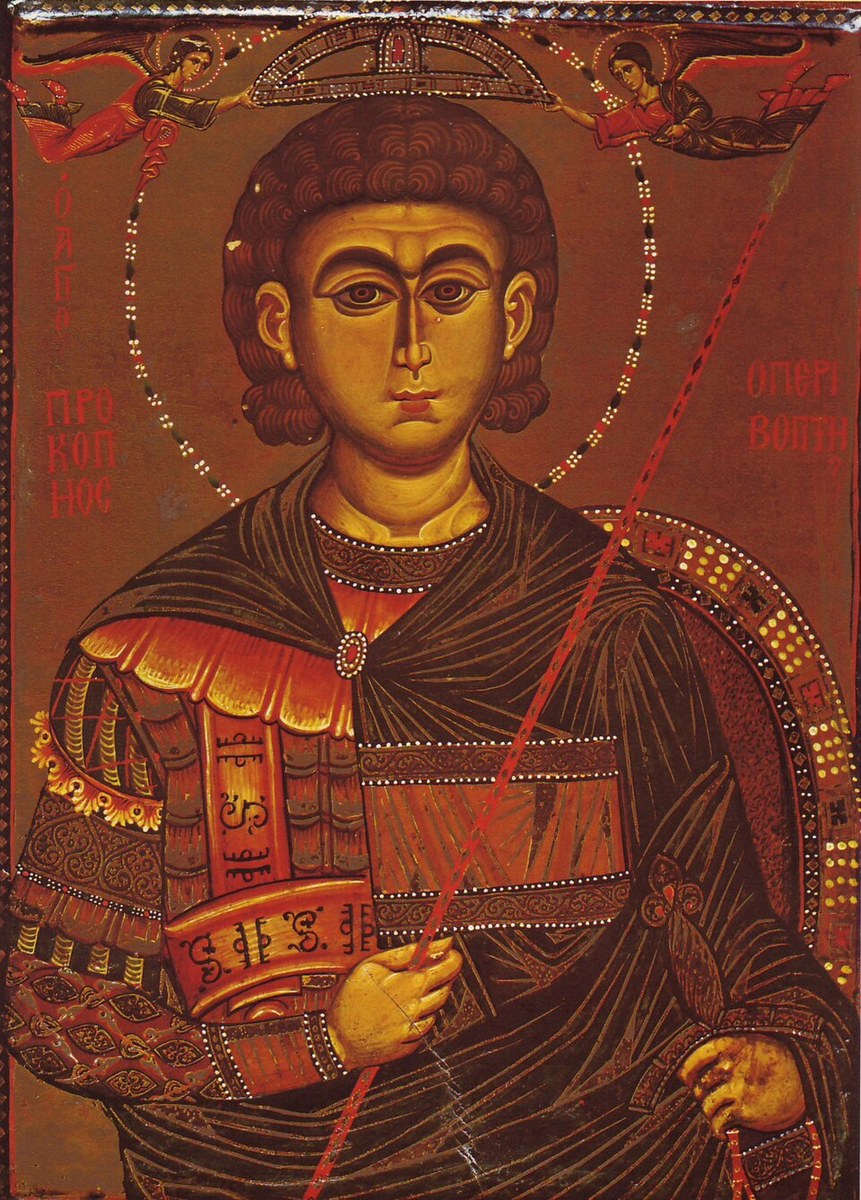
Procopius is painted as one of the warrior-saints: a young man, beardless or with the first down of a beard, with a full head of curling dark hair, in the dress of a Roman officer — cuirass or scale corselet, tunic, and a mantle fastened at the shoulder with a round clasp — holding a lance in the right hand and the hilt of a sheathed sword in the left, or a shield. In this he belongs with George, Demetrius, Theodore and Mercurius, and in the great fresco programmes of the Balkans and Cappadocia he stands among them on the lower register of the nave. Where the passion is illustrated he is shown with his cross of gold and silver bearing the three names; the cycle of his life supplies the vision on the road with the crystal cross, the goldsmith at his bench, the battle against the Agarenes, and the beheading of the twelve women with Theodosia. He is sometimes given the martyr's cross alone rather than arms, and in Russian menaion icons for July he appears at the head of the day, occasionally in civil dress.
The stored image is the thirteenth-century panel from the Monastery of St Catherine at Sinai (third quarter of the century, from the Crusader-period workshops of the monastery), inscribed Ο ΑΓ(ΙΟC) ΠΡΟΚΟΠΙΟC to the left of the head and Ο ΠΕΡΙΒΟΗΤ(ΟC) — "the renowned" — to the right. The saint is shown half-length, beardless and thick-haired, in a dark mantle over a red tunic with an ornamented sleeve and a jewelled shield behind his shoulder, holding a red lance and the sword-hilt; two flying angels above bring the martyr's crown toward his head.
Disputed questions
- The great martyr and the historical Procopius of Eusebius. Eusebius of Caesarea, an eyewitness, opens The Martyrs of Palestine with a Procopius who was the first to die in that province in the Great Persecution: a native of Scythopolis, a reader, interpreter and exorcist of the church of Jerusalem, an ascetic, taken to Caesarea and beheaded there for refusing to sacrifice and to pour libations to the four emperors. He was, in Eusebius's account, neither soldier nor officer; the date Eusebius gives is the seventh of the Macedonian month Desius, in the year 303, and the transmitted dates in the Greek and Syriac recensions differ among themselves. Modern scholarship is nearly unanimous that the soldier-martyr of the July 8 passion is a legendary elaboration of this same man — the reader of Scythopolis made into a duke of Alexandria, the refusal to sacrifice expanded by the borrowed materials of Acts 9 and of the Constantinian vision. The Byzantine Church, however, received the two accounts as two saints and keeps them on two days, and this collection follows that usage: the great martyr here on July 8, and Procopius the Reader on November 22. Neither entry asserts that they are two men; each records the identity question.
- Not to be confused with Procopius of Ustyug (†1303), the German merchant of Novgorod who became the first fool-for-Christ of the Russian land — commemorated on this same day, July 8, so that Russian day-lists carry two Procopii together and confusion is easy. The one is a Palestinian soldier-martyr of the fourth century, the other a Russian holy fool of the fourteenth; they share nothing but the name and the date.
- Not to be confused with Prokopius of Decapolis (†c. 750), the confessor against the iconoclasts, commemorated February 27, nor with Procopius of Sázava in Bohemia (†1053), whose Latin cult borrowed the great martyr's name and, in places, his iconography.
- Century of repose. His death in 303 belongs to the fourth calendar century and he is indexed here under the fourth, by the convention of this collection, though he is often styled a martyr of the third century.