
Pentecost week, day 7 · 55 days since Pascha
Leavetaking of Pentecost
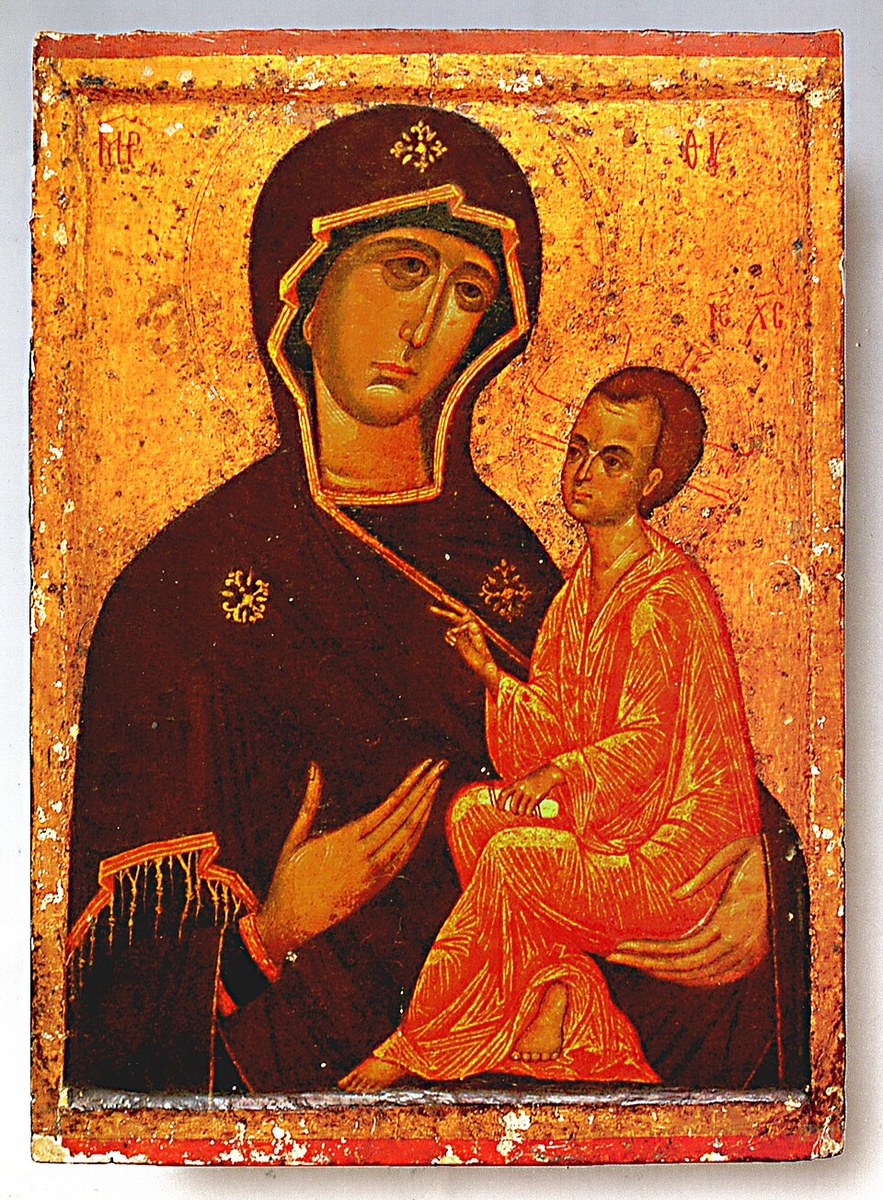
About Tikhvin Icon of the Mother of God →

Saints commemorated
-
Ven. David of Thessalonica
David was an Athonite monk of the Skete of Saint Anne who was hanged at Thessalonica on 26 June 1813 for confessing Christ before the Ottoman authorities. He came of the Kydonians of Aivali (Ayvalık) on the Asia Minor coast, a town bound to the Holy Mountain by long ties of dependency and patronage. Consumed by the desire for martyrdom that marked the Kollyvades generation, he first went to Magnesia to denounce Islam publicly and was only beaten and driven out; obtaining at length the reluctant blessing of his elder, he went to Thessalonica intending to recall an apostate monk to the faith. The Turkish authorities learned of it, arrested him, and the judge — fearing precisely that the renegade might be won back — ordered his immediate execution. He is one of the last of the Athonite new-martyrs of the Turkish period.
-
Tikhvin Icon
-
David of Thessalonica
David the Dendrite is the most beloved of the ascetics of Thessalonica and one of the best documented of the tree-dwelling hermits of the Christian East. A Mesopotamian by birth who came west as a young monk to the monastery of the holy martyrs Theodore and Mercurius outside the city walls, he refused to be made abbot and instead climbed into an almond tree beside the church, where he lived exposed to sun, frost and rain for three years until an angel bade him come down. From the cell he then occupied he healed, exorcised, counselled and prophesied for decades. In extreme old age he was sent as the city's ambassador to the emperor Justinian at Constantinople to plead that Thessalonica not be stripped of the prefecture of Illyricum; there he carried live coals and incense in his bare hands before the emperor and the senate without being burned, and won his city's cause. He died on the voyage home, about 540, within sight of the Thessalonian shore, having accomplished exactly the "one last work of love" the angel had foretold.
-
Dionysius of Suzdal
Dionysius was the cave-dwelling founder of the Pechersky (Caves) monastery of the Ascension at Nizhny Novgorod, the teacher of a generation of northern ascetics, and one of the most formidable churchmen of the age of Sergius of Radonezh and Dmitry Donskoy. Tonsured at the Kiev Caves and coming north to the Volga with an icon of the Mother of God from that monastery, he dug himself a cave in the bank above Nizhny Novgorod about 1335 and gathered a brotherhood that produced Saints Euthymius of Suzdal and Macarius of Unzha. Made bishop in 1374, he preached against the Strigolniki, survived a Tatar arrow, and stood almost alone against the attempt of Grand Prince Dmitry to impose his confessor Mityai on the metropolitan throne. He went twice to Constantinople, was raised to archbishop in 1382, and in 1384 was named metropolitan of Russia by the Patriarch — but on his way home was seized and imprisoned at Kiev by Prince Vladimir Olgerdovich, and died there on 15 October 1385, buried in the cave of Saint Anthony where his own monastic life had begun.
-
John of Gothia
John, bishop of the Goths of the Crimea, is one of the very few named figures through whom the history of the Gothic Church in the Crimea can be seen at all. Born at Partenit under the mountain of Ayu-Dag on the southern Crimean coast, he was consecrated bishop about 758 — not in the Empire, where the hierarchy was then iconoclast under Constantine V Copronymus, but in Georgia, which had kept clear of the heresy — and governed the Gothic see of Doros in the Crimean mountains. In 787 he led his people in a revolt against the Khazars, who then held the peninsula: the rising took the fortress of Doros and the mountain passes, but it collapsed within the year, and John was imprisoned at Phoulloi. He escaped across the Black Sea to Amastris in Paphlagonia, lived there some four years, and died there about 791, having foretold his own death within forty days of hearing that the Khazar ruler was dead. His relics were carried home to Partenit, to the church of the Apostles Peter and Paul which he had built at the foot of Ayu-Dag.
-
Tikhon of Lukhov
Tikhon of Lukhov (†16 June 1503), called Timothy in the world, was a nobleman in military service in the Grand Duchy of Lithuania who in 1482 left his country rather than accept the union with Rome, crossing into Muscovy in the train of Prince Feodor Belsky. He refused the rewards of his new service, gave away what he had, took the habit with the name Tikhon, and settled in the forest of the Lukh country on the border of the Kostroma land. There he lived by the work of his hands — a skilled copyist of books and a turner of wooden vessels — refused ordination to the priesthood out of humility, and formed with two companions, Photius and Gerasim, the community that became the Nikolo-Tikhonov monastery. He died so poor that his disciples had nothing to bury him in until the bishop of Suzdal sent a vestment. His relics were found incorrupt in 1569, and the healings that followed established the veneration of one of the most-loved wonderworkers of the Kostroma and Ivanovo country.
British Isles and Ireland
- Translation of the relics of St. Brannock of Braunton
- St. Corbican (8th C)
Troparia & kontakia
Apolytikion — Tone 4 (common of a monastic saint)
A dweller of the wilderness and an angel in the body wast thou shown to be, O God-bearing Father Tikhon: by fasting, vigil and prayer thou didst receive heavenly gifts, and thou healest the sick and the souls of them that run to thee with faith. Glory to him who gave thee strength, glory to him who crowned thee, glory to him who works healings through thee for all.
Kontakion — Tone 8
Let us hasten, O ye people, to the Virgin Theotokos and Queen, giving thanks to Christ our God; and gazing with compunction upon her wonderworking icon, let us fall down and cry out to her: O Mother of God, who hast come from the lands of the East into the land of Russia and hast brought with thee thy grace and thy compassions, save us who flee to thee from every calamity and affliction: rejoice, O Virgin, salvation of the world.
Kontakion — Tone 2 (common of a venerable father)
Having wounded thy flesh by abstinence and enlightened thy soul by unsleeping prayer, thou wast shown forth, O father David, a dwelling-place of the Spirit; wherefore, standing now before the Master of all, entreat Him to grant remission of sins unto us who honour thy memory.
Kontakion — Tone 8 (common of a hierarch and ascetic)
Having hollowed out for thyself a cave in the hill and thy heart for a dwelling of the Holy Spirit, thou didst gather a flock in the wilderness and shepherd it as a father, and didst keep the Church's order unbent before princes, O holy hierarch Dionysius; wherefore, having finished thy course in bonds, thou hast received the crown, and dost pray for our souls.
Synaxarion
With the David of old thou art joined, O new David, for thou didst lay low the Goliath of the passions. On the twenty-sixth, David passed through the gates of life.
Troparion — Tone 4
Today, as a most radiant sun, thy most honourable icon hath shone forth upon us in the air, O Sovereign Lady, enlightening the world with the rays of thy mercy; which great Russia, having reverently received from on high as a divine gift, doth glorify thee, O Mother of God, the Mistress of all, and doth joyfully magnify Christ our God who was born of thee. Pray to Him, O Lady, Queen and Mother of God, that He may preserve all the cities and lands of the Christians unharmed from every assault of the enemy, and may save them that in faith bow down before His divine image and thy most pure likeness, O Virgin who knewest not wedlock.
Troparion — Tone 4 (common of a new venerable-martyr)
Having taken up the ascetic's struggle, thou didst add to it the martyr's contest, O David; for despising the fleeting life, thou didst confess Christ before the ungodly and receive the crown by the noose. Wherefore, O new venerable-martyr, entreat Him that our souls may be saved.
Troparion — Tone 8 (common of a venerable father)
In thee, O Father, was that which is according to the image preserved unfailing; for taking up the Cross thou didst follow after Christ, and by thy deeds thou didst teach us to overlook the flesh, since it passeth away, but to care for the soul, a thing immortal. Wherefore, O venerable David, thy spirit rejoiceth together with the angels.
Troparion — Tone 4 (common of a hierarch)
O God of our fathers, who dealest with us ever according to Thy gentleness: take not Thy mercy from us, but by the prayers of Thy hierarch Dionysius direct our life in peace.
Troparion — Tone 4 (common of a hierarch and confessor)
O God of our fathers, who dealest with us ever according to Thy gentleness: take not Thy mercy from us, but by the prayers of Thy hierarch John guide our life in peace; for thou, O holy father, wast a rule of faith to thy people, and didst not bow before the enemies of the holy icons.
Readings
Epistle
Romans 1.7-12
7To all that be in Rome, beloved of God, called to be saints: Grace to you and peace from God our Father, and the Lord Jesus Christ. 8First, I thank my God through Jesus Christ for you all, that your faith is spoken of throughout the whole world. 9For God is my witness, whom I serve with my spirit in the gospel of his Son, that without ceasing I make mention of you always in my prayers; 10Making request, if by any means now at length I might have a prosperous journey by the will of God to come unto you. 11For I long to see you, that I may impart unto you some spiritual gift, to the end ye may be established; 12That is, that I may be comforted together with you by the mutual faith both of you and me.
Gospel
Matthew 5.42-48
42Give to him that asketh thee, and from him that would borrow of thee turn not thou away. 43Ye have heard that it hath been said, Thou shalt love thy neighbour, and hate thine enemy. 44But I say unto you, Love your enemies, bless them that curse you, do good to them that hate you, and pray for them which despitefully use you, and persecute you; 45That ye may be the children of your Father which is in heaven: for he maketh his sun to rise on the evil and on the good, and sendeth rain on the just and on the unjust. 46For if ye love them which love you, what reward have ye? do not even the publicans the same? 47And if ye salute your brethren only, what do ye more than others? do not even the publicans so? 48Be ye therefore perfect, even as your Father which is in heaven is perfect.