
Friday 16 July 2027
Hieromartyr Athenogenes, Bishop of Heracleopolis
Friday of the 4th week after Pentecost
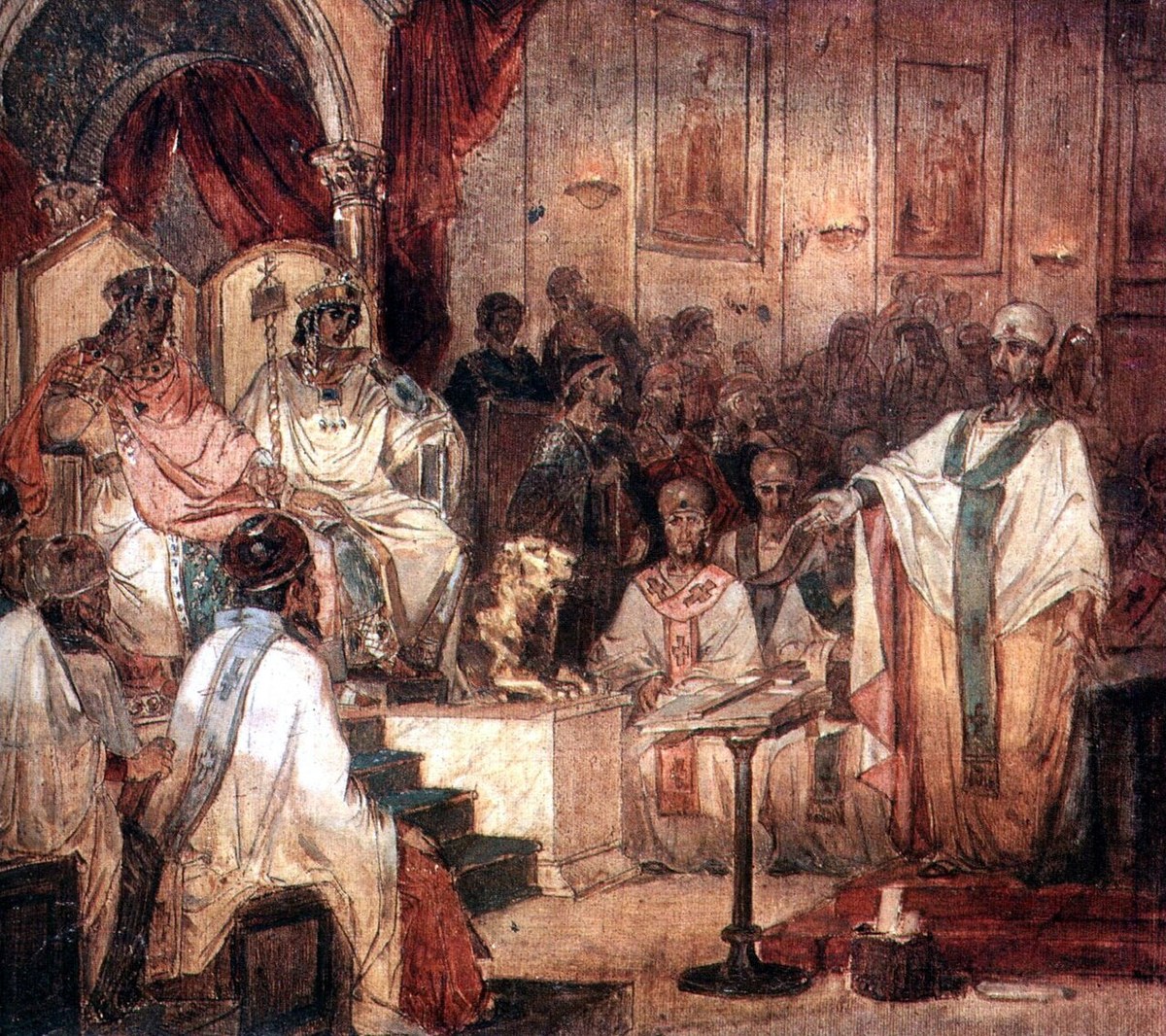
About Commemoration of the Fourth Ecumenical Council →

Saints commemorated
-
Saint of the day
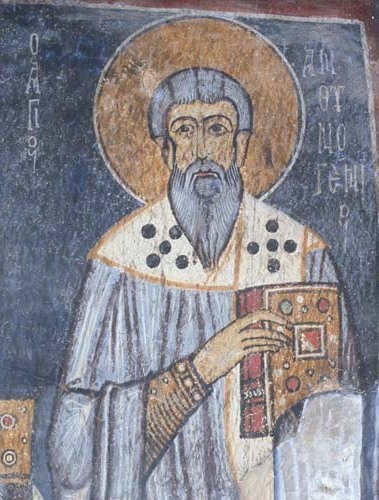
Hieromartyr Athenogenes, Bishop of Heracleopolis
Athenogenes was a bishop — in the older and more precise notices a chorepiskopos, a country-bishop — of Pedachthoe, a small place in Armenia Minor within the territory of Sebastea, who was burned alive with ten of his disciples in the Great Persecution, about the years 303–311. He is one of the very few martyrs of the fixed calendar whose passion may rest on the wording of an actual court record, and he is remembered for two things besides his death: the hymn he is said to have left his companions as he went to the fire — which a long tradition, following Nikodemos the Hagiorite, identifies with the evening hymn Phos Hilaron, "O Gladsome Light" — and the deer of Pedachthoe, which by the account of his synaxarion came down each year with her fawn to his shrine on the day of his memory. His witness is anchored in a single sentence of Basil the Great, who appeals to "the hymn of Athenogenes" as evidence of what the martyrs believed about the Holy Spirit.
-
Antiochus the Physician of Sebaste
Antiochus was a physician of Sebaste in Cappadocia and, by the tradition of the synaxaria, the brother of the Martyr Plato of Ancyra, from whom he learned the faith. He practised his art without fee, treating the sick of the cities of Cappadocia and Galatia and preaching the Gospel as he went, until he was arrested in the persecution of Diocletian by the governor Adrianos and refused to sacrifice. Cast into a cauldron of boiling water he was unhurt; wild beasts loosed on him lay down at his feet; and at his prayer, the account says, the idols of the place fell to dust. He was at last beheaded — and with him Cyriacus, one of the executioners, who confessed Christ at the sight and received the sword beside the man he had been sent to kill. The two were buried together. His memory is July 16.
-
Ennatha, Valentina and Paula
Ennatha, Valentina and Paula were three Christian virgins of Palestine martyred at Caesarea in the year 308, during the Great Persecution under Maximin, when the cruel governor Firmilian was putting the Christians of the province to death. Their passion is recorded by the eyewitness Eusebius of Caesarea in his Martyrs of Palestine. Ennatha (or Enniatha), a virgin of Gaza, was scourged and cruelly tormented for confessing Christ; Valentina, a virgin of Caesarea, brought to the altar to sacrifice, kicked it over and overthrew the fire upon it, and for this was tortured savagely; and the two were then burned together in one fire. Paula, a third, was beheaded. They are commemorated on February 10.
-
Faustus the Martyr
Faustus is a martyr of the persecution of Decius (249–251) of whom the synaxarion transmits almost nothing except the manner of his death, which is unforgettable: arrested for his Christian activity and refusing to renounce Christ, he was cruelly tortured and then nailed to a cross, and lived upon it for five days, at the end of which — blessing and giving thanks to God — he gave up his spirit. The Greek synaxaristis states plainly that his country and family are unknown. He is commemorated on July 16.
-
Julia of Carthage
Julia was a Christian girl of a good family of Carthage who lost everything in the sack of her city by barbarians, was sold into slavery, and served a pagan merchant with such patience, chastity and steadiness in prayer and fasting that her master came to prefer her to all his household — and yet could not move her an inch towards his gods. Carried with him on a trading voyage from Syria towards Gaul, she was put ashore, or taken from the ship, at Corsica, where the people were keeping a pagan festival; when she refused to join it and confessed herself a Christian she was tortured and crucified. Monks from a neighbouring island recovered her body; her relics were translated in the eighth century to Brescia in Lombardy, where the great monastery of Santa Giulia bears her name. She is one of the very few Western martyrs kept on the Byzantine fixed calendar, and one of the still fewer women whom the tradition records as dying on a cross. Corsica honours her as its patroness. She is commemorated on July 16 in the East and on May 22 in the West.
-
Martyrs of Pisidia
A great company of martyrs beheaded in Pisidia, in the highlands of southern Asia Minor, whose number the manuscripts give as one thousand and fifteen and, in another reading, as fifteen thousand. Beyond the place, the manner of their death and the number, the synaxarion transmits nothing whatever: no names, no emperor, no magistrate, no year. They are commemorated on July 16.
British Isles and Ireland
- St. Helier, missionary and Protomartyr of Jersey (560)
- St. Sinach MacDara (6th C)
Troparia & kontakia
Apolytikion
Most glorified art Thou, O Christ our God, who hast set our Fathers as beacons upon the earth, and by them hast guided us all into the true faith: O greatly merciful One, glory to Thee.
Apolytikion — Tone 4
Sharing in the ways of the Apostles and seated on their thrones, thou didst find in thy labours, O God-inspired one, the path to divine contemplation; wherefore, rightly dividing the word of truth, thou didst contend for the faith even unto blood, O hieromartyr Athenogenes: intercede with Christ God that our souls may be saved.
Apolytikion — Tone 4
Thy lamb Julia crieth out to Thee with a loud voice, O Jesus: I love Thee, my Bridegroom, and in seeking Thee I contend; I am crucified with Thee, and buried with Thee in Thy baptism; I suffer for Thy sake, that I may reign with Thee; I die for Thee, that I may live in Thee. Receive me as a spotless sacrifice offered to Thee in love; and by her prayers, O merciful One, save Thou our souls.
Kontakion
The preaching of the Apostles and the definitions of the Fathers have sealed the one faith of the Church; and she, wearing the garment of truth woven from the theology that comes from above, rightly divides and glorifies the great mystery of godliness.
Kontakion — Tone 2
Taking no payment for thy healing, thou didst give freely what thou hadst freely received, O wise Antiochus, and didst preach Christ to them thou madest whole; wherefore the fire and the beasts could not touch thee, and thine own slayer was taken captive to the faith. Entreat for us who honour thy memory.
Kontakion — Tone 4
Thou didst go up to the fire as to a feast, bearing thy children with thee, O wise Athenogenes; and leaving to thy friends the song of thanksgiving thou hadst sung, thou didst pass over into the unwaning Light: with thy ten disciples entreat for us who honour thee.
Troparion — Tone 4
Thy martyr Antiochus, O Lord, in his contest received the crown of incorruption from Thee our God; for having Thy strength he cast down the tyrants and shattered the feeble insolence of the demons: by his prayers save Thou our souls.
Troparion — Tone 4
Thy lambs cry out to thee with a loud voice, O Jesus: We thy virgins run after the fragrance of thy myrrh; for wounded are we by love of thee. Keep us in thy heavenly bridal chamber, O Saviour, together with the wise virgins, who by thy grace do glorify thee.
Troparion — Tone 4
Thy martyr Faustus, O Lord, in his contest received the crown of incorruption from Thee our God; for having Thy strength he cast down the tyrants and shattered the feeble insolence of the demons: by his prayers save Thou our souls.
Troparion — Tone 4
Thy martyrs, O Lord, in their contest received incorruptible crowns from Thee our God; for possessed of Thy strength they cast down the tyrants and shattered the feeble insolence of the demons: by their prayers, O Christ God, save Thou our souls.
Readings
Epistle
Romans 11.25-36
25For I would not, brethren, that ye should be ignorant of this mystery, lest ye should be wise in your own conceits; that blindness in part is happened to Israel, until the fulness of the Gentiles be come in. 26And so all Israel shall be saved: as it is written, There shall come out of Sion the Deliverer, and shall turn away ungodliness from Jacob: 27For this is my covenant unto them, when I shall take away their sins. 28As concerning the gospel, they are enemies for your sakes: but as touching the election, they are beloved for the fathers’ sakes. 29For the gifts and calling of God are without repentance. 30For as ye in times past have not believed God, yet have now obtained mercy through their unbelief: 31Even so have these also now not believed, that through your mercy they also may obtain mercy. 32For God hath concluded them all in unbelief, that he might have mercy upon all. 33O the depth of the riches both of the wisdom and knowledge of God! how unsearchable are his judgments, and his ways past finding out! 34For who hath known the mind of the Lord? or who hath been his counsellor? 35Or who hath first given to him, and it shall be recompensed unto him again? 36For of him, and through him, and to him, are all things: to whom be glory for ever. Amen.
Gospel
Matthew 12.1-8
1At that time Jesus went on the sabbath day through the corn; and his disciples were an hungred, and began to pluck the ears of corn, and to eat. 2But when the Pharisees saw it, they said unto him, Behold, thy disciples do that which is not lawful to do upon the sabbath day. 3But he said unto them, Have ye not read what David did, when he was an hungred, and they that were with him; 4How he entered into the house of God, and did eat the shewbread, which was not lawful for him to eat, neither for them which were with him, but only for the priests? 5Or have ye not read in the law, how that on the sabbath days the priests in the temple profane the sabbath, and are blameless? 6But I say unto you, That in this place is one greater than the temple. 7But if ye had known what this meaneth, I will have mercy, and not sacrifice, ye would not have condemned the guiltless. 8For the Son of man is Lord even of the sabbath day.