
Commemoration of the Fourth Ecumenical Council
The Commemoration of the Holy Six Hundred and Thirty God-bearing Fathers of the Fourth Ecumenical Council, gathered at Chalcedon in the year 451
Kept 16 July — The memory of the 630 Fathers who met at Chalcedon from October to November 451, received the Tome of Leo, and defined the two natures of Christ, Sunday nearest 07 16
On July 16 the Church keeps the memory of the six hundred and thirty God-bearing Fathers who assembled at Chalcedon, across the water from Constantinople, in October and November of the year 451, under the Emperor Marcian and the Empress Pulcheria, in the largest and best documented of all the councils of the undivided Church. Meeting two years after the violent synod at Ephesus that the Church calls the Robber Council, at which the archbishop of Constantinople Flavian had been beaten and deposed and died of it, the Fathers received the Tome of Pope Leo the Great, condemned the archimandrite Eutyches who had confessed "two natures before the union, one after," deposed Dioscorus of Alexandria, and set out the Definition of Chalcedon: one and the same Christ, Son, Lord, Only-begotten, made known in two natures, without confusion, without change, without division, without separation, the property of each nature preserved and concurring in one Person and one hypostasis. The Definition is the hinge of Orthodox Christology and the ground of everything the later councils built; it is also the point at which the ancient Churches of Egypt, Syria and Armenia parted from the imperial Church, a division not healed to this day.

After Ephesus: the question the third council left open
The Council of Ephesus in 431 had vindicated Cyril of Alexandria against Nestorius and confessed the Virgin as Theotokos, and the Formula of Reunion of 433 had brought Alexandria and Antioch to a common statement. But the terms in which Cyril had won — above all the phrase he believed to be Athanasius's, the one incarnate nature of God the Word — could be pressed in a direction he had not intended. If there is one nature after the union, in what sense is the Saviour still of one substance with us? The Antiochene tradition had always insisted on the integrity of the manhood; Alexandria on the singleness of the subject. After Cyril's death in 444 the question came to a head in the person of an old and revered archimandrite of Constantinople, Eutyches, godfather to the eunuch Chrysaphius who governed the palace of Theodosius II.
Eutyches, Flavian, and the Robber Council of 449
Summoned in 448 before the synodos endemousa of Constantinople under Flavian, Eutyches would not say that Christ is consubstantial with us according to the manhood, and confessed "two natures before the union, one nature after the union." He was deposed. He appealed to Rome and to Alexandria, and Chrysaphius obtained a new council at Ephesus in August 449 under Dioscorus, Cyril's successor. That assembly restored Eutyches, deposed Flavian and the Antiochene bishops, refused to allow the reading of the letter Leo had sent, and was carried through with soldiers and monks in the church. Flavian was assaulted in the proceedings and died within days on the road into exile. Leo, hearing what had happened, named it the latrocinium — the Robber Council — and the name has stuck.
Everything then turned on the death of an emperor. Theodosius II was thrown from his horse in July 450; his sister Pulcheria, who had been in eclipse, took the government, married the soldier Marcian, executed Chrysaphius, brought Flavian's body back to the capital for honourable burial, and summoned a new council.
The convocation, and the six hundred and thirty
The bishops were called first to Nicaea and then, so that the court could watch the proceedings, to Chalcedon, to the basilica of the Great Martyr Euphemia on the Asian shore. They met from 8 October to 1 November 451, in seventeen sessions, with imperial commissioners presiding over the order of business and papal legates present in the first rank — the only one of the first four councils at which Rome was properly represented from the beginning. The number transmitted by the acts and repeated in every synaxarion is six hundred and thirty, and it is by that number that the Church names them, as she names the three hundred and eighteen of Nicaea and the hundred and fifty of Constantinople. Among the Fathers were Anatolius of Constantinople, Flavian's successor; Juvenal of Jerusalem, who abandoned Dioscorus in the first session; Maximus of Antioch; Theodoret of Cyrrhus and Ibas of Edessa, restored after making their peace with the memory of Cyril; and Dioscorus of Alexandria, who was tried and deposed — for his conduct at the Robber Council and his contempt of the summons, and not, as the acts are careful to leave standing, for a formal heresy.
The Tome of Leo and the Definition of the two natures
The council's dogmatic labour was to hold together what the two great traditions had each defended. The Tome of Leo — the letter to Flavian that the Robber Council had refused to hear — was read out, and the bishops, examining it against Cyril's letters, acclaimed it in the words the acts preserve: Peter has spoken thus through Leo. Where the Tome seemed to divide the Person by speaking of each "form" doing what is proper to it, the Illyrian and Palestinian bishops objected until they were satisfied from Cyril himself.
The Definition was then drawn. It confesses one and the same Son, perfect in Godhead and perfect in manhood, truly God and truly man of a rational soul and body, consubstantial with the Father according to the Godhead and consubstantial with us according to the manhood, like us in all things save sin; begotten of the Father before the ages, and in the last days born of the Virgin Mary, the Theotokos, according to the manhood; made known in two natures (ἐν δύο φύσεσιν) — without confusion, without change, without division, without separation — the difference of the natures being in no way annulled by the union, but the property of each preserved and concurring in one Person and one hypostasis. The four adverbs are the council's contribution to the vocabulary of the faith, and they work negatively on purpose: they fence the mystery rather than explain it.
Euphemia the All-Praised
The tradition of the Church attaches to this council one of the most celebrated of its miracles. The Fathers, divided between the Orthodox and the party of Dioscorus, wrote out their two confessions, and laid both scrolls in the reliquary of the Great Martyr Euphemia in whose church they sat; and when the shrine was opened after prayer and sealed watching, the martyr held the Orthodox definition in her right hand and the heretical scroll lay at her feet. The Church keeps this miracle as a feast of its own on July 11, five days before the fixed memory of the council itself — the two commemorations standing together in the middle of July as the calendar's memorial of Chalcedon.
The canons, and Canon 28
Thirty canons are transmitted. They regulate ordination and the moveability of clergy, forbid the ordination of anyone without a title to a particular church, subject monasteries to the local bishop, and forbid clergy to enter the secular administration. Canon 28 is the famous one: it confirms to the see of Constantinople the privileges granted by the third canon of the Second Council and grants it jurisdiction over the metropolitans of Pontus, Asia and Thrace, on the express ground that the city is New Rome, honoured with the empire and the senate. The papal legates protested; Leo refused to confirm it, while accepting all the council's doctrine; and the canon has been at the root of the long dispute over the order of the patriarchal sees ever since.
The Antiochian dimension
Chalcedon is, in one sense, the vindication of the Antiochian theological instinct. It was Antioch that had always insisted on the completeness of the humanity and the reality of the economy in the flesh, and the Definition's consubstantial with us according to the manhood and its refusal to let the two natures be confused are that insistence made conciliar. Theodoret and Ibas, the surviving representatives of the Antiochene school, were restored to their sees by the council — a decision the Fifth Council would partly revisit in the affair of the Three Chapters. Maximus of Antioch sat as patriarch, and the council's Canon 2 of the earlier assembly, confirmed here, secured the Orient its own administrative sphere.
The cost was also felt at Antioch. Large parts of Syria — the monasteries above all, and the Syriac-speaking countryside — did not accept the Definition, and the Church of Antioch entered the long period of parallel hierarchies, Chalcedonian and non-Chalcedonian, out of which the Greek Orthodox Patriarchate of Antioch and the Syriac Orthodox Church both descend. The Antiochian Orthodox tradition therefore keeps this council with a double sense: as the definitive confession of the faith, and as the beginning of a division among Christians of the same city, the same language and the same martyrs, for whose healing the Church still prays.
Reception, and the Churches that did not receive it
Egypt rejected the council almost entire, and the Coptic Church has kept Dioscorus's memory as a saint; Armenia, absent through the Persian war of the same year, never received it; much of Syria and Ethiopia followed. The emperors spent the next two centuries trying to recover them — by the Henotikon of Zeno, by the Fifth Council's condemnation of the Three Chapters, by monothelitism — and every attempt cost the Church something and recovered nobody. Modern theological dialogue has produced agreed statements finding that the Orthodox and the Oriental Orthodox confess the same faith in different terminologies, without the formal communion being restored. In the Byzantine liturgical books the council is confessed without qualification: the Fathers of Chalcedon are the God-bearing Fathers, and their Definition is read as the Church's own voice.
Feast and commemoration
July 16 (church date; New Calendar civil July 16, Old Calendar civil July 29). The fixed notice is old: the Synaxarion of Constantinople carries the memory of the holy and ecumenical Fourth Council on this day, and the Slavonic menologia keep it here still — the calendars of the Moscow Patriarchate list "the memory of the holy Fathers of the Fourth Ecumenical Council (451)" among the fixed commemorations of July 16, beside the hieromartyr Athenogenes. That is the placement this corpus follows, and it is the reason the commemoration is entered here as a fixed feast.
The Byzantine typikon, however, prefers to sing the Fathers on a Sunday, and here the usages differ and must not be conflated:
- Greek usage appoints the office of the Fathers of the Fourth Ecumenical Council to the Sunday falling between 13 and 19 July — that is, the Sunday nearest July 16 — with the apolytikion and kontakion of the Fathers sung at the Liturgy. This is recorded in the frontmatter as the movable rule the Sunday nearest 16 July; the Sunday observance belongs to the movable sweep of this corpus, not to the fixed day.
- Slavonic usage keeps on that same Sunday the memory of the Fathers of the first six Ecumenical Councils — a wider commemoration that absorbs the Fourth — while retaining the fixed July 16 notice of the Fourth Council in the menologion.
- Some Greek day-lists for July 16 accordingly show no council commemoration at all on the fixed date, since for them the whole observance has migrated to the Sunday; the Greek synaxaristis for the day instead notes Euxitheos (Eudoxius), metropolitan of Thessalonica, who took part in the council, and Anastasius of Thessalonica, his predecessor.
The office, where it is sung, is that of the Holy Fathers: the readings of hierarchs, the apolytikion Most glorified art Thou, O Christ our God, and — in Greek parish practice — the reading of the Symbol of Faith with an explanation of the council's work. The Antiochian Archdiocese notes the commemoration in its calendar without proper festal propers.
A note on the schema. As with the Second Ecumenical Council, the project's constitution offers no feast_type for a commemoration of the Fathers of a council; theotokos-synaxis is used as the corpus's interim generic synaxis value, exactly as in that entry, and no new term is minted here. The standing question at the project's record of open questions covers it.
Hymns
Apolytikion
Most glorified art Thou, O Christ our God, who hast set our Fathers as beacons upon the earth, and by them hast guided us all into the true faith: O greatly merciful One, glory to Thee.
Kontakion
The preaching of the Apostles and the definitions of the Fathers have sealed the one faith of the Church; and she, wearing the garment of truth woven from the theology that comes from above, rightly divides and glorifies the great mystery of godliness.
Original translation from the Greek
Appointed readings
Epistle — Hebrews 13:7–16
7Remember them which have the rule over you, who have spoken unto you the word of God: whose faith follow, considering the end of their conversation. 8Jesus Christ the same yesterday, and to day, and for ever. 9Be not carried about with divers and strange doctrines. For it is a good thing that the heart be established with grace; not with meats, which have not profited them that have been occupied therein. 10We have an altar, whereof they have no right to eat which serve the tabernacle. 11For the bodies of those beasts, whose blood is brought into the sanctuary by the high priest for sin, are burned without the camp. 12Wherefore Jesus also, that he might sanctify the people with his own blood, suffered without the gate. 13Let us go forth therefore unto him without the camp, bearing his reproach. 14For here have we no continuing city, but we seek one to come. 15By him therefore let us offer the sacrifice of praise to God continually, that is, the fruit of our lips giving thanks to his name. 16But to do good and to communicate forget not: for with such sacrifices God is well pleased.
Gospel — John 17:1–13
1These words spake Jesus, and lifted up his eyes to heaven, and said, Father, the hour is come; glorify thy Son, that thy Son also may glorify thee: 2As thou hast given him power over all flesh, that he should give eternal life to as many as thou hast given him. 3And this is life eternal, that they might know thee the only true God, and Jesus Christ, whom thou hast sent. 4I have glorified thee on the earth: I have finished the work which thou gavest me to do. 5And now, O Father, glorify thou me with thine own self with the glory which I had with thee before the world was. 6I have manifested thy name unto the men which thou gavest me out of the world: thine they were, and thou gavest them me; and they have kept thy word. 7Now they have known that all things whatsoever thou hast given me are of thee. 8For I have given unto them the words which thou gavest me; and they have received them, and have known surely that I came out from thee, and they have believed that thou didst send me. 9I pray for them: I pray not for the world, but for them which thou hast given me; for they are thine. 10And all mine are thine, and thine are mine; and I am glorified in them. 11And now I am no more in the world, but these are in the world, and I come to thee. Holy Father, keep through thine own name those whom thou hast given me, that they may be one, as we are. 12While I was with them in the world, I kept them in thy name: those that thou gavest me I have kept, and none of them is lost, but the son of perdition; that the scripture might be fulfilled. 13And now come I to thee; and these things I speak in the world, that they might have my joy fulfilled in themselves.
Iconography
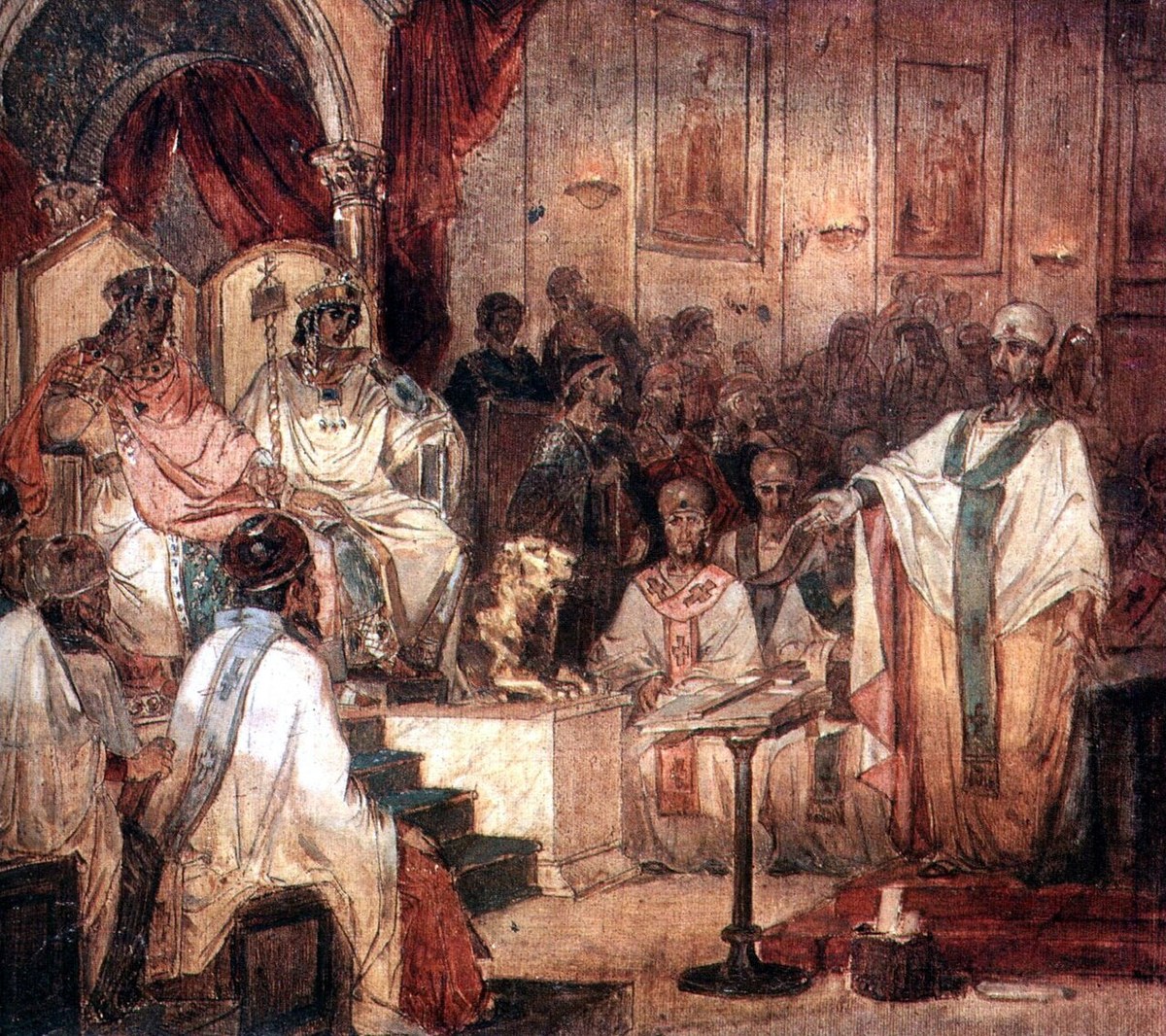
The councils have a single settled composition, and Chalcedon is painted in it: the synod in session, bishops ranked in a curve or in two facing tiers, vested in phelonion and omophorion with scrolls in their hands; at the centre, raised on the throne, the open Gospel book — the hetoimasia — declaring whose authority the assembly exercises; the emperor to one side, and beneath the Fathers' feet the condemned in disorder, their scrolls scattered. The features proper to the Fourth Council are two: the imperial pair, Marcian and Pulcheria, enthroned together, since it is their council; and, in the fuller cycles, the shrine of St Euphemia with the two scrolls, the martyr holding the Orthodox definition in her hand. Where the seven councils are painted in series along a narthex — as at the Athonite and Balkan katholika — Chalcedon is the fourth in the row, recognisable by the pair of thrones.
No pre-1900 Byzantine image of the council has been secured for this entry; the search of the digitised manuscript and fresco material returned only Western council cycles (the Nuremberg Chronicle woodcut of 1493, the St Gallen library ceiling) and the painting stored here. The stored image is V. I. Surikov's Fourth Ecumenical Council of 1876, one of the four council compositions he executed for the Cathedral of Christ the Saviour in Moscow: the emperor and empress enthroned at the left beneath the canopy, the ranks of bishops behind, a hierarch standing at the right with the scroll of the Definition, the Gospel open on a lectern before the assembly. It is an academic history painting rather than an icon, and is kept for the sake of the subject until a Byzantine exemplar is found; the painter died in 1916 and the work is long out of copyright.