
About "Joy of All Who Sorrow" Icon of the Mother of God →
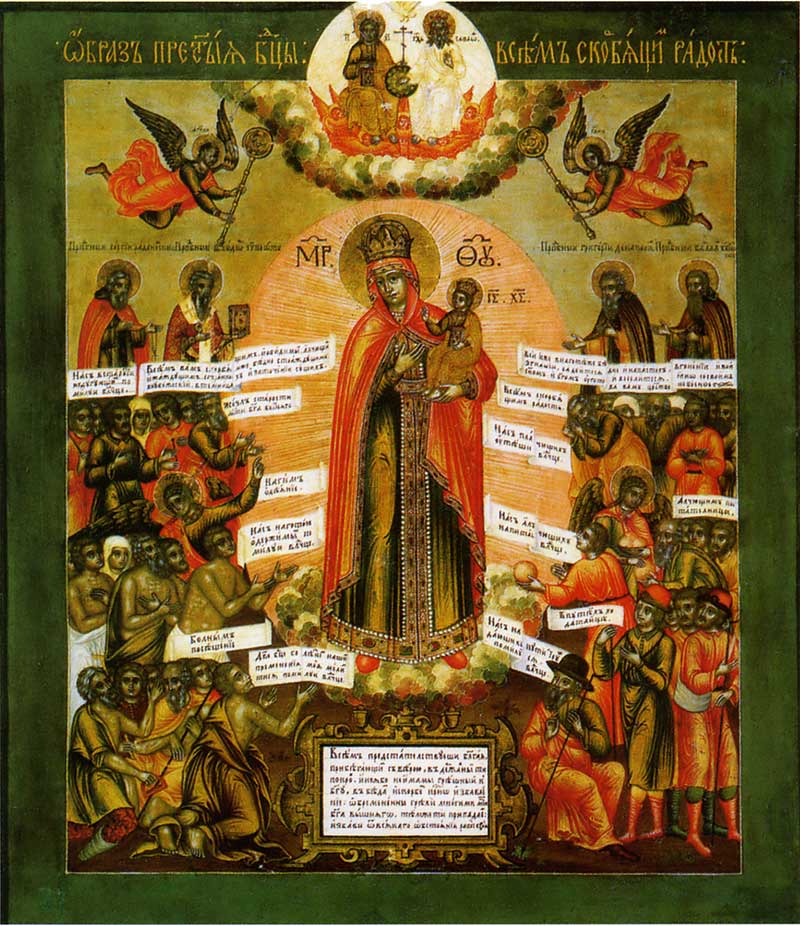
.jpg)
Saints commemorated
-
Martyr Arethas and Companions
-
Arethas and the Martyrs of Najran
Arethas (al-Harith) and the martyrs of Najran suffered around the year 523 in the Christian city of Najran in Himyar (South Arabia), when the Jewish Himyarite king Yusuf, called Dhu Nuwas — Dunaan in the Greek and Slavonic service books — set out to destroy Christianity in his realm. After the city surrendered on a sworn promise of safety, the king broke his oath and demanded that its Christians renounce Christ. Arethas, the aged chief of Najran, was beheaded with the leading men, and the whole confessing community — the tradition numbers them 4,299 — perished by the sword and by fire, among them the noblewoman Syncletica (Ruhm) with her daughters. Their massacre, uniquely well documented for so early a martyrdom, resounded through the Christian world and moved the Ethiopian king Elesbaan to cross the sea and overthrow the persecutor.
-
Athanasius I of Constantinople
Athanasius I, Patriarch of Constantinople, was a rigorous ascetic and reforming hierarch of the early Palaiologan age, twice occupying the patriarchal throne (1289–1293 and 1303–c. 1310) under the emperor Andronikos II. Born at Adrianople and named Alexius in the world, he was tonsured young and spent decades in the strictest monastic labour on Athos and elsewhere before being raised, against his will, to the patriarchate. As patriarch he waged an uncompromising campaign for the discipline of clergy and monks, drove idle bishops back to their sees, and made himself the tireless advocate of the poor, the refugees, and the famine-stricken of the capital — a severity that twice cost him his throne. He died in retirement in the monastery he had founded, and his relics were found incorrupt. He is not to be confused with Athanasius the Great, the fourth-century Archbishop of Alexandria and champion of Nicaea (kept January 18 and May 2) — a wholly different saint of a far earlier age; nor with Athanasius the Confessor of Paulopetrion (†821; kept February 22), the Bithynian abbot-confessor of the iconoclast age whom the OCA synaxarion styles "Athanasius the Confessor of Constantinople" — the title most easily confused with this patriarch's, though the two are five centuries apart.
-
Elesbaan, King of Ethiopia
Elesbaan (Kaleb Ella Asbeha), king of Aksum in Ethiopia in the early sixth century, is venerated as a righteous ruler for his defence of the Christians of South Arabia. When the Jewish Himyarite king Dhu Nuwas massacred the Christian city of Najran — the martyrdom of Arethas and his companions — Elesbaan, urged by Byzantium and the Church, crossed the Red Sea about the year 525, overthrew and killed the persecutor, and restored the Christian faith in Himyar. The tradition relates that in the evening of his life he laid aside his crown, sent it to be hung above the Holy Sepulchre in Jerusalem, and ended his days as an ascetic recluse. The Church keeps his memory on October 24, the day of the martyrs he avenged.
British Isles and Ireland
- St. Cadfarch, disciple of Iltyd (6th C)
- St. Maelor of Sark (586)
Troparia & kontakia
Kontakion — Tone 6
We have no other help, we have no other hope, but thee, O Lady. Do thou help us: in thee we hope, and of thee we make our boast, for we are thy servants; let us not be put to shame.
Kontakion — Tone 4
The light-bearing feast of the passion-bearers hath dawned this day as the herald of our gladness; keeping which, let us glorify the Lord who dwelleth in the highest.
Kontakion — Tone 2
Clothed in the shining garment of the priesthood, thou hast joyfully attained in spirit to the heavenly Kingdom; therefore the dwellings of the righteous received thee, where is unspeakable gladness, and the Word, and the choirs of all the saints, O hierarch Athanasius: pray without ceasing for us all.
Kontakion — Tone 4
Him who for the love of Christ the King laid aside the height of an earthly kingdom, and the shining crown of crowns, and the purple, and who was gloriously crowned by Him in the heavens — Elesbaan the wise king, who exchanged a corruptible and fleeting kingdom for the Kingdom Eternal — let us praise in songs of hymnody, as a great intercessor for the world.
Magnification
We magnify you, O holy passion-bearers, Arethas and those who suffered with thee, and we honour your precious sufferings which ye endured for Christ.
Troparion — Tone 4
To the Theotokos let us sinners and lowly ones now diligently hasten, and let us fall down in repentance, crying from the depths of our soul: O Lady, help us, take pity upon us; make haste, for we perish under the multitude of our transgressions; turn not thy servants away empty, for thee alone do we have as our hope.
Troparion — Tone 1
Having shown yourselves valiant in Christ against the godless king, O holy martyrs, and having convicted his Jewish unbelief in Christ, ye endured the torment of tortures and the severing of your heads; therefore the angels praised you, and the generations of the faithful glorify thee, O Arethas, and those who suffered with thee, as ye ever pray for our souls.
Troparion — Tone 1
By the light of a pure life thou didst burn away the thorns of passion, and with streams of tears thou didst water the barren earth, making of thy soul a field of much fruit, O most blessed Athanasius, luminary of Constantinople, adornment of patriarchs: entreat Christ God that our souls may be saved.
Troparion — Tone 4
Moved by divine zeal to avenge the shed blood of the righteous — as David was anointed by Samuel, so wast thou by the most wondrous Zeno, who prophetically foretold what should come to pass for thee, and by whose blessing, at thy vow to him, thou wast granted victory and triumph over the enemies — and thereafter, laying aside thy kingdom, thou didst finish thy life in the ascetic dwellings of the mountain, O king Elesbaan: entreat Christ the heavenly King to save our souls.
Readings
7th Matins Gospel
John 20.1-10
1The first day of the week cometh Mary Magdalene early, when it was yet dark, unto the sepulchre, and seeth the stone taken away from the sepulchre. 2Then she runneth, and cometh to Simon Peter, and to the other disciple, whom Jesus loved, and saith unto them, They have taken away the Lord out of the sepulchre, and we know not where they have laid him. 3Peter therefore went forth, and that other disciple, and came to the sepulchre. 4So they ran both together: and the other disciple did outrun Peter, and came first to the sepulchre. 5And he stooping down, and looking in, saw the linen clothes lying; yet went he not in. 6Then cometh Simon Peter following him, and went into the sepulchre, and seeth the linen clothes lie, 7And the napkin, that was about his head, not lying with the linen clothes, but wrapped together in a place by itself. 8Then went in also that other disciple, which came first to the sepulchre, and he saw, and believed. 9For as yet they knew not the scripture, that he must rise again from the dead. 10Then the disciples went away again unto their own home.
Epistle
2 Corinthians 9.6-11
6But this I say, He which soweth sparingly shall reap also sparingly; and he which soweth bountifully shall reap also bountifully. 7Every man according as he purposeth in his heart, so let him give; not grudgingly, or of necessity: for God loveth a cheerful giver. 8And God is able to make all grace abound toward you; that ye, always having all sufficiency in all things, may abound to every good work: 9(As it is written, He hath dispersed abroad; he hath given to the poor: his righteousness remaineth for ever. 10Now he that ministereth seed to the sower both minister bread for your food, and multiply your seed sown, and increase the fruits of your righteousness;) 11Being enriched in every thing to all bountifulness, which causeth through us thanksgiving to God.
Gospel
Luke 16.19-31
19There was a certain rich man, which was clothed in purple and fine linen, and fared sumptuously every day: 20And there was a certain beggar named Lazarus, which was laid at his gate, full of sores, 21And desiring to be fed with the crumbs which fell from the rich man’s table: moreover the dogs came and licked his sores. 22And it came to pass, that the beggar died, and was carried by the angels into Abraham’s bosom: the rich man also died, and was buried; 23And in hell he lift up his eyes, being in torments, and seeth Abraham afar off, and Lazarus in his bosom. 24And he cried and said, Father Abraham, have mercy on me, and send Lazarus, that he may dip the tip of his finger in water, and cool my tongue; for I am tormented in this flame. 25But Abraham said, Son, remember that thou in thy lifetime receivedst thy good things, and likewise Lazarus evil things: but now he is comforted, and thou art tormented. 26And beside all this, between us and you there is a great gulf fixed: so that they which would pass from hence to you cannot; neither can they pass to us, that would come from thence. 27Then he said, I pray thee therefore, father, that thou wouldest send him to my father’s house: 28For I have five brethren; that he may testify unto them, lest they also come into this place of torment. 29Abraham saith unto him, They have Moses and the prophets; let them hear them. 30And he said, Nay, father Abraham: but if one went unto them from the dead, they will repent. 31And he said unto him, If they hear not Moses and the prophets, neither will they be persuaded, though one rose from the dead.