
Athanasius I of Constantinople
Our Father among the Saints Athanasius I, Patriarch of Constantinople
Patriarch · Bishop · b. c. 1230 — d. c. 1315
Commemorated 24 October — Repose
Athanasius I, Patriarch of Constantinople, was a rigorous ascetic and reforming hierarch of the early Palaiologan age, twice occupying the patriarchal throne (1289–1293 and 1303–c. 1310) under the emperor Andronikos II. Born at Adrianople and named Alexius in the world, he was tonsured young and spent decades in the strictest monastic labour on Athos and elsewhere before being raised, against his will, to the patriarchate. As patriarch he waged an uncompromising campaign for the discipline of clergy and monks, drove idle bishops back to their sees, and made himself the tireless advocate of the poor, the refugees, and the famine-stricken of the capital — a severity that twice cost him his throne. He died in retirement in the monastery he had founded, and his relics were found incorrupt. He is not to be confused with Athanasius the Great, the fourth-century Archbishop of Alexandria and champion of Nicaea (kept January 18 and May 2) — a wholly different saint of a far earlier age; nor with Athanasius the Confessor of Paulopetrion (†821; kept February 22), the Bithynian abbot-confessor of the iconoclast age whom the OCA synaxarion styles "Athanasius the Confessor of Constantinople" — the title most easily confused with this patriarch's, though the two are five centuries apart.
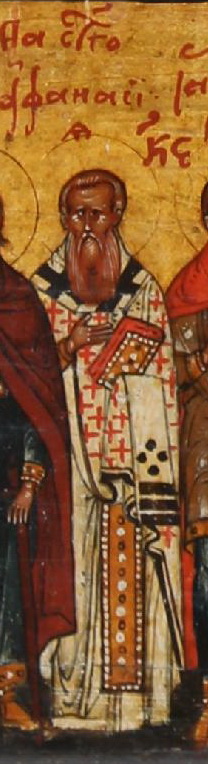
_-_October_-_44_-_Athanasius_I_of_Constantinople.jpg)
Origins and monastic formation
The saint was born about 1230 at Adrianople (Adrianopolis) in Thrace and received in baptism the name Alexius. Drawn young to the ascetic life by the love of Christ, he left home for Thessalonica, where he was tonsured a monk with the name Akakios, and thence embarked on a long monastic pilgrimage through the holy places of the Byzantine world. He lived on Mount Athos — where he took the name Athanasius — and in the monasteries of Mount Ganos and elsewhere, seeking out the most austere communities and the hardest labours, and gaining a reputation for extreme fasting, vigil, and poverty. It was from this world of strict monasticism, and not from the ranks of the learned court clergy, that he was drawn to the highest office of the Church.
First patriarchate (1289–1293)
On the resignation of the patriarch Gregory II, the emperor Andronikos II Palaiologos chose Athanasius — by then widely revered as a holy ascetic — and had him enthroned as patriarch in 1289. He brought to the office the whole severity of his monastic ideal. He demanded that bishops who had abandoned their dioceses for the comforts of the capital return to their flocks; he disciplined a worldly and often unruly clergy; he reformed the monasteries; and he set himself against the abuses of the powerful. Above all he made the patriarchate the champion of the poor: in a city crowded with refugees driven west by the advancing Turks and repeatedly gripped by famine, he organised relief, denounced the profiteers who hoarded grain, and pressed the rich and the government to feed the hungry. His rigour earned him bitter enemies among the clergy and the aristocracy, and in 1293, worn down by the opposition, he withdrew from the throne.
Second patriarchate (1303–c. 1310) and retirement
Ten years later, amid renewed disorder in the Church, Andronikos recalled him, and Athanasius was restored to the patriarchate in 1303. He resumed his reforming programme with undiminished strictness, and with the same result: the resistance of those he sought to discipline, exploited by his enemies, again made his position untenable, and about 1310 he resigned for the last time. He retired to the monastery of Christ the Saviour which he had founded, and there, in prayer and the ascetic life he had never truly left, he passed his remaining years, dying about the year 1315 (the sources vary, and some place his repose a little later). His relics were later found incorrupt, and miracles were reported at his tomb.
The letters
Athanasius left a large body of correspondence — letters to the emperor Andronikos, to officials, clergy, and monastics — which survives and is one of the most valuable documentary sources for the society, Church, and hardships of Constantinople in the reign of Andronikos II: the famines and refugee crises, the corruption he fought, and the moral vision of a patriarch who conceived his office as the guardianship of the poor.
Feast and commemoration
October 24 (church date; Old Calendar civil November 6), his repose, kept especially in the Slavic and Greek calendars alongside the martyrs of Najran and the righteous Elesbaan. He is classed among the holy hierarchs (patriarchs).
Hymns
Troparion — Tone 1
By the light of a pure life thou didst burn away the thorns of passion, and with streams of tears thou didst water the barren earth, making of thy soul a field of much fruit, O most blessed Athanasius, luminary of Constantinople, adornment of patriarchs: entreat Christ God that our souls may be saved.
Original translation from the Slavonic
Kontakion — Tone 2
Clothed in the shining garment of the priesthood, thou hast joyfully attained in spirit to the heavenly Kingdom; therefore the dwellings of the righteous received thee, where is unspeakable gladness, and the Word, and the choirs of all the saints, O hierarch Athanasius: pray without ceasing for us all.
Original translation from the Slavonic
Iconography
Athanasius is depicted as a patriarch in the sakkos and omophorion, with the white beard of an old man, blessing with his right hand and holding the Gospel, his ascetic gauntness marked in the older images. The stored image is his figure from a seventeenth-century Russian menaion icon (a calendar panel for October), which arranges the saints of the month in serried rows: Athanasius appears as a vested hierarch among the commemorations of October 24.