
Paschaltide, day 37 · 36 days since Pascha
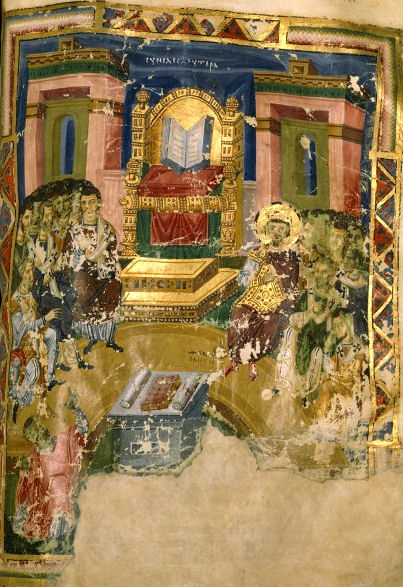
About Commemoration of the Second Ecumenical Council →

Saints commemorated
-
Saint of the day
Martyr Basiliscus, Bishop of Comana
Basiliscus (†c. 308) was a young Christian of the Pontic country, nephew of the great-martyr Theodore the Recruit, who confessed Christ at Amasea together with Eutropius and Cleonicus and was left alive in prison when they were crucified. Driven at last in iron sandals studded with nails to Comana in Pontus, he prayed beside a withered plane-tree that put out leaves while a spring broke from its root, saw the idols of the city fall at his word, and was beheaded, his body thrown into the river and recovered by the faithful. Over his grave outside Comana a martyrium arose — and it was there, ninety-nine years later, that John Chrysostom, dying on the forced march into his last exile, was met in a night vision by Basiliscus with the words, "Take courage, brother John; tomorrow we shall be together." Chrysostom died the next day and was buried beside him.
-
Righteous Melchizedek, king of Salem.
-
Commemoration of the Second Ecumenical Council (381).
-
John Vladimir of Serbia
John Vladimir (c. 990 – 22 May 1016) was prince of Dioclea — Duklja, the Serbian principality on the Adriatic that lay where Montenegro and northern Albania meet — and is honoured as the first canonised saint of the Serbian people. Caught between the Empire of Basil II and the Bulgarian tsardom of Samuel, he surrendered his fortress rather than let his people starve, was carried captive to Prespa, and was there married to Samuel's daughter Theodora Kosara and restored to his throne as the tsar's vassal. He ruled a decade in peace, remembered as a mild, just, and prayerful prince, and was beheaded at the church door at Prespa on 22 May 1016 by order of Samuel's nephew John Vladislav, who had sworn him safe conduct. His relics, laid first in his own church on Lake Skadar, rest today in Tirana, and return each year to the monastery near Elbasan that bears his name for his feast. He is venerated as great-martyr and wonderworker by Serbs, Albanians, Bulgarians, Macedonians and Montenegrins alike.
-
Marcellus and Codratus
Marcellus and Codratus are two martyrs of the Byzantine synaxaria commemorated on May 22, of whom nothing is transmitted but their names and the manner of their deaths: Marcellus was made to swallow molten lead, and Codratus — the Greek notices name him Kodros — was torn to pieces by horses, dragged over the ground until he died. The synaxarion gives each a single line of verse and no more: that Marcellus drank the boiling lead as easily as a man drinks water, and that Codratus, having run his course as a horseman runs it, lifted his hands and received the crown. Their place, their century, and the persecution under which they suffered are not recorded.
-
Sophia the Physician
Sophia, called the Physician (ἡ ἰατρός), is a martyr of the Byzantine synaxaria commemorated on May 22, known only from her bare synaxarion notice: a woman who practised the healing art and was put to death by the sword for Christ. Nothing of her country, her century, or the circumstances of her passion has been transmitted. The synaxarion preserves the single line of verse that is her whole biography — that she who had once been a healer of bodies was, by the sword, shown to be a healer of souls — and she stands in the calendar as one of the small number of women whom the Church remembers in a learned profession.
British Isles and Ireland
- St. Conall, abbot of Inniscoel (7th C)
Troparia & kontakia
Apolytikion
Most glorified art Thou, O Christ our God, who hast set our Fathers as beacons upon the earth, and by them hast guided us all into the true faith: O greatly merciful One, glory to Thee.
Apolytikion — Tone 4 (common of a martyr)
Thy martyr Basiliscus, O Lord, has received from Thee, our God, an incorruptible crown for the contest he endured; for, having Thy strength, he cast down the tyrants and broke in pieces the powerless insolence of the demons. At his supplications, O Christ God, save our souls.
Apolytikion — Tone 4
Thou didst rule thy people in gentleness and didst give thy body to the sword rather than break thy word, O Prince John Vladimir; wherefore Christ has crowned thee with the martyrs and made thy relics a fountain of healing. Intercede with Him, O passion-bearing prince, that our souls may be saved.
Apolytikion — Tone 4 (common of martyrs)
Thy martyrs Marcellus and Codratus, O Lord, have received from Thee, our God, incorruptible crowns for the contest they endured; for, having Thy strength, they cast down the tyrants and broke in pieces the powerless insolence of the demons. At their supplications, O Christ God, save our souls.
Apolytikion — Tone 4 (common of a woman martyr)
Thy lamb Sophia crieth out to Thee with a great voice, O Jesus: I love Thee, my Bridegroom, and seeking Thee I strive in contest; I am crucified and buried with Thee in Thy baptism, and I suffer for Thy sake that I may reign with Thee; I die for Thee that I may live in Thee. Receive me as a spotless sacrifice, offered to Thee in love. At her supplications, O merciful One, save our souls.
Kontakion
The preaching of the Apostles and the definitions of the Fathers have sealed the one faith of the Church; and she, wearing the garment of truth woven from the theology that comes from above, rightly divides and glorifies the great mystery of godliness.
Kontakion — Tone 8
Shod in iron and bound to a withered tree, thou didst pray, and the dry wood put forth leaves and a spring of living water broke from its root; wherefore, when thy head was struck off at Comana, thou didst become thyself a fountain of healings, O Basiliscus, and a comfort to the exiled.
Kontakion — Tone 8
Summoned by an oath and betrayed at the church door, thou didst receive the sword with a quiet heart, and didst take up thine own head as a crown; O John Vladimir, first-fruits of the saints of thy people, cease not to intercede for those who honour thee.
Readings
Epistle
Acts 17.1-15
1Now when they had passed through Amphipolis and Apollonia, they came to Thessalonica, where was a synagogue of the Jews: 2And Paul, as his manner was, went in unto them, and three sabbath days reasoned with them out of the scriptures, 3Opening and alleging, that Christ must needs have suffered, and risen again from the dead; and that this Jesus, whom I preach unto you, is Christ. 4And some of them believed, and consorted with Paul and Silas; and of the devout Greeks a great multitude, and of the chief women not a few. 5But the Jews which believed not, moved with envy, took unto them certain lewd fellows of the baser sort, and gathered a company, and set all the city on an uproar, and assaulted the house of Jason, and sought to bring them out to the people. 6And when they found them not, they drew Jason and certain brethren unto the rulers of the city, crying, These that have turned the world upside down are come hither also; 7Whom Jason hath received: and these all do contrary to the decrees of Cæsar, saying that there is another king, one Jesus. 8And they troubled the people and the rulers of the city, when they heard these things. 9And when they had taken security of Jason, and of the other, they let them go. 10And the brethren immediately sent away Paul and Silas by night unto Berea: who coming thither went into the synagogue of the Jews. 11These were more noble than those in Thessalonica, in that they received the word with all readiness of mind, and searched the scriptures daily, whether those things were so. 12Therefore many of them believed; also of honourable women which were Greeks, and of men, not a few. 13But when the Jews of Thessalonica had knowledge that the word of God was preached of Paul at Berea, they came thither also, and stirred up the people. 14And then immediately the brethren sent away Paul to go as it were to the sea: but Silas and Timotheus abode there still. 15And they that conducted Paul brought him unto Athens: and receiving a commandment unto Silas and Timotheus for to come to him with all speed, they departed.
Gospel
John 11.47-57
47Then gathered the chief priests and the Pharisees a council, and said, What do we? for this man doeth many miracles. 48If we let him thus alone, all men will believe on him: and the Romans shall come and take away both our place and nation. 49And one of them, named Caiaphas, being the high priest that same year, said unto them, Ye know nothing at all, 50Nor consider that it is expedient for us, that one man should die for the people, and that the whole nation perish not. 51And this spake he not of himself: but being high priest that year, he prophesied that Jesus should die for that nation; 52And not for that nation only, but that also he should gather together in one the children of God that were scattered abroad. 53Then from that day forth they took counsel together for to put him to death. 54Jesus therefore walked no more openly among the Jews; but went thence unto a country near to the wilderness, into a city called Ephraim, and there continued with his disciples. 55And the Jews’ passover was nigh at hand: and many went out of the country up to Jerusalem before the passover, to purify themselves. 56Then sought they for Jesus, and spake among themselves, as they stood in the temple, What think ye, that he will not come to the feast? 57Now both the chief priests and the Pharisees had given a commandment, that, if any man knew where he were, he should shew it, that they might take him.