
John Vladimir of Serbia
The Holy Great Martyr and Wonderworker John Vladimir, Prince of Dioclea
Prince · Great Martyr · Wonderworker · b. c. 990 — d. May 22, 1016 (1015 in the Greek and Slavonic menaia), at Prespa
Commemorated 22 May — Beheaded at the door of the church at Prespa by order of the Tsar John Vladislav
John Vladimir (c. 990 – 22 May 1016) was prince of Dioclea — Duklja, the Serbian principality on the Adriatic that lay where Montenegro and northern Albania meet — and is honoured as the first canonised saint of the Serbian people. Caught between the Empire of Basil II and the Bulgarian tsardom of Samuel, he surrendered his fortress rather than let his people starve, was carried captive to Prespa, and was there married to Samuel's daughter Theodora Kosara and restored to his throne as the tsar's vassal. He ruled a decade in peace, remembered as a mild, just, and prayerful prince, and was beheaded at the church door at Prespa on 22 May 1016 by order of Samuel's nephew John Vladislav, who had sworn him safe conduct. His relics, laid first in his own church on Lake Skadar, rest today in Tirana, and return each year to the monastery near Elbasan that bears his name for his feast. He is venerated as great-martyr and wonderworker by Serbs, Albanians, Bulgarians, Macedonians and Montenegrins alike.
.jpg)
Origins and the principality of Dioclea
Vladimir was born about the year 990 into the ruling house of Dioclea (Greek Διόκλεια; Slavonic Duklja, later Zeta, the core of modern Montenegro), succeeding his father Petrislav as prince about the year 1000, while still a young man. His land lay on the Adriatic between the Byzantine possessions of Dalmatia and the expanding Bulgarian power inland, and the Chronicle of the Priest of Dioclea — the oldest narrative of his life — describes him as it describes no other prince of that house: holy, peaceful, humble, full of wisdom and the fear of God, and given to prayer from his youth. He is said to have founded churches and monasteries, to have provided for the poor and the sick, to have set teachers over his people, and to have kept a place of prayer apart in the woods above his court to which he withdrew daily.
His reign belongs to the last and fiercest phase of the long war between the Emperor Basil II and the Bulgarian tsar Samuel. Vladimir held to the Byzantine alliance, which made his small principality a target: Samuel needed Dioclea to break the chain of pro-imperial Balkan rulers on his flank.
Samuel's invasion, the fortress of Oblik, and the captivity
About 1009–1010 Samuel marched on Dioclea. Vladimir withdrew his people into the mountain fortress of Oblik and was besieged there. The Chronicle preserves the tradition of the siege in a hagiographical key: the rock swarmed with venomous serpents, and at the prince's prayer they lost their power to harm, so that no man of his was bitten — a wonder his later cult never forgot, and the reason he is invoked against snakes and their bite in the Adriatic hinterland. But hunger did what the serpents could not. Rather than see his people starve or be cut down in a sortie, Vladimir went down alone and gave himself up to Samuel on condition that his people be spared. He was carried off to Samuel's capital at Prespa in Macedonia and imprisoned there.
Theodora Kosara
There follows the episode on which the popular memory of the saint chiefly rests. Kosara, called in religion and in the Slavonic tradition Theodora, the daughter of the Tsar Samuel, came with her maids to wash the feet of the prisoners and to bring them food — an act of imperial almsgiving — and, seeing the young prince in his chains, was moved by his beauty and his gentleness. She asked her father to give him to her in marriage. Samuel consented; and — whether from affection, as the Chronicle has it, or from the calculation that a son-in-law would be a safer vassal than a conquered enemy, as modern historians judge — he released Vladimir, restored him to Dioclea as his own dependent ruler, and added to his lands the region of Dyrrhachium.
Vladimir returned with Kosara to reign at his court by the Lake of Skadar, and the Chronicle says that from that time he never again went out to war but lived with his wife in a marriage more like the fellowship of monastics than of princes, and gave himself to the building of churches and the care of his people. Kosara is honoured with him in Serbian and Montenegrin memory as a righteous wife.
The murder at Prespa
Samuel was broken by Basil II at Kleidion in 1014 and died the same year; his son Gabriel Radomir was murdered within a year by his own cousin, John Vladislav, who seized the tsardom. Vladislav, insecure on a throne he had usurped and mistrustful of a brother-in-law with a Byzantine past, summoned Vladimir to Prespa. Vladimir's wife and his people warned him not to go. Vladislav sent him a golden cross as a pledge of safe conduct; Vladimir sent it back with the message that Christ had suffered not on gold but on wood, and that he would come only on the word of the bishops — whereupon two bishops and a hermit were sent to swear to his safety in the tsar's name, and, unwilling to be the cause of war, he went.
At Prespa the tsar received him with honour, and then set his soldiers to kill him. Vladimir took refuge in the church; the account has the bishops themselves persuaded or compelled to bring him out, giving him the Holy Mysteries first. As he came through the door of the church he was struck down and beheaded, on 22 May 1016 — the tradition adding that he took up his own severed head, mounted, and rode to the place where he was to be buried, the detail that fixed his iconography for good.
Relics and translations
The body was left where it fell and buried in the church at Prespa, and healings began at once, so that Vladislav — who lived only two years more, dying before Dyrrhachium in 1018 — was persuaded to let Kosara carry her husband's relics home. She laid them in the church of the Most Pure Mother of God of Krajina (Prečista Krajinska) by Lake Skadar, which Vladimir himself had built beside his court; and she entered a convent of her own founding, where she lived out her life beside the church and was buried at her husband's feet.
The relics moved with the fortunes of the region: to Dyrrhachium (Durrës) about 1215, and then, in 1381, to the church which the Albanian lord Karl Thopia built for them near Elbasan — the monastery of Shën Gjon Vladimiri, St John Vladimir, which became the centre of his cult and remained so under Ottoman rule. Since 1995 the relics have been kept in the Orthodox cathedral at Tirana, and are carried back to the monastery near Elbasan each year for the feast of May 22, where Orthodox Albanians and pilgrims from Montenegro, Serbia and Macedonia keep the day together. His cross, preserved by the Andrović family of the Crmnica in Montenegro, is borne in procession to the summit of Mount Rumija on the feast of Pentecost, a custom of great antiquity in which Orthodox, Catholic, and Muslim inhabitants of the region have all traditionally taken part.
Veneration and later cultus
Vladimir is the earliest saint of the Serbs and the first ruler of a South Slav land to be venerated as a martyr. His cult was already established in Dioclea in the eleventh century — the Chronicle implies a written Life, now lost, which its compiler used — and it spread with the relics into Albania and with the Ohrid archbishopric into Macedonia and Bulgaria. A Greek Akolouthia with the Life was printed at Venice in 1690 for the use of the Greek-speaking faithful of the Elbasan region, and a Church Slavonic office followed in 1802; both are the channel through which the Greek and Russian calendars know him, and both are the reason the Greek menologia style him βασιλεύς, "king," a rank he never held. He is the patron of Bar in Montenegro, is honoured throughout the Serbian Orthodox Church, and is one of the two or three saints in whom the Orthodox of Albania find their own history.
Feast and commemoration
May 22 (church date; New Calendar civil May 22, Old Calendar civil June 4), the day of the martyrdom at Prespa. The feast is kept with a full festal office in the Serbian Church, where he is the first of the national saints; in Albania, where it is one of the great days of the Orthodox year and draws the annual procession of the relics from Tirana to the monastery near Elbasan; and in the Bulgarian, Macedonian and Montenegrin calendars. In Greek use he is commemorated as "John Vladimir the king and wonderworker" on the strength of the 1690 Venice office; in Russian and Antiochian use he is a simple commemoration of the day, kept together with Basiliscus of Comana and the Commemoration of the Second Ecumenical Council. The Rumija procession with his cross belongs not to this feast but to Pentecost, and so falls under the movable cycle.
Hymns
Apolytikion — Tone 4
Thou didst rule thy people in gentleness and didst give thy body to the sword rather than break thy word, O Prince John Vladimir; wherefore Christ has crowned thee with the martyrs and made thy relics a fountain of healing. Intercede with Him, O passion-bearing prince, that our souls may be saved.
Kontakion — Tone 8
Summoned by an oath and betrayed at the church door, thou didst receive the sword with a quiet heart, and didst take up thine own head as a crown; O John Vladimir, first-fruits of the saints of thy people, cease not to intercede for those who honour thee.
Original translation from the Greek
Iconography
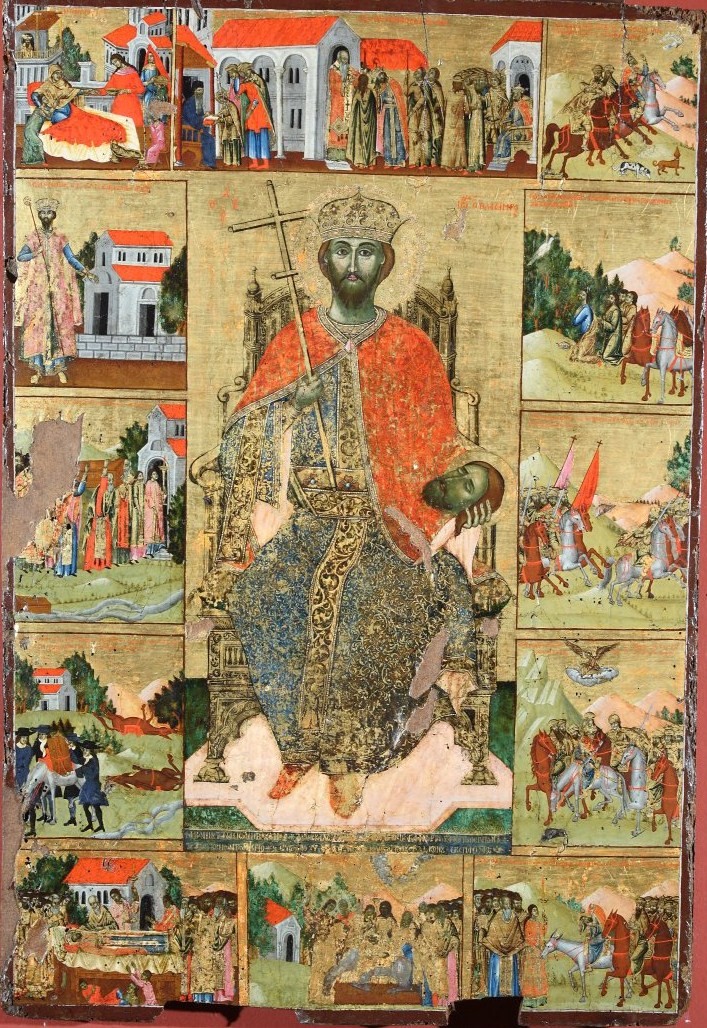
John Vladimir is painted as a crowned prince in the full regalia of a Balkan ruler — the jewelled stemma or open crown, the loros or gold-worked sakkos over a long tunic, the scarlet mantle — and he is a cephalophore: he carries his own severed head, most often cradled in the left hand or the left arm, while the right holds the processional cross of his confession, sometimes a long staff-cross. The crown, the cross, and the carried head are the three marks by which his images are identified without an inscription, and the head distinguishes him at once from Vladimir the Great of Kiev, who is shown crowned with a cross but whole. He may be shown enthroned, or standing, or mounted — the last recalling the tradition that he rode with his head in his hands to the place of his burial. Frescoes and panel icons of him are numerous in Albania, Montenegro and Macedonia from the seventeenth century onward; the Ardenica and Elbasan workshops made him a principal subject.
The stored image is the great narrative icon of 1739 by the Albanian painter Kostandin Shpataraku (fl. 1736–1767), egg tempera on wood, made for the Monastery of Ardenica and now in the National Museum of Medieval Art at Korçë. The saint sits enthroned at the centre in crown and scarlet mantle, holding the cross in his right hand and his own severed head in his left, with the Greek inscription naming him beside the halo; and around the central panel run twelve narrative scenes of his life and posthumous miracles, drawn from the Greek hagiography printed at Venice half a century earlier — the court, the captivity, the horsemen, the mountain, the betrayal, the burial, the healings. It is at once the most complete iconographic statement of his cult and a document of the eighteenth-century Albanian Orthodox school that made it.
Disputed questions
- Serbian, Bulgarian, or Albanian? Vladimir was a Serbian prince of Dioclea, a Bulgarian tsar's son-in-law and vassal, killed on Bulgarian soil, and buried for six centuries in Albania. Each of the three traditions has accordingly claimed him. The Orthodox Church in America's calendar heads him "Prince of Bulgaria"; the Greek synaxaristis makes him a native of "Vladimir in Bulgaria" and traces his descent from Samuel himself; the Serbian and Montenegrin tradition, and the Chronicle of the Priest of Dioclea, place him unambiguously in Duklja as the son of Petrislav. The disagreement is recorded, not resolved: the historical evidence supports Dioclea, and the epithet used here is of Serbia (Duklja being a Serbian principality) with the Albanian and Bulgarian veneration noted as fact.
- 1016 or 1015? The Chronicle of the Priest of Dioclea and the modern historians give 22 May 1016, which fits the sequence of Samuel's death (1014), Gabriel Radomir's murder, and Vladislav's death in 1018. The Greek and Slavonic office-books and, following them, the Russian and OCA calendars give 1015. The day is not in dispute.
- The Greek Life and the Chronicle diverge. The 1690 Greek Akolouthia supplies a set of episodes unknown to the Chronicle: that Vladimir kept virginity within his marriage; that he combated the Bogomils; and that Kosara, suspecting the reason for his daily absences at prayer and resenting his continence, slandered him to her brother and so procured his death. The Chronicle, by contrast, makes Kosara wholly blameless and devout, and gives Vladislav's motive as political. The Greek version is the later of the two and bears the marks of a hagiographical rewriting; the divergence is set out here because both accounts circulate in Orthodox use, and readers of the Greek synaxarion will not find the Kosara of the Serbian tradition.
- Great-martyr, martyr, or passion-bearer? Vladimir was killed by a Christian ruler for reasons of state, not for confessing Christ — the classic profile of the passion-bearer (compare Boris and Gleb). The liturgical tradition nevertheless styles him great-martyr (μεγαλομάρτυς) and wonderworker, and the Slavonic menaion reads мученик. This entry follows the liturgical usage and types him great-martyr, noting the tension; per TAXONOMY the two terms are not combined where the sources lead with one.
- Not to be confused with Vladimir the Great, Equal-to-the-Apostles, the baptiser of Rus' (July 15), nor with Vladimir Yaroslavich of Novgorod (October 4), nor with the several later Serbian princes of the name.