
Commemoration of the Second Ecumenical Council
The Commemoration of the Holy One Hundred and Fifty God-bearing Fathers of the Second Ecumenical Council, gathered at Constantinople in the year 381
On May 22 the Church keeps the memory of the one hundred and fifty God-bearing Fathers who assembled at Constantinople from May to July of the year 381, under the Emperor Theodosius the Great, in the council the Church numbers second among the Ecumenical Councils. Meeting fifty-six years after Nicaea, in a capital that had been in Arian hands for a generation, the Fathers confessed the Holy Spirit to be Lord and God, not a creature, against the Pneumatomachi or Macedonians who fought against His divinity; they completed the Creed of Nicaea with the articles on the Spirit, the Church, baptism, and the resurrection, in the form the Orthodox world confesses at every Liturgy to this day; and they condemned by name the Eunomians, the Semi-Arians, the Sabellians, the followers of Marcellus and of Photinus, and Apollinaris, who had denied a human mind to Christ. The council was presided over first by Meletius of Antioch, who died in the midst of it, then by Gregory the Theologian, who resigned the see of Constantinople before it, and finally by Nectarius, his successor.

The Church after Nicaea
The Council of Nicaea in 325 had confessed the Son to be of one essence (ὁμοούσιος) with the Father, but had not settled the controversy; the sixty years that followed were the long Arian crisis, in which the word homoousios was attacked, defended, exiled, restored, and glossed by a whole family of compromise formulas. Under Constantius and again under Valens the imperial power stood behind the Arianising parties. In the East, and above all in Constantinople, the great church of the capital was held by Arian bishops for some forty years, so that when Gregory the Theologian came to the city in 379 the Orthodox had no basilica and met in the small house-church he called the Anastasia — the "Resurrection" — where he preached the five Theological Orations that gave the Nicene faith its final form of expression.
Two things had changed by 380. The first was the theological labour of the Cappadocians — Basil the Great, whose treatise On the Holy Spirit (375) had answered the objection that the Spirit is merely a creature or a ministering power; Gregory of Nyssa; Amphilochius of Iconium; and Gregory the Theologian himself, who taught plainly what earlier writers had left in reserve: that the Spirit is God. The second was the accession of the Spanish general Theodosius in 379, a convinced Nicene, who in February 380 published the edict Cunctos populos requiring the faith of Damasus of Rome and Peter of Alexandria, and in November entered Constantinople and put the Orthodox in possession of the churches.
The convocation and the Fathers
Theodosius summoned the bishops of the Eastern prefectures to meet in the capital in May 381. It was in intention an Eastern council: no Western bishops attended, no legate of Rome was present, and Egypt came late. The number of the Fathers transmitted by the acts and repeated in every synaxarion is one hundred and fifty, and it is by that number that the Church names them — the hundred and fifty Fathers — as she names the three hundred and eighteen of Nicaea. Thirty-six Macedonian bishops also came, hoping for a formula they could sign; when they would not confess the Spirit consubstantial with the Father and the Son, they withdrew, and the council proceeded without them.
Among the Fathers the calendar and the historians name Meletius of Antioch, Gregory the Theologian, Gregory of Nyssa, Cyril of Jerusalem, Amphilochius of Iconium, Peter of Sebaste (Basil's brother), Diodore of Tarsus, Acacius of Beroea, Optimus of Antioch in Pisidia, and Helladius of Caesarea, Basil's successor. Basil the Great himself had died on 1 January 379 and did not live to see the council his life's work made possible — a point the Byzantine encomia never fail to make.
Meletius of Antioch, and the Antiochian weight of the council
The council's first president was Meletius, archbishop of Antioch — three times exiled for the Nicene faith, the shepherd under whom the young John Chrysostom had been baptised and made reader, and the man whose personal authority in the East was second to none. He it was who enthroned Gregory the Theologian in the Great Church. He died at Constantinople during the council's session, and was mourned with a funeral oration by Gregory of Nyssa; his body was carried back to Antioch and laid beside the martyr Babylas.
His death exposed the wound the council could not heal: the Meletian schism at Antioch, where two Nicene bishops — Meletius and Paulinus — had for twenty years each held a portion of the Orthodox flock, Rome and Alexandria recognising Paulinus and the East recognising Meletius. An agreement had been sworn that the survivor should succeed to the whole city; instead the Eastern bishops at the council consecrated Flavian to Antioch, and the schism ran on for another generation. The episode is the reason the second council's aftermath is remembered in the Antiochian tradition with a certain gravity: the council that completed the Creed also left the great see of the East divided, and it was not until the episcopate of Flavian's successors, and the good offices of John Chrysostom himself, that Antioch was again in full communion with Rome and Alexandria.
Gregory the Theologian's presidency and resignation
On Meletius's death the presidency passed to Gregory, whom the council had just confirmed as archbishop of Constantinople. His tenure lasted weeks. The Egyptian and Macedonian bishops, arriving late, challenged the canonical validity of his translation from the little see of Sasima to the capital, invoking the Nicene prohibition of moving bishops from see to see. Weary of the strife, and unwilling to be the cause of a new division, Gregory rose and offered his resignation in words the Church has remembered — comparing himself to the prophet Jonah, and asking to be thrown overboard that the ship might be saved. Theodosius accepted it. Gregory preached his great farewell to the assembled bishops and to the city and withdrew to Cappadocia, to the writing that occupied his last years.
In his place the council elected, at the emperor's suggestion, Nectarius — an elderly and respected praetor of Tarsus, a catechumen, who was baptised and consecrated together, and who presided over the remainder of the sessions. He is himself commemorated by the Church on October 11.
The Creed completed
The council's enduring work is the Symbol of Faith. What the Fathers of 381 transmitted — or, in the more cautious view of modern historians, what the Church received under their name and Chalcedon in 451 ratified as theirs — is the Niceno-Constantinopolitan Creed: the Nicene articles left substantially as they stood, the anathemas of 325 dropped, and the third article greatly enlarged to confess the Holy Spirit as
the Lord, the Giver of life, who proceedeth from the Father, who with the Father and the Son together is worshipped and glorified, who spake by the prophets —
followed by the articles on one holy, catholic and apostolic Church, one baptism for the remission of sins, and the resurrection of the dead and the life of the age to come. Against the Macedonian evasion that the Spirit was homoiousios, "of like essence," the Fathers confessed Him worshipped and glorified with the Father and Son — the liturgical argument Basil had pressed from the doxology itself — and so declared, without repeating the contested word for the Spirit, that He is not a creature but God.
Two consequences follow from that article and belong to the history of the feast. The first is the completion of Trinitarian dogma: after 381 the Church's confession of the three Persons in one essence needed no further definition, and the controversies that followed moved to Christology. The second is that the clause "who proceedeth from the Father" — with the council's own Canon 7 (and Canon 1 of the following council) forbidding addition to or subtraction from the Creed — became the ground on which the Orthodox East rejected the later Latin interpolation of the Filioque: not as an incidental word, but as an alteration of a text an Ecumenical Council had sealed.
The heresies condemned, and the canons
Canon 1 anathematises by name every party of the Arian aftermath: the Eunomians or Anomoeans (who taught the Son unlike the Father in essence, after Aetius and Eunomius); the Arians or Eudoxians; the Semi-Arians or Pneumatomachi — the Macedonians, so called from Macedonius, the deposed Arian bishop of Constantinople, who granted the Son but fought against the Spirit; the Sabellians; the Marcellians, followers of Marcellus of Ancyra, whose zeal against Arius had collapsed the distinction of Persons; the Photinians; and the Apollinarians, followers of Apollinaris of Laodicea, who had taught that in Christ the Word replaced the human mind, leaving a body and soul without a rational principle — a Christ, as Gregory the Theologian answered, in whom what was not assumed was not healed.
Canon 2 confined bishops to their own dioceses on the civil model, naming the great regions — Egypt, the Orient (Antioch), Asia, Pontus, Thrace — and so gave the five-fold shape of Eastern administration its first canonical statement. Canon 3 assigned to the bishop of Constantinople the precedence of honour after the bishop of Rome, "because Constantinople is New Rome" — the canon whose reception the West resisted for centuries and which lies at the root of the later disputes over the patriarchal order. Canon 4 annulled the acts of Maximus the Cynic, the intruder who had attempted the see of Constantinople against Gregory. Canons 5 to 7 — which touch the Western Tome, the reception of Eastern bishops, and the manner of receiving converted heretics (some by chrismation, some by baptism) — are transmitted with the four but are held by most scholars to be later additions of the synods of 382 and after.
Reception as Ecumenical
The council was not universally received at once. Rome had not been represented, and the West long declined Canon 3. Its dogmatic authority was established at the Council of Chalcedon in 451, which read the Creed of the hundred and fifty Fathers beside that of the three hundred and eighteen, declared them of one force and one authority, and thereby fixed the second council's ecumenical rank. From Chalcedon onward the Creed of Constantinople is the Creed of the Church; it entered the Liturgy at Antioch and Constantinople in the late fifth and early sixth centuries, and it is sung, not merely recited, in the Antiochian usage to this day.
The commemoration itself
The Byzantine calendar keeps the memory of the Fathers of each of the great councils, and assigns to the hundred and fifty of Constantinople the fixed day of May 22 — the month in which the council opened. The commemoration is old and is carried by the Greek synaxaristis, the Slavonic menaion, and the calendars of every jurisdiction; in Russian use it is the principal commemoration of the day. It stands alongside the Church's other conciliar memories: the Fathers of Nicaea on the Seventh Sunday after Pascha (with a fixed May 29 notice in some menologia), the Fathers of the Seventh Council on the Sunday nearest October 11, the Fathers of the Fourth Council on July 16, and the Fathers of the first six councils together on the Sunday nearest that day.
Feast and commemoration
May 22 (church date; New Calendar civil May 22, Old Calendar civil June 4). The day is not of festal rank in the strict sense: it is a commemoration of the Fathers, served with the office of the holy hierarchs and the hymns of the Councils, combined with the day's martyr, Basiliscus of Comana, and — in Slavonic and Greek use — with the prince-martyr John Vladimir of Serbia. Because May 22 falls after Pascha but in some years before and in others after Pentecost, the office is joined to the Pentecostarion or to the ordinary Octoechos according to the year; where the day falls in the week after Pentecost the coincidence is felt, since the council's whole work was the confession of the Spirit whose descent has just been kept. In Greek parish practice the day is often marked by a reading of the Symbol of Faith with the council's history explained; the Antiochian Archdiocese notes the commemoration in its calendar without proper festal propers.
A note on the schema. the project's constitution fixes a closed list of feast_type values, none of which fits a commemoration of the Fathers of a council. The nearest available term is theotokos-synaxis, which the corpus already uses as its interim generic synaxis value for the Synaxis of John the Forerunner and the Three Holy Hierarchs — a synaxis of saints rather than of the Theotokos. No new term is minted here. The gap is flagged for a deliberate decision — a council / synod feast_type, or the generalisation of theotokos-synaxis into a subject-neutral synaxis — extending the standing feast_type question at the project's record of open questions, which already records the parallel absences for the Forerunner's synaxis and for relic-veneration feasts.
Hymns
Apolytikion
Most glorified art Thou, O Christ our God, who hast set our Fathers as beacons upon the earth, and by them hast guided us all into the true faith: O greatly merciful One, glory to Thee.
Kontakion
The preaching of the Apostles and the definitions of the Fathers have sealed the one faith of the Church; and she, wearing the garment of truth woven from the theology that comes from above, rightly divides and glorifies the great mystery of godliness.
Original translation from the Greek
Appointed readings
Epistle — Hebrews 13:7–16
7Remember them which have the rule over you, who have spoken unto you the word of God: whose faith follow, considering the end of their conversation. 8Jesus Christ the same yesterday, and to day, and for ever. 9Be not carried about with divers and strange doctrines. For it is a good thing that the heart be established with grace; not with meats, which have not profited them that have been occupied therein. 10We have an altar, whereof they have no right to eat which serve the tabernacle. 11For the bodies of those beasts, whose blood is brought into the sanctuary by the high priest for sin, are burned without the camp. 12Wherefore Jesus also, that he might sanctify the people with his own blood, suffered without the gate. 13Let us go forth therefore unto him without the camp, bearing his reproach. 14For here have we no continuing city, but we seek one to come. 15By him therefore let us offer the sacrifice of praise to God continually, that is, the fruit of our lips giving thanks to his name. 16But to do good and to communicate forget not: for with such sacrifices God is well pleased.
Gospel — John 17:1–13
1These words spake Jesus, and lifted up his eyes to heaven, and said, Father, the hour is come; glorify thy Son, that thy Son also may glorify thee: 2As thou hast given him power over all flesh, that he should give eternal life to as many as thou hast given him. 3And this is life eternal, that they might know thee the only true God, and Jesus Christ, whom thou hast sent. 4I have glorified thee on the earth: I have finished the work which thou gavest me to do. 5And now, O Father, glorify thou me with thine own self with the glory which I had with thee before the world was. 6I have manifested thy name unto the men which thou gavest me out of the world: thine they were, and thou gavest them me; and they have kept thy word. 7Now they have known that all things whatsoever thou hast given me are of thee. 8For I have given unto them the words which thou gavest me; and they have received them, and have known surely that I came out from thee, and they have believed that thou didst send me. 9I pray for them: I pray not for the world, but for them which thou hast given me; for they are thine. 10And all mine are thine, and thine are mine; and I am glorified in them. 11And now I am no more in the world, but these are in the world, and I come to thee. Holy Father, keep through thine own name those whom thou hast given me, that they may be one, as we are. 12While I was with them in the world, I kept them in thy name: those that thou gavest me I have kept, and none of them is lost, but the son of perdition; that the scripture might be fulfilled. 13And now come I to thee; and these things I speak in the world, that they might have my joy fulfilled in themselves.
Iconography
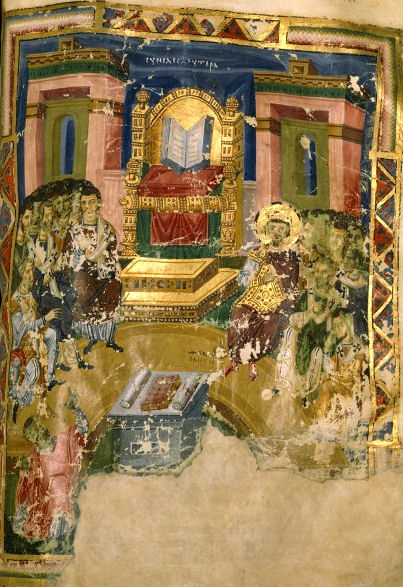
The Ecumenical Councils have a settled iconography, worked out in Byzantine manuscript painting and carried into the fresco cycles that run along the narthex walls of Athonite and Balkan churches, where the seven councils are painted in series. The composition is a synod in session: the bishops seated in a curve or in two facing ranks, vested in phelonion and omophorion, scrolls in their hands; at the centre, on a raised throne, not the emperor but the open Gospel book — the hetoimasia, the prepared throne of Christ, declaring that the council's authority is the Lord's and not the assembly's. The emperor, when shown, sits to one side. Beneath the feet of the Fathers the condemned heretics are painted small and in disorder, their scrolls scattered or torn, sometimes crouching or tumbling out of the frame. For the Second Council in particular the presiding figure is Gregory the Theologian, and the scene may be paired with the Descent of the Holy Spirit, since the council's subject was the Spirit's divinity.
The stored image is the earliest and most authoritative surviving depiction: the miniature of the Council of Constantinople in the imperial copy of the Homilies of Gregory the Theologian made at Constantinople between 879 and 882 for the Emperor Basil I (Paris, Bibliothèque nationale de France, MS grec 510, fol. 355). The throne with the open book stands at the centre beneath a gold canopy, the ranks of bishops to left and right, the haloed figure of Gregory at the right hand of the throne, and below, on the ground, the scrolls of the condemned cast down. The lower third of the folio is lost to damage — the miniature is reproduced here as it survives.
A second stored image gives the subject in its nineteenth-century Russian form: the Second Ecumenical Council painted by Vasily Surikov in 1876, one of the four council compositions he executed for the Cathedral of Christ the Saviour in Moscow. An aged hierarch stands reading the scroll of the Creed before the seated bishops, the Gospel book open on a folding lectern before them. It is an academic history painting rather than an icon, and is kept as a variant for the sake of the subject's later reception; the underlying work is pre-1900 and its author died in 1916, so it is in the public domain.