
Basiliscus of Comana
The Holy Martyr Basiliscus, who suffered at Comana in Pontus
Martyr · d. c. 308 (some accounts c. 310), at Comana Pontica
Commemorated 3 March — Commemorated with Eutropius and Cleonicus, his fellow-confessors at Amasea, 22 May — Martyrdom by beheading at Comana in Pontus
Basiliscus (†c. 308) was a young Christian of the Pontic country, nephew of the great-martyr Theodore the Recruit, who confessed Christ at Amasea together with Eutropius and Cleonicus and was left alive in prison when they were crucified. Driven at last in iron sandals studded with nails to Comana in Pontus, he prayed beside a withered plane-tree that put out leaves while a spring broke from its root, saw the idols of the city fall at his word, and was beheaded, his body thrown into the river and recovered by the faithful. Over his grave outside Comana a martyrium arose — and it was there, ninety-nine years later, that John Chrysostom, dying on the forced march into his last exile, was met in a night vision by Basiliscus with the words, "Take courage, brother John; tomorrow we shall be together." Chrysostom died the next day and was buried beside him.
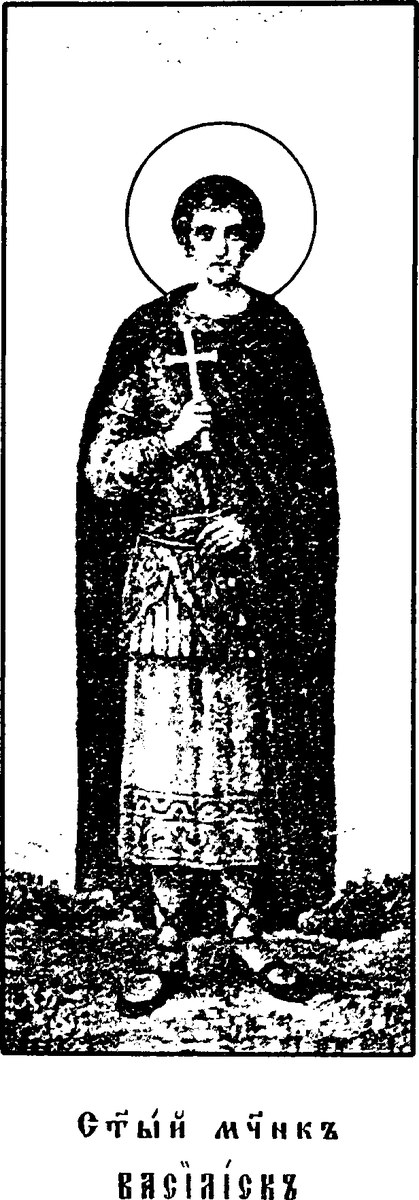

Origins: the kindred of Theodore the Recruit
Basiliscus belonged to the cluster of soldier-saints of Amasea on the river Iris, the Pontic country of northern Asia Minor, whose head is the great-martyr Theodore the Recruit (Tyron), burned alive about the year 306. The Greek passion gives Basiliscus's home village as Chumialon (Χουμιαλά) in the territory of Amasea, and names him expressly as Theodore's nephew — his sister's son. He was, on every account, a young man, and the tradition ranks him with Eutropius and Cleonicus, fellow-soldiers and kinsmen of Theodore, who were arrested in the same sweep and shut in the same prison. Their common story is told under Eutropius, Cleonicus and Basiliscus, whose memory the Church keeps on March 3; the present entry follows the thread that belongs to Basiliscus alone, and which the calendar honours on May 22.
The prison at Amasea and the leave-taking
In the last and fiercest of the persecutions — begun under Diocletian and carried on in the East under Galerius and Maximinus — the three were brought before the governor of Pontus and refused, under bribes and under torture, to sacrifice. Eutropius and Cleonicus were crucified; Basiliscus, the youngest, was not put to death with them. The account has him kept back in the prison at Amasea, whether because his trial was deferred or because the magistrates hoped that a young man left alone would give way.
He did not. In prison the Lord appeared to him — so the passion relates — promising him help and foretelling that he would die at Comana, so that the martyr knew his end before it came. The guards, who had watched his patience and had seen wonders worked at his prayer, so far honoured him that they let him go home to Chumialon to take leave of his mother and his brothers; and there, instead of saving himself, he spent his liberty exhorting his kindred to hold fast to Christ and telling them plainly that he would not see them again.
The march to Comana: the iron sandals, the tree and the spring
A new governor, Agrippa (Ἀγρίππας; Agrippinus in some copies), came to Pontus and resumed the persecution at Amasea. Learning that the imprisoned Christian had been allowed out of the city, he was enraged, and sent soldiers with a hard-handed official to bring him back and then to convey him to Comana for judgement. To punish the concession and to break him on the road, the governor ordered that Basiliscus be shod in iron sandals with the nails driven inward, so that every step tore his feet; and in these he was driven over the Pontic roads.
At the heat of the day the escort halted at a house near a withered plane-tree, and, going in to eat and drink, chained the martyr upright to the dry trunk in the sun. Basiliscus prayed there; and the account relates that as he prayed the ground shook, the dead tree put out green leaves and covered him with its shade, and a spring of sweet water broke from its root and ran at his feet — and that his chains fell from him. The soldiers ran out at the noise; they drank of the spring, loosed the martyr from the tree, and — some of them, the passion says — believed and were baptised, while the sick of the neighbouring village were brought to him and healed. The wonder is the sign by which this saint is remembered: a martyr on the road to death who leaves living water behind him.
Martyrdom at Comana
Brought at last before Agrippa at Comana, Basiliscus was commanded to sacrifice. He answered that he offered God a sacrifice already — a sacrifice of praise and thanksgiving — and that the gods of the city were nothing. Taken into the temple to be compelled, he prayed; and fire came down (so the account has it), the roof of the temple was rent, and the idols fell and were broken to pieces. The governor, more hardened than converted, pronounced the sentence: Basiliscus was beheaded with the sword, about the year 308 (some copies and the Latin martyrologies give c. 310), and his body was cast into the river that the Christians might have no relics.
Relics and the martyrium at Comana
The Christians of Comana drew the body from the water by night and buried it in a ploughed field outside the town. Afterwards a leading man of the place named Marinus, moved by the healings that were worked at the grave, raised a church over the relics; and this martyrium of St Basiliscus, standing outside Comana with its presbyterium — the household of clergy who served it — became a place of pilgrimage and of cures. It is the single most consequential fact about this obscure Pontic martyr, because of what happened at that church a century later.
The vision granted to John Chrysostom
In September 407 the exiled archbishop of Constantinople, John Chrysostom, was being driven on foot toward Pityus on the far north-eastern shore of the Black Sea — an order which his enemies intended, and the soldiers understood, as a sentence of death by exhaustion. Sick and broken, he could go no further than Comana in Pontus, and was lodged in the presbyterium attached to the martyrium of St Basiliscus outside the town.
There, in the night, according to the Dialogue of Palladius — Chrysostom's friend and his earliest biographer, writing within a few years of the event — the martyr appeared to him and said:
Take courage, brother John; for tomorrow we shall be together.
Palladius adds that the priest of the shrine had received in the same night the charge, "Prepare a place for our brother John, for he is coming." In the morning John begged the escort to let him stay until the fifth hour; when they forced the march on him he collapsed within a few miles and was carried back to the martyrium. There he asked for white baptismal garments, put off the clothes he had worn, was given the Holy Mysteries, sealed his life with the words "Glory to God for all things" and the Amen, and died — on 14 September 407. He was buried in that church, beside the relics of Basiliscus; and it was from Comana that the relics of Chrysostom were brought back in triumph to Constantinople in 438 (see Translation of the relics of John Chrysostom).
The martyr's address — brother John — is what the Church has chiefly remembered of Basiliscus: a young provincial who had died unknown a hundred years earlier greeting the greatest preacher of the Christian East as an equal, on the ground of a shared martyrdom. The episode is why a saint with a bare synaxarion notice is nonetheless named in every life of Chrysostom, and it is the reason his martyrium at Comana was remembered at all.
Later veneration
The commemoration is universal in the Greek and Slavonic menaia. In the Caucasus a local tradition of Abkhazia identifies the place of Chrysostom's death — and therefore of Basiliscus's grave — with Kamani (Komany) in the valley of the Gumista near Sukhumi, where a monastery keeps the memory of both saints and shows a tomb ascribed to the martyr. The identification is a local one, is not that of the Byzantine sources, and is treated under Disputed questions; but it has given Basiliscus a living cultus in Georgia and Abkhazia far from Pontus. In Greek use the name Βασιλίσκος and the May 22 memory are also carried into the Ionian and Cretan menologia; in Russia the martyr appears as Василиск Команский in the menaia for May 22 / June 4.
Feast and commemoration
Basiliscus is commemorated on May 22 (church date; New Calendar civil May 22, Old Calendar civil June 4), the day of the martyrdom at Comana, and again on March 3 with his fellow-confessors of Amasea. May 22 is his own day and carries his propers; the Greek synaxarion distich for it turns on his name — Βασιλίσκος, "little king" — and on the beheading: as the martyr gave his head to the sword, he set his foot on the head of the serpent. The same day in the Byzantine calendar carries the Commemoration of the Second Ecumenical Council and, in Slavonic and Greek use alike, the prince-martyr John Vladimir of Serbia; the martyr's memory is therefore usually kept in combination, and in Russian parish practice it is the Council that dominates the day. Because May 22 stands in the weeks after Pascha in some years and after Pentecost in others, the office is joined either to the Pentecostarion or to the ordinary Octoechos according to the year.
Hymns
Apolytikion — Tone 4 (common of a martyr)
Thy martyr Basiliscus, O Lord, has received from Thee, our God, an incorruptible crown for the contest he endured; for, having Thy strength, he cast down the tyrants and broke in pieces the powerless insolence of the demons. At his supplications, O Christ God, save our souls.
Kontakion — Tone 8
Shod in iron and bound to a withered tree, thou didst pray, and the dry wood put forth leaves and a spring of living water broke from its root; wherefore, when thy head was struck off at Comana, thou didst become thyself a fountain of healings, O Basiliscus, and a comfort to the exiled.
Original translation from the Greek
Iconography
Basiliscus is painted as a young martyr, beardless or with the first down of a beard, in the tunic and mantle of a layman — or, where his soldiership is stressed and he is drawn into the warrior type of his uncle Theodore the Recruit, in the short military tunic and cloak — and he holds the cross of confession in his right hand. Two attributes are proper to him and told his images apart in the menologia: the iron sandals, sometimes shown on his feet or lying at them; and the green plane-tree with the spring at its root, which appears in the narrative scene of his passion, with the chained martyr beneath the leaves and the soldiers drinking. His martyrdom is shown as a beheading, and in the fuller cycles a further scene sets him beside the deathbed of John Chrysostom in the martyrium at Comana — the martyr standing at the head of the dying hierarch, which is the only iconographic subject in which the two saints appear together.
The Menologion of Basil II, the usual first resort for minor saints of the fixed year, contains miniatures only for September to February and so has none for either of Basiliscus's feasts (May 22, March 3). A search of Wikimedia Commons for the martyr under his Greek, Latin, and Russian names returned nothing depicting him; the entry is listed as wanting an icon.
The stored image is the captioned plate of the illustrated Zhitiya Svyatykh (1903–1911).
Disputed questions
- Soldier and layman, or bishop of Comana? The Greek passion and the synaxaria present Basiliscus as a young layman — in the fuller accounts a soldier of the Amasean garrison — the nephew of Theodore the Recruit, with no ecclesiastical rank whatever. The English calendar of the Orthodox Church in America nevertheless heads the day "Martyr Basiliscus, Bishop of Comana," and some Western reference works follow it. The episcopal title has no support in the passion, in the Greek synaxarion notice, or in the Slavonic menaion (which reads simply мученик Василиск); it appears to have arisen from the association of his name with the church at Comana of which he was the patron, not the pastor. The disagreement is recorded here rather than resolved: this entry follows the Greek and Slavonic witness and types him martyr only.
- Two feasts, one martyr. The Basiliscus of March 3, commemorated with Eutropius and Cleonicus, is the same person as the Basiliscus of May 22; the two days keep the two stages of one life — the confession and imprisonment at Amasea, and the martyrdom at Comana. He is not to be doubled into two saints. The group entry Eutropius, Cleonicus and Basiliscus states the same identity from the other side.
- Not to be confused with the several other bearers of the name in the calendar — among them the Basiliscus commemorated with the martyrs of Nicomedia, and the fifth-century usurping emperor Basiliscus, who is no saint at all.
- Which Comana? The Byzantine sources place the martyrdom and the martyrium at Comana Pontica, on the Iris, the modern Gümenek near Tokat in Turkey — the same Comana at which Chrysostom died, and from which his relics were fetched in 438. The Abkhazian identification with Kamani near Sukhumi rests on the similarity of the name and on a local tradition of the tomb; it is not attested in Palladius or the fifth-century historians, and this entry treats it as a devotional tradition rather than a topographical finding.
- The year. The passion supplies no consular date. The synaxaria and the modern handbooks give c. 308, reckoning from Theodore the Recruit's death about 306 and the succession of governors; c. 310 is also transmitted, and the Greek notice ties the persecution loosely to "the reign of Maximian." Any year between 306 and 311 is compatible with the account.