
Feast of the Holy Chief Apostles Peter and Paul
The Feast of the Holy, Glorious and All-Praised Chief Apostles Peter and Paul
On June 29 the Church keeps in a single office the memory of the two apostles she calls prōtokoryphaioi, "chief and first-throned" — Peter, the fisherman of Galilee who confessed the Christ and was crucified head downward at Rome, and Paul, the persecutor of Tarsus who was struck down on the Damascus road and beheaded on the Ostian Way. Attested at Rome from the middle of the fourth century and universal in the East from at least the fifth, it is one of the five great feasts of the fixed year outside the Twelve, served with an all-night vigil, and it is the culmination and the close of the Apostles' Fast, which every year runs up to its eve. The two are honoured together not because they were alike — the tradition is candid that they were not, and that they once quarrelled publicly at Antioch — but because their labour, their city and their crown were one.
_-_Icon_of_The_Embrace_of_the_Apostles_Peter_and_Paul_-_WA1982.192_-_Ashmolean_Museum.jpg)
The two apostles
The lives of the two are given separately in this collection, at Peter and Paul; what follows concerns the feast itself. It is worth stating at the outset why the Church pairs them. They are not the first-called (that is Andrew), nor the first martyred (that is James the son of Zebedee), nor the longest surviving (that is John the Theologian). Peter is of the Twelve; Paul is not of the Twelve and not of the Seventy, and never saw the Lord in the flesh. Their pairing is a theological judgement made very early: that the Church of the circumcision and the Church of the Gentiles are one Church, and that the two men who most represent them belong on one day. The Byzantine hymnography says it plainly — Peter the head of the apostles, Paul the teacher of the nations; the rock and the sword; the keys and the epistles.
The origin of the date
The earliest documentary evidence is Roman. The Depositio Martyrum preserved in the Chronograph of 354 enters, under III kalendas Iulias — 29 June — "Peter in the Catacombs and Paul on the Ostian Way, in the consulate of Tuscus and Bassus," that is in the year 258. The entry is nearly two centuries later than the martyrdoms themselves, and its meaning has been argued ever since. Many historians take it to record a translation of the relics to the cemetery ad Catacumbas on the Appian Way during the persecution of Valerian, when the Christian burial grounds were confiscated and the two bodies were moved to safety together; on that reading June 29 is the anniversary of the translation, and the day of the martyrdoms is simply not transmitted. Others hold that 258 is the year of the entry's compilation or of the first public keeping of an older memory. The Church's tradition, followed by all the synaxaria, is that June 29 is the day of the martyrdoms; whether Peter and Paul died in the same year was already disputed in antiquity, the Latin poet Prudentius saying explicitly that a year lay between them.
Rome had by the fifth century three stations on the day — at the Vatican for Peter, on the Ostian Way for Paul, and at the catacombs for both; Leo the Great's sermons for June 29 are among the earliest full witnesses to the feast's rank. In the East the joint commemoration is fixed by the same date and was solemn at Constantinople by the sixth century, with the church of the Holy Apostles as its natural centre. That East and West have kept the same day for the two apostles without interruption through every later division is one of the quiet facts of the calendar.
The Apostles' Fast
In Byzantine practice the feast is the terminus of a fast, and cannot be understood apart from it. The Fast of the Holy Apostles — in Arabic and Greek usage often simply "the fast of Peter and Paul" — begins on the Monday after the Sunday of All Saints, that is on the second Monday after Pentecost, and runs to the eve of June 29. Because its start depends on Pascha and its end does not, it is the one fast of the year with no fixed length: after a very early Pascha it may run six weeks, and after a very late one it shrinks to a few days or vanishes entirely, in which case the eve alone is kept. Its origin is old — it is already presupposed by the Apostolic Constitutions as a fast kept after Pentecost — and its rationale is that of the apostles themselves, who "fasted and prayed" before being sent out from Antioch (Acts 13:2). Its rules are the mildest of the four fasts: fish, wine and oil on most days, with the ordinary strictness on Wednesday and Friday. The feast breaks it, and in most parishes the breaking of the fast at the Liturgy of the Chief Apostles is the day's most tangible mark.
The Synaxis of the Holy Twelve Apostles follows on June 30, the morrow-synaxis by which the Byzantine rite regularly gathers the companions of a great feast; the pattern is the same as that of the Synaxis of the Theotokos after the Nativity or of the Forerunner after the Theophany. Peter is named in it, Paul is not, since he is not of the Twelve.
The feast in the Antiochian tradition
The Church of Antioch has an interest in this day beyond the common one. Peter is by the unanimous ancient lists the founder of its see and its first bishop, with Evodus after him and Ignatius the God-bearer after Evodus; Paul was made an apostle out of Antioch, sent from Antioch, and returned to Antioch, and it was in that city that "the disciples were called Christians first" (Acts 11:26). The one open dispute recorded between the two apostles happened there (Gal. 2:11–14). A great many Antiochian churches, in Syria, Lebanon and the diaspora, bear the two names together, and June 29 is their ʿīd — the patronal feast — as well as the name-day of every Butrus and Bulus. The seventeenth-century Aleppo school of icon-painting, which produced the joint image stored with this entry, is the visible form the feast took in that tradition.
Feast and commemoration
June 29; New Calendar civil June 29, Old Calendar civil July 12. The rank is that of a vigil (ἀγρυπνία) in the Greek books and of a polyeleos-to-vigil feast in the Slavonic, with a forefeast of one day and, in Greek usage, an afterfeast effectively carried by the Synaxis of the Twelve on June 30. It is counted among the five great feasts of the fixed year that stand outside the Twelve Great Feasts, with the Nativity and Beheading of the Forerunner, the Circumcision and the Protection of the Theotokos — the enumeration varies slightly between the Greek and Slavonic traditions, but June 29 is in every version of the list.
Because the day is fixed and the Apostles' Fast is not, the feast's relation to the fast changes from year to year; what does not change is that the fast ends here. In Russian usage the day is Petrov den', one of the great markers of the agricultural year, with a large body of custom attached to it; in Greek usage the panegyris of the innumerable churches of Ἅγιοι Ἀπόστολοι falls on this day. The two apostles have no other joint fixed feast; Peter is commemorated again on January 16 for his precious chains and on June 30 with the Twelve.
Note on schema. the project's constitution fixes a closed list of feast_type values, none of which covers the joint feast of two saints. This entry follows the precedent already set by the Three Holy Hierarchs (January 30) and the Synaxis of the Forerunner (January 7) and uses feast_type: theotokos-synaxis, although the term's name wrongly implies the Theotokos. No new term is minted here; the shortfall belongs with the standing feast_type question already logged in the project's record of open questions.
Hymns
Apolytikion — Tone 4
O first-enthroned among the Apostles and teachers of the inhabited world, intercede with the Master of all things to grant peace to the world and to our souls the great mercy.
Kontakion — Tone 2
The steadfast and God-inspired heralds, the chief of thy disciples, O Lord, thou hast taken to thyself for the enjoyment of thy good things and for rest; for their labours and their death thou hast received above every whole burnt offering, O thou who alone knowest the secrets of the heart.
Original translation from the Greek
Canon
Σταύρωσις εἷλε κήρυκα Χριστοῦ Πέτρον· Τομὴ δὲ Παῦλον, τὸν τεμόντα τὴν πλάνην.
Appointed readings
Epistle — 2 Corinthians 11:21–12:9
21I speak as concerning reproach, as though we had been weak. Howbeit whereinsoever any is bold, (I speak foolishly,) I am bold also. 22Are they Hebrews? so am I. Are they Israelites? so am I. Are they the seed of Abraham? so am I. 23Are they ministers of Christ? (I speak as a fool) I am more; in labours more abundant, in stripes above measure, in prisons more frequent, in deaths oft. 24Of the Jews five times received I forty stripes save one. 25Thrice was I beaten with rods, once was I stoned, thrice I suffered shipwreck, a night and a day I have been in the deep; 26In journeyings often, in perils of waters, in perils of robbers, in perils by mine own countrymen, in perils by the heathen, in perils in the city, in perils in the wilderness, in perils in the sea, in perils among false brethren; 27In weariness and painfulness, in watchings often, in hunger and thirst, in fastings often, in cold and nakedness. 28Beside those things that are without, that which cometh upon me daily, the care of all the churches. 29Who is weak, and I am not weak? who is offended, and I burn not? 30If I must needs glory, I will glory of the things which concern mine infirmities. 31The God and Father of our Lord Jesus Christ, which is blessed for evermore, knoweth that I lie not. 32In Damascus the governor under Aretas the king kept the city of the Damascenes with a garrison, desirous to apprehend me: 33And through a window in a basket was I let down by the wall, and escaped his hands. 1It is not expedient for me doubtless to glory. I will come to visions and revelations of the Lord. 2I knew a man in Christ above fourteen years ago, (whether in the body, I cannot tell; or whether out of the body, I cannot tell: God knoweth;) such an one caught up to the third heaven. 3And I knew such a man, (whether in the body, or out of the body, I cannot tell: God knoweth;) 4How that he was caught up into paradise, and heard unspeakable words, which it is not lawful for a man to utter. 5Of such an one will I glory: yet of myself I will not glory, but in mine infirmities. 6For though I would desire to glory, I shall not be a fool; for I will say the truth: but now I forbear, lest any man should think of me above that which he seeth me to be, or that he heareth of me. 7And lest I should be exalted above measure through the abundance of the revelations, there was given to me a thorn in the flesh, the messenger of Satan to buffet me, lest I should be exalted above measure. 8For this thing I besought the Lord thrice, that it might depart from me. 9And he said unto me, My grace is sufficient for thee: for my strength is made perfect in weakness. Most gladly therefore will I rather glory in my infirmities, that the power of Christ may rest upon me.
Gospel — Matthew 16:13–19
13When Jesus came into the coasts of Caesarea Philippi, he asked his disciples, saying, Whom do men say that I the Son of man am? 14And they said, Some say that thou art John the Baptist: some, Elias; and others, Jeremias, or one of the prophets. 15He saith unto them, But whom say ye that I am? 16And Simon Peter answered and said, Thou art the Christ, the Son of the living God. 17And Jesus answered and said unto him, Blessed art thou, Simon Bar-jona: for flesh and blood hath not revealed it unto thee, but my Father which is in heaven. 18And I say also unto thee, That thou art Peter, and upon this rock I will build my church; and the gates of hell shall not prevail against it. 19And I will give unto thee the keys of the kingdom of heaven: and whatsoever thou shalt bind on earth shall be bound in heaven: and whatsoever thou shalt loose on earth shall be loosed in heaven.
Iconography
Two types dominate. The first is the paired standing or bust image: Peter on the left as the viewer sees it (Christ's right), grey-haired and short-bearded in ochre and blue-green, holding keys, a scroll or a cross-staff; Paul on the right, bald-domed with a long dark pointed beard, in blue-green and deep red, clasping the codex of the Epistles and sometimes a sword. The colours are deliberately crossed so that the two read as a single composition. Very often they hold between them a model of a church, the two of them together supporting it — the most compact statement the tradition makes about the feast.
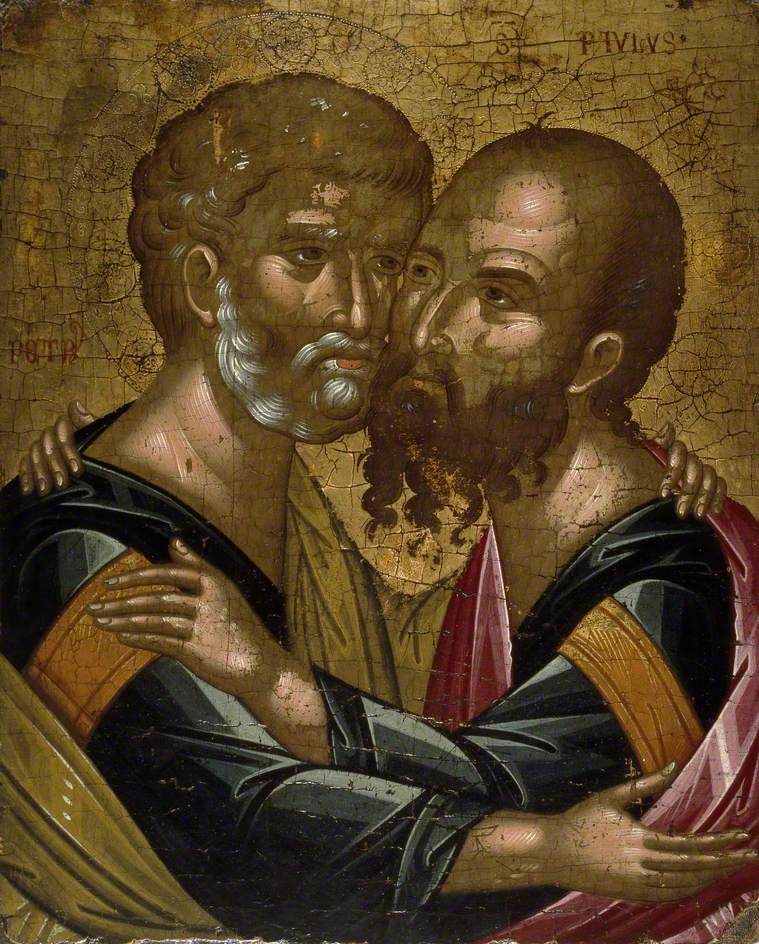
The second is the Embrace of the Apostles (Ἀσπασμὸς τῶν Ἀποστόλων, in Russian Objatie apostolov): the two men in half-length, arms about each other's shoulders, cheek pressed to cheek in the kiss of peace. The type appears in Byzantine art by the eleventh century, is common in Cretan panels of the fifteenth and sixteenth, and is theologically pointed: it shows precisely the two apostles who are recorded as having quarrelled, reconciled and united, and it is the icon most often given as a wedding or peace gift in the Greek world.
The stored primary image is a fifteenth-century Cretan panel by Angelos Akotantos (active 1436–1450), now in the Ashmolean Museum at Oxford: the classic Embrace, with the inscriptions ΠΕΤΡ(ΟΣ) at the left and S. PAVLVS at the right in the Latin form usual in Venetian Crete, Peter with white curling hair and beard, Paul bald and dark-bearded, each with a hand on the other's shoulder against a gold ground now finely craquelured.
A second image is stored as a variant: an Aleppo icon of 1667, tempera on panel, of the Antiochian school, now in the Melkite archeparchy of Aleppo (photographed for Wikimedia by Michel Bakni; the underlying panel is of 1667 and long out of copyright, and the photograph is a faithful flat reproduction of a two-dimensional work, so the storage rests on the age of the panel and not on the photographer's grant). It shows the paired standing type in the distinctive Syrian idiom — flat gold ground, the Greek inscriptions Ο ΑΓΙΟΣ ΠΕΤΡΟΣ and Ο ΑΓΙΟΣ ΠΑΥΛΟΣ, Peter in brown with a great ring of keys hanging at his side and his hand extended toward Paul, Paul in pale yellow holding a jewelled book — and is included here because the Aleppo workshops of the seventeenth century are the visible tradition of the Church of Antioch in this collection's own frame of reference.