
Andrew Bogoliubsky
The Holy Right-believing Great Prince Andrew Bogoliubsky, passion-bearer, of Vladimir
Passion Bearer · Prince · b. c. 1111 — d. night of 29–30 June 1174, at Bogolyubovo; buried 4 July
Commemorated 4 July — Burial in the Dormition cathedral at Vladimir after his murder at Bogolyubovo
Andrew Bogoliubsky (c. 1111–1174), son of Yuri Dolgoruky and grandson of Vladimir Monomakh, is the great prince who moved the centre of gravity of the Russian lands from Kiev to Vladimir, and who is venerated as a passion-bearer for the manner of his death. He carried the Vladimir Icon of the Mother of God north from Vyshgorod in 1155; at the place where the horses would go no further he founded Bogolyubovo, from which he takes his name, and there had the vision that produced the Bogolyubskaya icon. He built about thirty churches — the Dormition cathedral at Vladimir, the Golden Gate, the Intercession on the Nerl — sought a metropolitan see of his own from Constantinople, and established two feasts still kept by the Russian Church: the Protection of the Mother of God (October 1) and the All-Merciful Saviour (August 1). On the night of 29–30 June 1174 he was cut down in his own palace at Bogolyubovo by a conspiracy of his household; the Church keeps July 4, the day of his burial in the Dormition cathedral. His incorrupt relics were uncovered there in 1702.

The son of Dolgoruky
Andrew was born about 1111, the son of Yuri Dolgoruky, prince of Rostov-Suzdal, by a Polovtsian (Cuman) princess, daughter of Khan Aepa — and so, on his father's side, a grandson of Vladimir Monomakh. He was brought up in the north-eastern forests, in the young towns of the Zalesye which his father was founding: Moscow (first named in 1147), Yuriev-Polsky (1152), Dmitrov (1154).
The chroniclers agree on two things about him from the start: he was a formidable soldier, and he was devout to a degree that struck his contemporaries. He rose for the night office and went to the churches before matins with his own candles; he gave freely to the poor and to the clergy; and he preferred the north to the endless dynastic campaigning in the south. The by-name Bogoliubsky — "the God-loving" — is drawn from his residence at Bogolyubovo, but the chroniclers plainly heard it as a description. In the fighting near Lutsk in 1150 he was nearly killed and attributed his escape to the prayers of the Great Martyr Theodore Stratelates, on whose feast it happened.
The icon that would not go further
In 1155, tired of his father's southern wars, Andrew left his appanage at Vyshgorod near Kiev and went north — without Yuri's leave, and taking with him the wonderworking icon of the Mother of God that had come from Constantinople and was kept in the convent there. Ten versts short of Vladimir, at the meadow above the Klyazma, the horses drawing the icon stopped and could not be made to go on. Andrew kept vigil there through the night, and the Theotokos appeared to him, holding a scroll, and bade him leave the icon at Vladimir and not carry it to Rostov as he had intended, and build a church on the place of the vision.
Out of that night came three things: the Vladimir Icon of the Mother of God, henceforth the palladium of the Russian land and one of the most venerated images in Orthodoxy; the Bogolyubskaya icon, which Andrew commissioned to depict the Mother of God exactly as she had stood before him with the scroll; and the town and monastery of Bogolyubovo (from 1158), with the prince's stone palace beside the church — the only surviving fragment of civil architecture of pre-Mongol Rus, and the place where he would be killed.
The building of Vladimir
On his father's death in 1157 Andrew became prince of Rostov, Suzdal and Vladimir, and made Vladimir — a town of no great antiquity, without a boyar aristocracy to bargain with — his capital, in deliberate preference to the old cities. He then built on a scale nobody in Rus had attempted since Yaroslav.
The cathedral of the Dormition at Vladimir (1158–1160) was raised to house the Vladimir Icon and endowed with a tithe of the principality's revenues; it became the metropolitan church of north-eastern Rus and, in the following centuries, the model on which the Dormition cathedral of the Moscow Kremlin was built. He raised the Golden Gate of Vladimir (1164), and, in 1165, in memory of his son Izyaslav, the church of the Intercession on the Nerl — a small white church standing alone in a water-meadow, generally reckoned the most beautiful building in Russia. The chronicles credit him with about thirty churches in all.
The two feasts, and the quarrel over the metropolitanate
Andrew's church policy was of a piece with his politics: he wanted the north to be ecclesiastically as well as politically independent of Kiev, and he petitioned the patriarch of Constantinople, Luke Chrysoberges, for a separate metropolitan see at Vladimir. The patriarch refused; the most Andrew obtained was the honour of the white klobuk for his bishop, Theodore, as a mark of dignity. The affair ended badly — Theodore ("Feodorets") quarrelled with the metropolitan of Kiev, was condemned and put to death there in 1169 — and the chroniclers are divided on how much of the blame is Andrew's.
Two feasts, however, are securely his gift to the Russian calendar:
- The Protection of the Mother of God (Pokrov), October 1 — the commemoration of the vision of Andrew the Fool-for-Christ at Blachernae, which the Greeks had never made a feast. Andrew Bogoliubsky established it in his lands, and it became, and remains, one of the best-loved feasts of the Russian Church.
- The Procession of the Precious Cross and the All-Merciful Saviour, August 1 — instituted after his victory over the Volga Bulgars in 1164, when the Cross and the Vladimir Icon were carried before the army; the same day was said to have brought the emperor Manuel Comnenus a victory over the Saracens, and the two rulers agreed to keep the feast together.
The sack of Kiev
The record is not all light. In 1169 Andrew sent an army south under his son Mstislav which took Kiev by storm and sacked it for three days, burning churches and the Caves monastery and carrying off their treasures and icons — the first time the mother-city of Rus had been plundered by Rus. Andrew did not go himself, and did not take the Kievan throne, sending a brother to hold it and remaining at Vladimir: the point of the campaign was precisely that Kiev no longer mattered. The chroniclers of the south never forgave him, and the event is inseparable from the judgement of his reign. It is recorded here because a hagiography that suppressed it would not be worth reading; the Church glorified him for the manner of his death, not for the conduct of his wars.
The murder at Bogolyubovo
Andrew ruled his boyars hard, and in the summer of 1174 a conspiracy formed against him in his own household: the Kuchkovichi — the kin of Stephen Kuchka, whose lands had become Moscow and whose daughter had been Andrew's wife — together with his steward, his keeper of the keys, and about twenty others.
On the night of 29–30 June they broke into the prince's chamber in the palace at Bogolyubovo, having first stolen away his sword — the sword of Saint Boris, which hung at his bed. Andrew, an old man of sixty-three, fought them off bare-handed in the dark and was struck down with many wounds. Believing him dead, the murderers went to drink; but he had recovered and crawled down the staircase turret, and they traced him by the blood and killed him at the foot of the stair. He died, the chronicler says, praying and forgiving: Lord, into thy hands I commend my spirit. The parallel with Boris and Gleb, the first Russian passion-bearers, was drawn at once, and it is the reason for his classification.
His body was thrown out and lay unburied while Bogolyubovo was plundered. A servant of his, Kuzma of Kiev, recovered it, wrapped it and got it into the church porch. Only after two days was it taken into the church of the Nativity of the Theotokos at Bogolyubovo, and on the sixth day it was carried in procession to Vladimir and laid in the Dormition cathedral. That burial is the commemoration of July 4.
Relics and veneration
Local veneration began early — the Tale of the Murder of Andrew Bogoliubsky, written in Vladimir within a generation, is already a martyr's passion in form and calls him "the second Boris." His relics were uncovered incorrupt in 1702 in the Dormition cathedral at Vladimir, and general church veneration follows from that date; they rest there still. He is commemorated also in the Synaxis of the Saints of Vladimir. The Bogolyubskaya icon, made at his order, is itself one of the great wonderworking images of Russia.
Feast and commemoration
July 4 (church date; New Calendar civil July 4, Old Calendar civil July 17) — the burial of the holy prince. He is kept by the Russian Orthodox Church and by the Orthodox Church in America, and is commemorated additionally in the Synaxis of the Saints of Vladimir (June 23). The day is shared, in the Russian books, with Andrei Rublev and the Royal Martyrs of Russia, and universally with Andrew of Crete.
Hymns
Apolytikion — Tone 8 (of a right-believing prince and passion-bearer)
Thou didst love Christ above a kingdom, and didst adorn thy land with churches as with stars; and when the murderers came upon thee in the night, thou didst render thy soul into the hands of God with forgiveness upon thy lips. O holy passion-bearer Prince Andrew, entreat Christ God that our souls may be saved.
Kontakion — Tone 8
Thou didst bring the icon of the Mother of God into the land of Vladimir, and she took it for her own dwelling; thou didst build her a house of white stone, and she received thee, slain in the night, into her protection. Wherefore we cry to thee: Rejoice, O Andrew, God-loving prince and passion-bearer.
Original translation from the Slavonic
Iconography
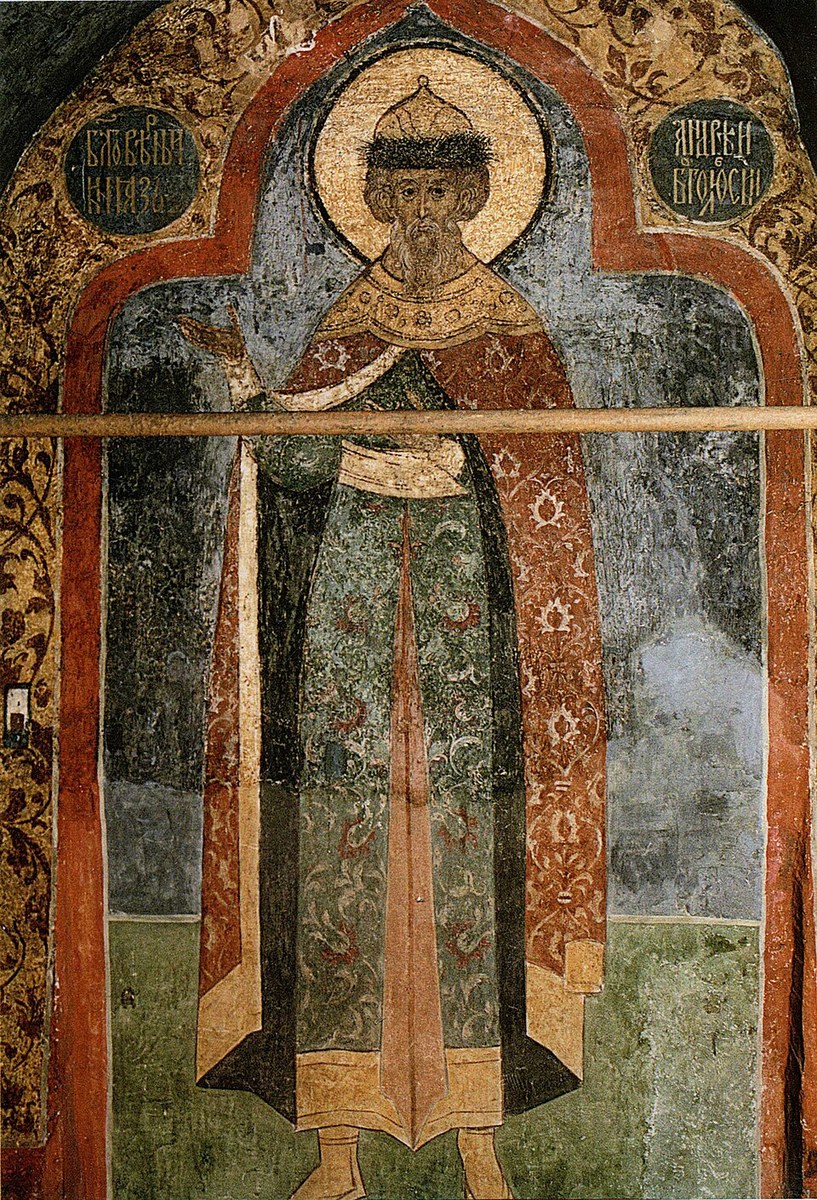
Andrew is painted as a right-believing prince: a bearded man of middle age in the princely dress — a long patterned kaftan and a heavy mantle, with a fur-trimmed cap or a small crown — and with a halo, his right hand raised in prayer or holding a cross, his left often holding a model of a church, the sign of a builder, or, in the Vladimir types, the Bogolyubskaya icon with the Mother of God and her scroll. In narrative cycles he appears in the scene of the vision on the Klyazma, kneeling before the standing Theotokos, and in the scene of his murder.
The stored image is his figure from the princely portrait gallery of the Archangel Cathedral of the Moscow Kremlin — the dynastic necropolis of the Muscovite house, whose walls carry a full-length series of the ancestral princes. The programme is that of 1564–65, surviving in the careful recreation of 1652–66; Wikimedia Commons dates the painting to the sixteenth century. The prince stands frontally in a green-and-gold patterned robe under a red mantle, haloed and crowned, his right hand open in prayer, beneath a painted arch, and the medallions to either side of his head carry the inscription Блговѣрный князь / Андреи Боголюбскіи — "the right-believing prince Andrew Bogoliubsky" — on which the identification rests.
Disputed questions
- Whose kinsmen killed him? The Russian chronicles name the Kuchkovichi, the family of his first wife, at the head of the conspiracy, with the steward Anbal the Yasin and the key-keeper Ephrem Moizich. The Orthodox Church in America's life instead makes the ringleaders the brothers of his second wife, a Volga Bulgar, on the ground that his campaigns had ruined her people. The two accounts are not reconcilable and both are current; the chronicle version is followed here and the other recorded.
- The date of death and the date of the feast. The murder is placed on the night of 29–30 June 1174 (some sources give 28–29 June); the Church commemorates him on July 4, which is the day of his burial at Vladimir, and the calendars are careful to style the day "the burial of the holy prince Andrew." A death-day feast would in any case have collided with the feast of the Apostles Peter and Paul.
- Passion-bearer or martyr? He is glorified as blagovernyi knyaz and passion-bearer, not as a martyr: he was killed for political reasons by fellow Christians, and accepted the death with forgiveness. The distinction is the same one made for Boris and Gleb, and it is a precise one.
- The character of his reign. Modern historians read him as the first Russian ruler to attempt autocracy — the founder of the Vladimir-Suzdal ascendancy from which Moscow grew — and as the author of the sack of Kiev in 1169. The hagiographic tradition and the historical assessment have never been fully reconciled, and this entry does not attempt to reconcile them.
- Not to be confused with the other saints named Andrew commemorated on July 4: Andrew of Crete the hymnographer, and the iconographer Andrei Rublev.