
Synaxis of the Archangel Michael and the Other Bodiless Powers
Kept 8 November — The chief feast of the Archangel Michael and all the angelic orders
On November 8 the Church keeps the chief of her feasts of the holy angels: the Synaxis (assembly) of the Archangel Michael and all the Bodiless Powers of heaven. The feast gathers into one commemoration the whole angelic world — the nine orders ranged by tradition in three triads, from the Seraphim before the throne to the guardian angels closest to men — under the leadership of Michael the Archistrategos, "chief commander" of the heavenly hosts, who at the fall of Lucifer rallied the faithful angels with the cry that is his very name: "Who is like God?" With Michael the feast names the archangels Gabriel, Raphael, Uriel, Selaphiel, Jegudiel, Barachiel, and (in many books) Jeremiel. Its date is itself a sermon: November, the ninth month from March, for the nine ranks; the eighth day, for the Eighth Day of the age to come, when the angels shall come with the Son of Man in his glory.

The angels in Scripture and the Church's faith
The existence of a vast created order of spirits, "ministering spirits, sent forth to minister for them who shall be heirs of salvation" (Hebrews 1:14), runs through the whole of Scripture: the cherubim set at the gate of Eden, the angel of the Lord that stays Abraham's hand and wrestles with Jacob, the hosts seen by Isaiah and Ezekiel and Daniel, the archangel Gabriel who announces the Forerunner and the Incarnation, the angel who rolls back the stone, the "war in heaven" of the Apocalypse. The Church confesses the angels in the first article of the Creed, among the "things invisible" made by God through the Son (Colossians 1:16); they are creatures, not gods — bodiless, deathless, mighty, but finite and made — and the whole point of a feast of the angels is to honour them rightly, as fellow-servants, without the idolatry that turns servants into lords.
That danger was real and local. The valley of the Lycus in Phrygia, where the Miracle at Chonae would later be set, had been warned by the Apostle Paul himself against a "worshipping of angels" (Colossians 2:18), and the mid-fourth-century Council of Laodicea, meeting a few miles away, condemned in its thirty-fifth canon the practice of "naming" and invoking angels as though they were rulers of the world, anathematizing it as a forsaking of Christ — while affirming the angels' true veneration. The received tradition sees in that same council the establishing of the November 8 feast: the Church's positive answer to a crooked piety, fixing the honour of the angels within the confession of the one God whom they serve.
The nine orders: the hierarchy of Dionysius
The Church's ordered account of the angelic world — nine "ranks" (τάγματα) gathered into three triads — is drawn from Scripture but systematised in the treatise On the Celestial Hierarchy, part of the Corpus Areopagiticum transmitted under the name of Dionysius the Areopagite, the Athenian convert of Paul. Whatever the true date and authorship of that profound mystical-theological corpus — a question treated in the Areopagite's own entry — its scheme of the nine orders was received by the Fathers of East and West (Gregory the Theologian and Gregory the Great among them) and became the Church's common language for the invisible world; the hymns of this very feast presuppose it.
Dionysius names the nine from the words of Scripture and arranges them by their nearness to God:
- The first and highest triad, immediately about the throne: the Seraphim ("burning ones," Isaiah 6), six-winged, aflame with love and kindling it in others; the Cherubim ("fullness of knowledge," Genesis 3:24; Ezekiel 10), many-eyed, radiant with the light of the knowledge of God; and the Thrones (Colossians 1:16), who bear God mystically and are the ministers of his justice.
- The middle triad, the order of governance: Dominions (Κυριότητες), who rule the lower angels and teach the mastery of self; Powers (Δυνάμεις), who work the miracles of God and strengthen the patient; and Authorities or Virtues (Ἐξουσίαι), who hold power over the demons and shield men from temptation.
- The lowest triad, nearest to the created world and to us: Principalities (Ἀρχαί), who watch over nations and rulers; Archangels, the messengers of God's great tidings, who reveal the prophecies and mysteries of the faith; and Angels, the lowest and closest to men, the guardians who guide, uphold the steadfast, and raise the fallen, and "never abandon us, and are always ready to help, if we desire it."
All nine are called, loosely, "angels," from their office of being sent (ἄγγελος, messenger); the Lord reveals his will to the highest, who pass it in turn to the lower, so that the whole hierarchy is a single ladder of light from God to man. The feast keeps them all together — this is the force of the word Synaxis, an assembly — with Michael at their head.
Michael the Archistrategos and the fall of Lucifer
Over all nine ranks the tradition sets the Archangel Michael as Ἀρχιστράτηγος, chief-commander of the hosts of the Lord — the title under which he appears to Joshua (below) and the character in which the Church invokes him. His pre-eminence is bound up with the primal catastrophe of the spiritual world. When Lucifer, "son of the morning" (Isaiah 14:12), the highest of the creatures, was lifted up in pride and would set his throne above God's, drawing after him a third of the stars of heaven (Revelation 12:4), it was Michael who stood fast and rallied the angels who remained faithful. The Church hears in his Hebrew name itself — mi-ka-El, "Who is like God?" — the war-cry of that first battle: not a name only but a confession, the humble creature's refusal of the creature's self-exaltation, hurled against the "I will be like the Most High." "Let us attend! Let us stand aright before our Creator," the tradition puts on his lips, "and let us not consider doing what is displeasing to God." So the Apocalypse: "there was war in heaven: Michael and his angels fought against the dragon; and the dragon fought and his angels, and prevailed not" (Revelation 12:7–9). The feast of the Bodiless Powers is therefore also a feast of the great confession by which the angelic world was divided and confirmed: the good angels fixed for ever in the love of God, the fallen fixed for ever in their revolt.
The named archangels
Beyond Michael, Scripture and tradition give the names and offices of the chief archangels — seven "who stand before God" (Tobit 12:15; Revelation 8:2), to whom an eighth is often added. The Church names them and reads their names as their ministries:
- Michael — "Who is like God?" — chief commander, defender of the people of God, who treads down the dragon.
- Gabriel — "the strength of God" — the herald of the divine counsels, who announced to Zachariah the birth of the Forerunner (Luke 1:19) and to the Virgin the Incarnation of the Word (Luke 1:26), and who is honoured in his own synaxis on the day after the Annunciation (March 26) and again on July 13.
- Raphael — "the healing of God" — the companion and healer of the Book of Tobit (Tobit 3:16; 12:15).
- Uriel — "the fire (or light) of God" — the enlightener of darkened minds (2 Esdras 4–5).
- Selaphiel — "the prayer of God" — who moves men to prayer and prays for them.
- Jegudiel (Jehudiel) — "the glorifier of God" — who encourages labour for the glory of God and intercedes for its reward.
- Barachiel — "the blessing of God" — the distributor of God's blessings on good works.
- Jeremiel (Jerahmeel) — "the exaltation of God" — the eighth name, added in many books from 2 Esdras 4:36.
The biblical appearances of Michael
The Church's veneration of Michael rests on a chain of scriptural manifestations, which the hymns of the feast and the synaxarion rehearse:
- Joshua at Jericho. When Joshua son of Nun stood before the walls of Jericho, "there stood a man over against him with his sword drawn in his hand," who declared himself "captain of the host of the Lord" (ἀρχιστράτηγος δυνάμεως Κυρίου), and bade Joshua loose his sandal, for the ground was holy (Joshua 5:13–16). The tradition reads this captain of the Lord's host as Michael, and it is from this passage above all that his standing title Archistrategos derives.
- Daniel. In the visions of Daniel, Michael is "one of the chief princes" who comes to the aid of the people (Daniel 10:13, 21), and "the great prince which standeth for the children of thy people," who shall arise at the time of the end (Daniel 12:1) — the angelic guardian of Israel, and so, the Church reads, of the new Israel.
- Jude. The Epistle of Jude records that "Michael the archangel, when contending with the devil he disputed about the body of Moses, durst not bring against him a railing accusation, but said, The Lord rebuke thee" (Jude 9) — a fragment of ancient tradition witnessing both to Michael's authority over the adversary and to his own creaturely humility.
- The Apocalypse. In Revelation 12:7 Michael leads the angels in the war against the dragon, the definitive scriptural image of his office as commander of the heavenly host.
To these Scripture and tradition join the many acts of the "power of the Lord" wrought through the Archangel: the pillar of cloud and fire before Israel in the Exodus and the drowning of Pharaoh's host; the smiting of the hundred and eighty-five thousand of Sennacherib's army in a night (4 Kingdoms 19:35); the protection of the Three Youths in the furnace (Daniel 3) and of Daniel among the lions; and, in the age of the Church, deliverances without number — among them the Miracle at Chonae, where Michael cleft the rock to swallow the flood loosed against his shrine, a wonder so beloved that it holds its own feast on September 6 and shares its hymns with this day.
Why the eighth of the ninth month
The date is chosen to teach. In the old reckoning the year began in March; November is therefore the ninth month, kept for the nine ranks of the angels. And the eighth day is chosen because the number eight is, for the Fathers, the number of the age to come: the present world runs in the seven days of its creation, but "after the end of this age will come the Eighth Day," the day of the Dread Judgment that has no evening, when — as the Gospel of the feast proclaims — "the Son of man shall come in his glory, and all the holy angels with him" (Matthew 25:31). The angels who now minister unseen will then be revealed as the reapers and the retinue of the Judge; to keep their feast on the eighth day is to set the whole angelic world under the sign of that consummation.
The spread of the feast and the dedication of churches
From its Byzantine establishment the Synaxis of the Bodiless Powers became one of the great fixed feasts of the angelic year and the head of a whole cycle of Michaelite commemorations — with the Miracle at Chonae (September 6), the Synaxis of Gabriel (March 26 and July 13), and countless local dedications. Its hold on the Christian imagination is measured in stone: from the sanctuary of Monte Gargano and the Michaelion at Constantinople to the innumerable churches, cathedrals and monasteries of the East, the Archangel is among the most widely dedicated of all the saints. In Rus' the devotion was especially intense — "there was not a city," the old accounts say, "without a church or chapel of the Archangel Michael"; the Archangel Cathedral (Arkhangelsky Sobor) in the Moscow Kremlin became the burial church of the grand princes and tsars, and cathedrals of the Archangel rose at Kiev, Smolensk, Nizhny Novgorod, Great Ustiug and elsewhere. Michael was invoked as the defender of cities and of armies, the conqueror of every spiritual and bodily enemy — the "Blessed Host of the Heavenly King," as a famous Kremlin icon names the Christian soldiery ranged under his command.
Feast and commemoration
November 8 (church date; New Calendar civil November 8; Old Calendar civil November 21), kept universally in the Byzantine rite as the principal feast of the holy angels. The Menaion appoints a full festal service of the Bodiless Powers, and the day is one of the more solemn of the fixed November calendar; in many places it is a patronal feast of the first magnitude. It is not of the Twelve Great Feasts, and falls within no fasting season (the Nativity Fast begins on November 15). The feast heads the year's cycle of angelic commemorations and shares its principal hymns — troparion and kontakion — with the Miracle of the Archangel Michael at Chonae (September 6). In 2026 November 8 falls on a Sunday, when the Resurrectional service of the tone is combined with the feast.
Hymns
Troparion — Tone 4
Commanders of the heavenly hosts, we the unworthy implore you: by your prayers encompass us with the shelter of the wings of your immaterial glory, and guard us who fall down before you and cry out with fervour: deliver us from dangers, O marshals of the powers on high.
Original translation from the Greek
Kontakion — Tone 2
Chief commanders of God, ministers of the divine glory, guides of men and leaders of the Bodiless Powers: ask for us what is profitable, and great mercy, as chief commanders of the Bodiless hosts.
Original translation from the Greek
Appointed readings
Epistle — Hebrews 2:2–10
2For if the word spoken by angels was stedfast, and every transgression and disobedience received a just recompence of reward; 3How shall we escape, if we neglect so great salvation; which at the first began to be spoken by the Lord, and was confirmed unto us by them that heard him; 4God also bearing them witness, both with signs and wonders, and with divers miracles, and gifts of the Holy Ghost, according to his own will? 5For unto the angels hath he not put in subjection the world to come, whereof we speak. 6But one in a certain place testified, saying, What is man, that thou art mindful of him? or the son of man, that thou visitest him? 7Thou madest him a little lower than the angels; thou crownedst him with glory and honour, and didst set him over the works of thy hands: 8Thou hast put all things in subjection under his feet. For in that he put all in subjection under him, he left nothing that is not put under him. But now we see not yet all things put under him. 9But we see Jesus, who was made a little lower than the angels for the suffering of death, crowned with glory and honour; that he by the grace of God should taste death for every man. 10For it became him, for whom are all things, and by whom are all things, in bringing many sons unto glory, to make the captain of their salvation perfect through sufferings.
Gospel — Luke 10:16–21
16He that heareth you heareth me; and he that despiseth you despiseth me; and he that despiseth me despiseth him that sent me. 17And the seventy returned again with joy, saying, Lord, even the devils are subject unto us through thy name. 18And he said unto them, I beheld Satan as lightning fall from heaven. 19Behold, I give unto you power to tread on serpents and scorpions, and over all the power of the enemy: and nothing shall by any means hurt you. 20Notwithstanding in this rejoice not, that the spirits are subject unto you; but rather rejoice, because your names are written in heaven. 21In that hour Jesus rejoiced in spirit, and said, I thank thee, O Father, Lord of heaven and earth, that thou hast hid these things from the wise and prudent, and hast revealed them unto babes: even so, Father; for so it seemed good in thy sight.
Iconography
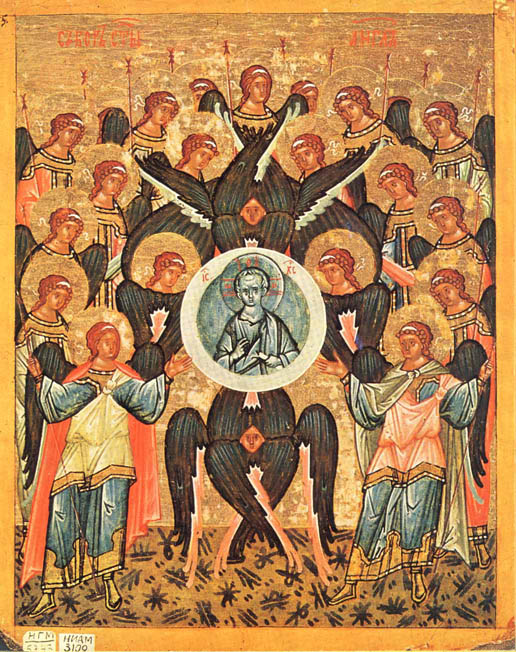
The classic image of the feast is the Synaxis of the Archangels (Собор архангелов, the "Angelic Deesis"): the two chief archangels, Michael and Gabriel, stand facing the viewer and incline toward one another, together bearing between them a great disc or mandorla — a "mirror" or medallion — within which appears the bust of the youthful Christ Emmanuel, blessing; about and above them hover the six-winged Seraphim and the many-eyed Cherubim, and in developed versions the further ranks of the heavenly host are ranged in tiers. The composition is at once a portrait of the angelic world and a confession that the angels exist wholly for the service and the showing-forth of Christ, whom they carry and adore. A second great type is Michael the Archistrategos as warrior: winged, armed, treading the dragon underfoot, holding a spear or a flaming sword and often a green branch or a sphere; and a third is the narrative composition of the deeds of the Archangel, with the Miracle at Chonae at its centre.
The stored primary icon is a Russian panel of the end of the fifteenth century of the Synaxis type — Michael and Gabriel bearing the medallion of Christ Emmanuel, with the seraphim about them. The stored variant is one of the great early witnesses of the type: the "Christ Emmanuel with the Archangels" (the Angelic Deesis) of about 1190, painted probably at Vladimir and long kept over the north doors of the Dormition Cathedral of the Moscow Kremlin, now in the Tretyakov Gallery — the Emmanuel enthroned in a medallion between the two inclining archangels, a work of the highest rank of pre-Mongol Rus'.