
Synaxis of the Most Holy Theotokos
The Synaxis of our Most Holy Lady the Theotokos and Ever-Virgin Mary
On December 26, the second day of the Nativity of Christ, the Church keeps the Synaxis of the Most Holy Theotokos — the assembly of the faithful to honour the Virgin Mary, the Mother of God, through whom the Incarnation came to pass. It follows an ancient pattern by which the day after a Great Feast honours the chief human participant in the mystery: as September 9 honours Joachim and Anna after the Nativity of the Theotokos, and January 7 honours the Forerunner after Theophany, so the morrow of Christ's birth is given to her who bore him. The day also carries the Church's commemoration of the Flight into Egypt (Matthew 2:13–15), when Joseph, warned by an angel of Herod's murderous intent, took the Child and his Mother by night into Egypt — at whose coming, the tradition says with Isaiah, the idols of Egypt fell. Falling within the fast-free days after the Nativity, it is kept with the festal hymns of the afterfeast, the proper service of the Theotokos joined to them.

The meaning of the "synaxis"
A synaxis (σύναξις, "a gathering, an assembly") is, in the language of the liturgical books, a service at which the faithful come together to honour a particular person or event of the sacred history — most often the person who stood closest to a mystery just celebrated. The Byzantine calendar keeps a recurring rhythm: the day of a Great Feast glorifies the central act of God, and the day after "assembles" in honour of the human being through whom that act was accomplished. So the day after the Nativity of the Theotokos (September 9) is the synaxis of her parents, the righteous Joachim and Anna; the day after Theophany (January 7) is the synaxis of John the Forerunner, who baptised the Lord; the day after the Meeting the synaxis of Symeon and Anna; and the day after the Annunciation (March 26) the synaxis of the Archangel Gabriel, who brought the message. By the same logic the second day of the Nativity of Christ is the synaxis of the one who gave the incarnate God his flesh: the Most Holy Theotokos. On the first day the Church glorifies the Redeemer born for the salvation of the world; on the second she turns to honour, "in an appropriate manner," the Ever-Virgin who bore him. The feast is old: fourth-century fathers, among them Epiphanius of Cyprus, already witness to it, and in the ancient Menaia the day bore the names "the Nativity Gifts" — for the gifts of the Magi to the newborn King — and "the Flight into Egypt."
The Theotokos: Mother of God, new Eve, living Temple
The synaxis is the Church's festal confession of the title the whole mystery of this week rests upon: Theotokos, "the one who gave birth to God." The title was not invented at a council; it was the received devotion of the Christian people, sung and prayed for centuries before it was defined. But when Nestorius, patriarch of Constantinople, taught in 428 that Mary should be called only Christotokos, "Mother of Christ" — as though the man born of her were joined to the Word rather than being the Word made flesh — the title became the touchstone of the faith of the Incarnation. The homily of Proclus of Constantinople "in praise of the holy Virgin Theotokos," preached before Nestorius himself, opened the public controversy; and the Third Ecumenical Council, gathered at Ephesus in 431 under the presidency of Cyril of Alexandria, confessed that the one born of the Virgin is truly God, and therefore that she who bore him is truly Theotokos, Mother of God. To deny her the title is to divide the one Christ; to give it her is to confess that in her womb God and man were made one. The feast of the Synaxis is, in effect, the calendar's yearly keeping of the faith of Ephesus at the very place where it is most concrete — the manger.
Around the one title the hymnography gathers the ancient images of the Mother of God. She is the new Eve: where the first woman, deceived, opened the door to death, the second, believing, opened it to Life, so that (as the stichera of the day sing) the flaming sword that guarded paradise turns back and the way to the tree of life is opened again. She is the living Temple and the animate ark, the one who contained in her body the God whom the heavens cannot contain; the unhewn mountain of Daniel, the bush unconsumed of Moses, the shut gate of Ezekiel through which the Lord alone has passed. These are not ornaments of praise only: each is a way of confessing that a real human woman truly bore the real and undivided God, and that in bearing him she was not consumed but glorified.
The Flight into Egypt
To the Synaxis the tradition joined the memory of the Flight into Egypt, and the day still carries it. The Gospel of Matthew relates that after the Magi had departed, an angel of the Lord appeared to Joseph in a dream: "Arise, and take the young child and his mother, and flee into Egypt, and be thou there until I bring thee word: for Herod will seek the young child to destroy him" (Matthew 2:13). Joseph rose in the night and went down into Egypt, and remained there until the death of Herod, "that it might be fulfilled which was spoken of the Lord by the prophet, saying, Out of Egypt have I called my son" (Matthew 2:15, citing Hosea 11:1). The flight sets the newborn Christ at once under the shadow of the Cross: the King is hunted from his cradle, and the massacre of the Innocents of Bethlehem (kept three days later, on December 29) follows upon Herod's frustrated wrath.
The Church read the descent into Egypt through the prophecy of Isaiah: "Behold, the Lord sitteth upon a swift cloud, and shall come into Egypt, and the idols of Egypt shall be moved at his presence, and their heart shall faint within them" (Isaiah 19:1). From this the tradition drew the image, dear to festal hymnody and iconography, of the idols of Egypt toppling from their pedestals as the Christ-child entered the land — the first-fruits of the Gospel's conquest of the whole idolatrous world, worked not by force but by the mere presence of the incarnate God carried in his Mother's arms. The "swift cloud" on which the Lord comes the fathers read, in turn, as a figure of the Virgin herself, light and undefiled, bearing God without the seed of man; the same image returns at the Transfiguration. So the Flight, joined to the Synaxis, honours the Theotokos precisely in her office: she is the one who bears God into the world, and into Egypt, and wherever the idols must fall.
Joseph, David, and James: the kindred of the Incarnation
Anciently the second day of the Nativity also gathered the memory of the household of the Incarnation — Joseph the Betrothed, guardian of the mystery; David the King, from whose line the promise came; and James the Brother of the Lord, Joseph's son, who shared the flight and the return. In the received order of the calendar this commemoration has become the movable Sunday after the Nativity, kept on whatever Sunday falls between December 26 and 31 (or on December 26 itself when no Sunday intervenes) — so that in many years the two coincide, and the fixed December 26 remains the historic anchor of their joint honour. The tradition that identifies the youth leading the donkey in the icon of the Flight as James the Brother of the Lord binds the two commemorations together: the kindred who guarded the child are honoured on the same day the Church honours his Mother.
Feast and commemoration
December 26 (church date; Old Calendar civil January 8), the second day of the Nativity and the first full day of its afterfeast. The rank is that of a Theotokos synaxis kept within a Great Feast's afterfeast: there is no independent vigil, but the Menaion appoints a proper service of the Mother of God — stichera, an apolytikion, a kontakion, and a canon of the Theotokos — sung together with the festal hymns of the Nativity, which continue to govern the services until the leavetaking on December 31. The day is not a fasting day: it falls within the fast-free stretch (the sviatki of Russian usage) that runs from the Nativity to the forefeast of Theophany, in which even Wednesday and Friday are kept without fasting in honour of the Incarnation. In Russian practice the clergy vest in blue, the colour of the feasts of the Theotokos; Greek usage keeps no fixed colour system and uses festal vestments.
The commemoration of the Flight into Egypt is proper to this day in the Byzantine reckoning; the adoration of the Magi and the shepherds, once joined to it, is now gathered into the first day of the feast (December 25), while the Flight is kept on the 26th. The relationship of the fixed Synaxis to the movable Sunday after the Nativity — which commemorates Joseph, David, and James — is noted above and in the movable feast's own file.
Hymns
Troparion — Tone 4
O most pure Mother of God, thy holy Synaxis is adorned with manifold beauties; gifts are brought unto thee, O Lady, by the many peoples of the world. Rend asunder the bonds of our sins by thy mercy, and save our souls.
Original translation from the Slavonic
Kontakion — Tone 6
He who before the morning star was begotten of the Father without a mother is made flesh this day upon the earth of thee without a father; wherefore a star proclaimeth the glad tidings unto the Magi, while angels with shepherds hymn thine undefiled childbearing, O thou who art full of grace.
Original translation from the Greek
Appointed readings
Epistle — Hebrews 2:11–18
11For both he that sanctifieth and they who are sanctified are all of one: for which cause he is not ashamed to call them brethren, 12Saying, I will declare thy name unto my brethren, in the midst of the church will I sing praise unto thee. 13And again, I will put my trust in him. And again, Behold I and the children which God hath given me. 14Forasmuch then as the children are partakers of flesh and blood, he also himself likewise took part of the same; that through death he might destroy him that had the power of death, that is, the devil; 15And deliver them who through fear of death were all their lifetime subject to bondage. 16For verily he took not on him the nature of angels; but he took on him the seed of Abraham. 17Wherefore in all things it behoved him to be made like unto his brethren, that he might be a merciful and faithful high priest in things pertaining to God, to make reconciliation for the sins of the people. 18For in that he himself hath suffered being tempted, he is able to succour them that are tempted.
Gospel — Matthew 2:13–23
13And when they were departed, behold, the angel of the Lord appeareth to Joseph in a dream, saying, Arise, and take the young child and his mother, and flee into Egypt, and be thou there until I bring thee word: for Herod will seek the young child to destroy him. 14When he arose, he took the young child and his mother by night, and departed into Egypt: 15And was there until the death of Herod: that it might be fulfilled which was spoken of the Lord by the prophet, saying, Out of Egypt have I called my son. 16Then Herod, when he saw that he was mocked of the wise men, was exceeding wroth, and sent forth, and slew all the children that were in Bethlehem, and in all the coasts thereof, from two years old and under, according to the time which he had diligently enquired of the wise men. 17Then was fulfilled that which was spoken by Jeremy the prophet, saying, 18In Rama was there a voice heard, lamentation, and weeping, and great mourning, Rachel weeping for her children, and would not be comforted, because they are not. 19But when Herod was dead, behold, an angel of the Lord appeareth in a dream to Joseph in Egypt, 20Saying, Arise, and take the young child and his mother, and go into the land of Israel: for they are dead which sought the young child’s life. 21And he arose, and took the young child and his mother, and came into the land of Israel. 22But when he heard that Archelaus did reign in Judaea in the room of his father Herod, he was afraid to go thither: notwithstanding, being warned of God in a dream, he turned aside into the parts of Galilee: 23And he came and dwelt in a city called Nazareth: that it might be fulfilled which was spoken by the prophets, He shall be called a Nazarene.
Iconography
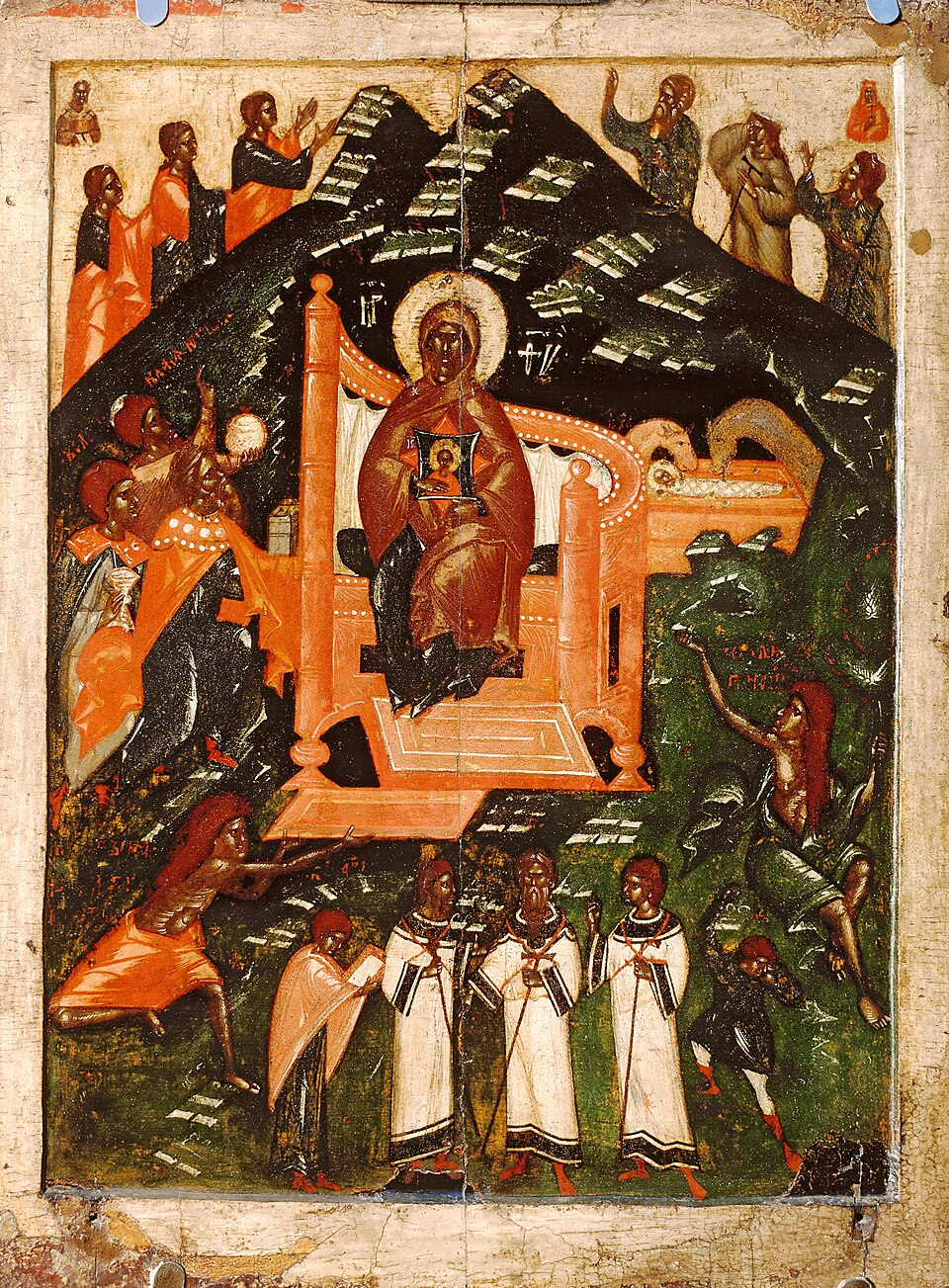
The proper icon of the feast — the "Synaxis of the Mother of God" (Собор Богоматери) — is a pictured hymn: it renders in paint the Nativity sticheron "What shall we offer thee, O Christ, who for our sake hast appeared on earth as man? Each of the creatures made by thee bringeth thee its thanksgiving: the angels their hymn, the heavens the star, the Magi their gifts, the shepherds their wonder, the earth a cave, the wilderness a manger — and we, a Virgin Mother." At the centre the Theotokos is enthroned with the incarnate Christ; a choir of angels bows above; and to either side come the wise men with their gifts and the shepherds with their staves, while below, personified as figures, the Earth offers the cave and the Wilderness the manger. The composition is the Church's clearest visual statement that the Nativity is the Theotokos's feast as much as her Son's — the whole creation gathered to bring its offering, and she at the heart of it, the offering of the human race.
Distinct from this, and equally proper to December 26, is the icon of the Flight into Egypt: the Virgin seated on a donkey holding the Child and looking back, Joseph following with staff and cloak, a youth (the tradition names him James, the Lord's brother) leading the beast, and behind them a walled city from whose ramparts the idols topple headlong — the visual form of Isaiah's prophecy. Both types belong to the day, and both are frequently gathered, with the adoration of the shepherds and Magi, into the borders of the great Nativity icon, which is sometimes itself inscribed "The Synaxis of the Most Holy Theotokos."
The stored image is the earliest known Russian icon of the feast: a Pskov-school panel of the late fourteenth or early fifteenth century (tempera on wood, 81 × 61 cm), now in the State Tretyakov Gallery, Moscow. The enthroned Theotokos and Child stand at the centre beneath a choir of angels; the Magi and shepherds approach from the sides, and below them the personified Earth and Wilderness bring the cave and the manger — the "What shall we offer thee" hymn set out in full.