
John of Damascus
Our Venerable Father John of Damascus, the Golden Stream
Venerable · b. c. 675/676, Damascus — d. c. 749, at the Lavra of St Sabbas
Commemorated 4 December — Repose at the Lavra of St Sabbas
John of Damascus (c. 675/676–c. 749) is the last of the Greek Fathers of the Church and her greatest theologian-hymnographer: an Arab Christian of Damascus, born into the family of the Mansur that administered the finances of the Umayyad caliphate, who left a high court office to become a monk of the Great Lavra of Saint Sabbas in the Judean desert. From beyond the reach of the iconoclast emperors he wrote the three Orations Against Those Who Attack the Holy Images — the classic Orthodox defence of the veneration of icons, grounded in the Incarnation — for which the tradition tells that his severed right hand was restored by the Mother of God, the origin of the "Three-handed" icon. His Fountain of Knowledge, whose third part, An Exact Exposition of the Orthodox Faith, is the first systematic summa of Christian theology, shaped the dogmatic teaching of both East and West. Called Chrysorrhoas, the "Golden Stream," for the grace of his eloquence, he is the master of Byzantine hymnography — the Paschal Canon "The Day of Resurrection," the funeral idiomela, and, by tradition, the ordering of the Octoechos are his. He reposed at Mar Saba about 749 and is commemorated on December 4.

Origins: the Mansur of Damascus
John was born at Damascus about the year 675, into one of the great Christian families of Syria, the Mansur. Damascus was then the capital of the Umayyad caliphate, and the city and its Christians lived under Muslim rule; his grandfather Mansur ibn Sarjun had held the administration of Damascus and, the tradition holds, had been party to its peaceful surrender to the Arabs in 635. His father, Sergius (Sarjun) ibn Mansur, held the high office of logothete or chief financial officer at the caliphal court — a Christian trusted with the public revenues by the caliph himself. John (in Arabic Yuhanna) was reared to succeed to that office, and to a Christian faith held openly in the heart of the Islamic world.
For his education his father, the tradition relates, ransomed from the Damascus slave-market a learned monk of Calabria or Sicily, Cosmas (called "the Monk"), taken captive by Arab raiders, and set him to teach his son and a second boy of the household — the orphan Cosmas, John's adoptive brother, who would become the hymnographer bishop of Maiuma. Under this Cosmas the two boys were grounded in grammar and rhetoric, in the whole round of Greek learning — dialectic, arithmetic, geometry, music, astronomy — and above all in theology, so that John came to a mastery of the Fathers and of the secular sciences alike that his works everywhere display.
The court and the withdrawal
On his father's death John succeeded him in the service of the caliph, holding, in the tradition's account, the chief administrative and financial office of Damascus and standing high in the counsels of the court — a Christian at the head of a Muslim state's revenues, as his father and grandfather had been. Yet the world's honour did not hold him. Whether from the turning of the times against the Christian officials of the caliphate, or from the pull of the ascetic life, John laid down his office, distributed his wealth, freed his servants, and went up to the desert of Palestine, to the Great Lavra of Saint Sabbas (Mar Saba) in the gorge of the Kedron between Jerusalem and the Dead Sea. There he was received as a monk, was schooled in humility by a stern old elder (the tale of the elder's forbidding him to write, and of the Mother of God's command that the gift be loosed, belongs to the developed vita), and in time was ordained priest by the Patriarch John V of Jerusalem. Mar Saba was his home for the rest of his life, and there he wrote the works that made him the teacher of the Church.
The defence of the holy icons
The great public act of John's life was his stand for the holy images. In 726, and more sweepingly in 730, the emperor Leo III the Isaurian set the power of the Eastern empire against the veneration of icons, ordering them removed and destroyed and persecuting those who honoured them — the beginning of the iconoclast controversy that would trouble the Church for more than a century. John, living under the caliph and so beyond the emperor's reach, took up the pen the empire's own defenders of icons could not safely lift, and wrote his three Orations Against Those Who Attack the Holy Images (Pros tous diaballontas tas hagias eikonas, c. 726–730).
Their argument became the Church's own. John distinguished sharply between the adoration (latreia) due to God alone and the honour or veneration (proskynēsis, timētikē proskynēsis) rightly shown to the images of Christ, of His Mother, and of the saints — an honour that "passes to the prototype," so that he who venerates the icon venerates the person depicted, not the wood and paint. He grounded the very possibility of the icon in the Incarnation: the God who in the Old Covenant could not be imaged, because He had not been seen, has in Christ taken flesh and become visible, and to refuse to depict Him is to deny that He truly became man. "I do not worship matter," he wrote, "I worship the God of matter, who for my sake became matter and deigned to dwell in matter, and through matter worked my salvation." The Orations gathered the patristic witness, answered the charge of idolatry from the Scriptures themselves, and gave iconoclasm the theological refutation on which the Seventh Ecumenical Council would draw.
The miracle of the hand
The most famous of the traditions attached to this struggle is the miracle of the severed hand. The emperor Leo, unable to reach John, is said to have had a letter forged in John's hand, offering to betray Damascus to the empire, and to have sent it to the caliph as proof of his minister's treason. The caliph, persuaded, ordered John's right hand cut off and hung up in the market-place. Restored to him at his entreaty, John laid the dead hand before an icon of the Mother of God and prayed through the night for its healing that he might go on writing in her Son's defence; and in the morning the hand was found rejoined and whole, only a thread-like line marking where it had been severed. In thanksgiving he fastened to the icon a hand wrought of silver — and from this, the tradition holds, comes the celebrated icon of the Theotokos "of the Three Hands" (Tricherousa, Trojeručica), which John took with him to Mar Saba and which passed in later centuries to the Monastery of Hilandar on Mount Athos, where it is venerated to this day. The caliph, convinced of his innocence, would have restored him to office; but John chose the desert.
The theologian: the Fountain of Knowledge
At Mar Saba John wrote the work that earned him his place as the summing-up of Greek patristic theology, the Fountain of Knowledge (Pēgē gnōseōs), dedicated to Cosmas of Maiuma. It is in three parts. The first, the Dialectica (Philosophical Chapters), sets out the logical and philosophical vocabulary — largely Aristotelian — that theology needs. The second, On Heresies, catalogues a hundred heresies from the earliest times to his own, ending with a first Christian account of the rise of Islam, which he treats as a Christian heresy. The third and greatest, An Exact Exposition of the Orthodox Faith (Ekdosis akribēs tēs orthodoxou pisteōs), in a hundred chapters, is the first systematic theology of the Christian East: a single ordered synthesis of the whole faith — God and the Trinity, creation and providence, the Incarnation and the two natures and two wills of Christ, the Mother of God, the icons, the sacraments, the last things — drawn from Scripture and the Fathers and the decrees of the six councils. John claimed no novelty; his boast was that he set down nothing of his own but gathered and arranged the teaching of the Fathers. Translated into Latin in the twelfth century as De fide orthodoxa, the Exposition became a textbook of the medieval West, used by Peter Lombard and Thomas Aquinas, so that John taught the schoolmen of the Latin Church as he had taught the Greek.
Beside this stand his other dogmatic and polemical works: treatises against the Manichaeans, the Nestorians, the Monophysite Jacobites, and the iconoclasts; works on the two wills of Christ and on the Trisagion; the great homilies — three on the Dormition of the Mother of God, and others on the Nativity of the Theotokos, the Transfiguration, and Holy Saturday — and the vast florilegium of patristic and biblical texts known as the Sacra Parallela.
The hymnographer: the Golden Stream
John of Damascus is, with his brother Cosmas, the supreme master of Byzantine hymnography, and it is for this above all that the daily worship of the Church still lives by his labour. The tradition ascribes to him the ordering of the Octoechos (the Paraklētikē), the great book of the eight tones on whose weekly cycle of resurrection hymns the Sunday services of the whole year are built. From his hand come many of the festal canons — several in the difficult iambic metre, among them the iambic canons of the Nativity, of Theophany, and of Pentecost — and, crowning them all, the Paschal Canon, "The Day of Resurrection, let us be radiant, O peoples" (Anastaseōs hēmera), sung at the Midnight Office of Pascha in every church of the Byzantine rite, the very voice of the Orthodox Paschal joy. His also are the eight funeral idiomela — "What sweetness of this life remains unmixed with grief? … all is weaker than a shadow, all more deceiving than a dream" — that the Church sings over her dead, turning grief to hope in the Resurrection. Much of this work is transmitted in the service books under the signature "John the Monk" (Iōannou monachou), the label met again and again in this collection's canon ascriptions — from the Nativity of the Theotokos to the feasts of Symeon the Stylite, Cosmas and Damian, and many more.
To this range of eloquence he owed his surname Chrysorrhoas, the "Golden Stream," and the byname of his family, Mansur, "the victorious," was turned by his admirers into a title of his triumph over heresy — and by his enemies into a reproach (see below).
Repose
John died at the Great Lavra of Saint Sabbas about the year 749, full of years, and was buried there; his cell and tomb were long shown at Mar Saba. His relics were in later centuries translated to Constantinople. The iconoclast Council of Hieria (754), which the empire summoned to condemn the icons, anathematised him by his family name — "Mansur, the ill-named lover of the Saracens," "worshipper of images and writer of falsehoods" — three times cursing his memory; but the Seventh Ecumenical Council at Nicaea (787), which restored the veneration of the icons, reversed the sentence and acclaimed him among the Church's teachers, and the Church has honoured him ever since as the foremost champion of the icons and the last of the great Greek Fathers. The Latin Church, which had long used his theology, formally named him a Doctor of the Church in 1890.
Feast and commemoration
John is commemorated on December 4 (church date; Old Calendar civil December 17), the day of his repose, within the Nativity Fast, sharing the day with the great-martyr Barbara, to whose service the Menaion joins his own full office. The feast is universal — Antiochian, Greek, Slavic, and OCA calendars agree — and Damascus lies within the historic Patriarchate of Antioch, so that John is honoured with particular warmth as a saint of the Antiochian world. Some older usages also noted a commemoration of him on other days, but December 4 is his feast throughout the Byzantine rite. His name recurs through the whole year not as a commemoration only but as the author heard at nearly every service, above all at Pascha.
Hymns
Troparion — Tone 8
Guide of Orthodoxy, teacher of piety and holiness, luminary of the world, God-inspired adornment of monastics, O wise John: by thy teachings thou hast enlightened all, O lyre of the Spirit. Intercede with Christ our God that our souls may be saved.
Original translation from the Greek
Kontakion — Tone 4
Let us all sing the praise of John, the venerable hymnographer and revealer of God, the teacher and luminary of the Church who withstood her every foe: for by the might of the Cross he cast down the heresies of the heretics, and was shown to be an unassailable rampart of the Orthodox.
Original translation from the Greek
Iconography
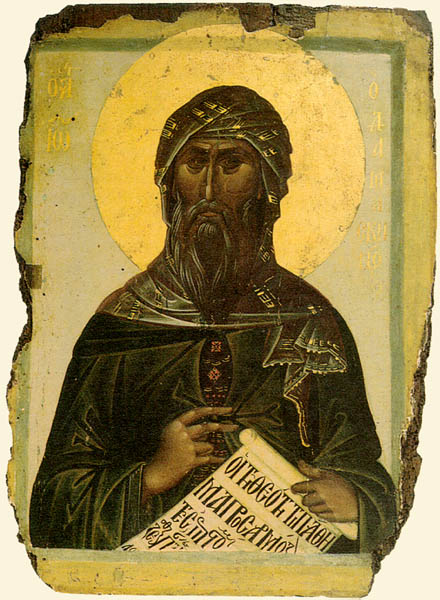
John of Damascus is depicted as a monk in the prime of maturity, dark-haired and with a full, somewhat pointed beard, most often wearing his distinctive head-dress: a turban or cloth wound about the head (the skepē), the mark of his Damascene and Eastern origin, which sets him apart at once from every other monastic saint. He holds a scroll — bearing the words of a hymn, most often the opening of a Resurrection or Nativity canon — and sometimes a book; his right hand may be raised in teaching or blessing, and in some icons the healed right hand, or the icon of the Three-handed Mother of God, recalls the miracle. He is frequently paired with his brother Cosmas of Maiuma, the two hymnographers together.
The stored primary image is a fourteenth-century Byzantine icon from Mount Athos: the saint in his turban, holding an inscribed scroll, haloed and named "Ὁ ἅγιος Ἰωάννης ὁ Δαμασκηνός" (source, public domain, pd-old-work).
A second stored image is the celebrated icon of the saint by the Cretan master Emmanuel Tzanes (17th century): John richly vested and holding a great scroll of his own verses, with a medallion of the Theotokos on his breast, inscribed "Ὁ ἅγιος Ἰωάννης ὁ Δαμασκηνός" (source, public domain, pd-old-work).
Disputed questions
- Dates. His birth is placed about 675/676 and his repose about 749; both are approximate, resting on the tradition and on the sequence of his works rather than on documents. Some accounts extend his life to c. 754 or later.
- The court office and the withdrawal. The details of John's office at the caliphal court and the circumstances of his resignation vary in the sources; the vita attributed to John, Patriarch of Jerusalem (10th c.) is late and legendary in much of its detail, including the fullest form of the forged-letter and severed-hand narrative. The historical core — an Arab Christian official of Damascus who became a monk of Mar Saba and wrote against iconoclasm — is secure.
- "Mansur" and the iconoclast anathema. The Council of Hieria (754) cursed him under his family name Mansur as a "lover of the Saracens," making his very standing under Muslim rule a reproach; the Seventh Ecumenical Council (787) vindicated him. The polemic is recorded as part of his memory.
- Barlaam and Ioasaph. The Greek spiritual romance of Barlaam and Josaphat was long ascribed to John of Damascus; modern scholarship assigns it rather to Euthymius the Athonite (†1028), and the Damascene attribution is no longer held. The ascription is noted where the tale is treated.
- Not to be confused with the other Johns of the calendar — above all John Chrysostom, John the Theologian, John the Forerunner, John the Almsgiver, and John the Faster — nor with the John, Bishop of Damascus met in some synaxaria (commemorated in the Greek books on October 12), a distinct hierarch of the city and not the hymnographer.