
Translation of the Relics of John Chrysostom
On January 27 the Church keeps the translation of the relics of John Chrysostom, Archbishop of Constantinople, from Comana in Pontus — where the exiled hierarch had died on the forced march of his banishment on September 14, 407 — back to the imperial capital in the year 438. Thirty-one years after his death, and after his name had at last been restored to the diptychs and the schism his condemnation had caused was healed, his disciple Proclus, now Patriarch of Constantinople, obtained from the emperor Theodosius II — son of the very Arcadius and Eudoxia who had exiled the saint — the return of the body. Received across the Bosphorus with an immense throng of torches and boats, the relics were laid among the emperors in the Church of the Holy Apostles; and the emperor, laying his face upon the coffin, publicly implored the saint's pardon for the sin of his parents. The tradition tells that when the people cried, "Receive thy throne, O Father!" the dead lips of the saint moved to answer, "Peace be unto all." The feast is one of the three fixed commemorations of Chrysostom in the Byzantine year (with November 13, his repose transferred, and January 30, the Three Hierarchs).
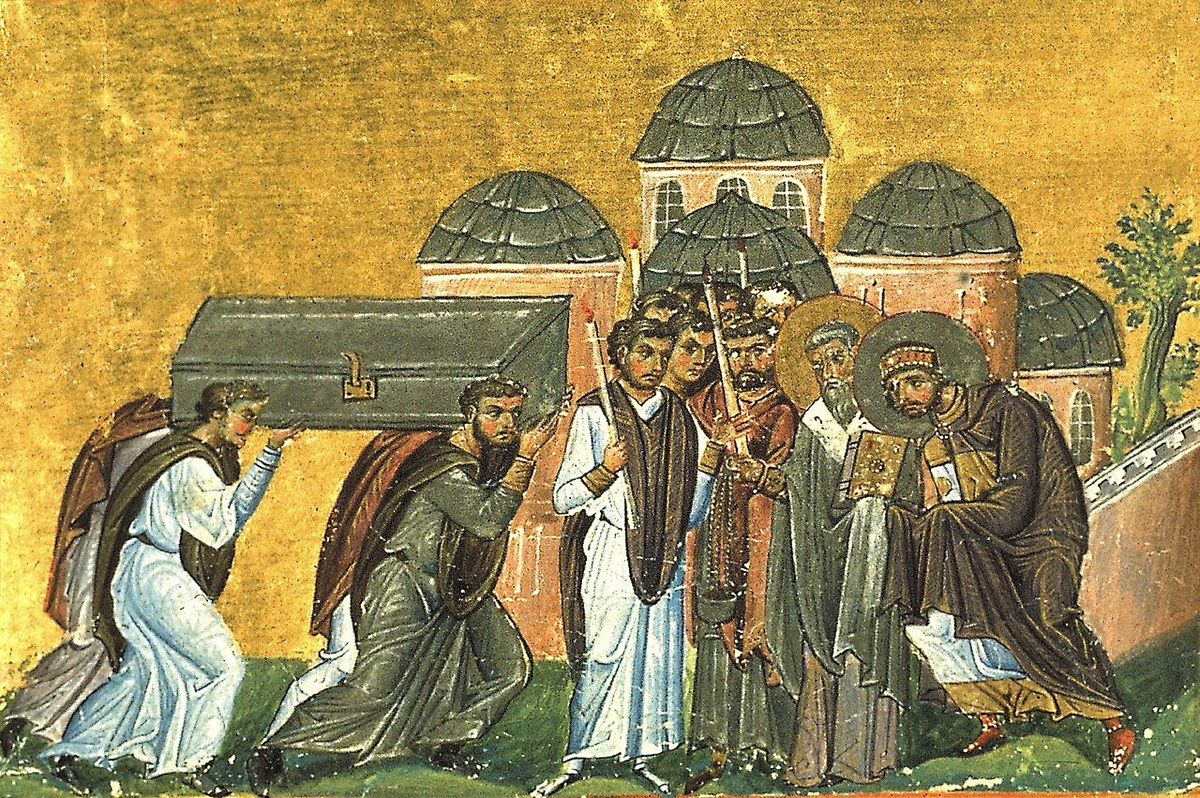

The death in exile and the wound in the Church
John Chrysostom, the golden-mouthed preacher of Antioch and Archbishop of Constantinople, was twice driven from his see by the enmity of the empress Aelia Eudoxia and of Theophilus of Alexandria, condemned at the Synod of the Oak in 403, and finally banished in 404 to the edge of the empire. He died on 14 September 407 at Comana in Pontus, worn out by the deliberate hardship of the march toward his last place of exile at Pityus, with the words "Glory to God for all things" on his lips; he was buried there, beside the martyr Basiliscus at whose shrine he had died. His full Life, ministry, and repose are given in his own entry — John Chrysostom; this feast concerns only what befell his body afterward.
His death did not end the quarrel. The West had never accepted his condemnation: Pope Innocent I of Rome, and with him the whole Latin Church, refused to recognize the deposition and broke communion with the three Eastern sees — Constantinople, Alexandria, and Antioch — that had carried it out or consented to it. The condition Rome set for the restoration of communion was that John's name be entered again in the diptychs, the sacred lists of the honoured dead read aloud at the Liturgy, from which his enemies had struck it. The wound to the unity of the Church was thus bound up with the memory of the dead archbishop, and could not be healed until he was publicly vindicated.
The rehabilitation under Atticus and Proclus
The vindication came by stages. Atticus, archbishop of Constantinople from 406, who had at first been among John's opponents, yielded to the pressure of the Johannite party and of Rome and restored John's name to the diptychs of the capital about the year 417; Alexandria and Antioch followed, and communion with the West was gradually re-established. The work was completed under Proclus — John's own disciple, whom the saint had ordained, and who became Patriarch of Constantinople in 434. Proclus preached a celebrated homily in praise of his master and pressed for the final act of reconciliation: the bringing home of the body itself, so that the city which had cast the living archbishop out might receive the dead one with honour.
The translation of 438
In 438, thirty-one years after the death at Comana, Proclus obtained from the emperor Theodosius II the imperial authority for the translation. Theodosius was the son of Arcadius and Eudoxia, the emperor and empress under whom John had been exiled and had died; and the tradition dwells on the poignancy of the son undoing his parents' sin. A delegation was sent to Comana; and here the synaxaria transmit a wonder — that the relics, at first immovable, would not be lifted until Theodosius sent a letter of entreaty addressed to the saint himself as to a living father, begging his forgiveness for the wrong done by his parents, whereupon the body yielded and was taken up.
The relics were borne to the Bosphorus and carried across to Constantinople in a great nocturnal procession of ships and torches, the emperor and the patriarch and the whole city going out to meet them. As the coffin was set within the sanctuary, the people are said to have cried out with one voice, "Receive thy throne, O Father!" (Ἀπόλαβε τὸν θρόνον σου, Πάτερ) — the throne of the archbishops of the city from which he had been driven — and the tradition tells that the lips of the dead saint parted and answered, "Peace be unto all" (Εἰρήνη πᾶσι), the bishop's greeting to his flock. Theodosius, laying his face and his eyes upon the coffin, prayed aloud for the pardon of his parents, "who had sinned in ignorance." The relics were then enshrined in the Church of the Holy Apostles, in the imperial mausoleum among the tombs of the emperors — the dead hierarch given a place of honour above those who had condemned him.
Afterward
At the Holy Apostles the relics of Chrysostom rested for more than seven and a half centuries, until the sack of Constantinople by the armies of the Fourth Crusade in 1204, when — with the relics of Gregory the Theologian — they were carried off to Rome. There they lay in the Basilica of Saint Peter until 27 November 2004, when Pope John Paul II returned the relics of both hierarchs to the Ecumenical Patriarch Bartholomew I, and they were enshrined in the Patriarchal Cathedral of Saint George in the Phanar, where they rest today. That later return is a historical event kept where local usage appoints; the fixed liturgical feast of the translation remains the January 27 commemoration of the homecoming of 438.
Feast and commemoration
January 27 (church date; New Calendar civil January 27; Old Calendar civil February 9). The feast is kept universally in the Byzantine rite; the tradition records that the annual commemoration of the translation was established at Constantinople and passed thence into the universal Menaion. It is the second of the three fixed feasts of Chrysostom in the church year — his repose, transferred off the Elevation of the Cross to November 13, is his principal feast; January 27 keeps the translation of his relics; and January 30 gathers him with Basil the Great and Gregory the Theologian in the Synaxis of the Three Holy Hierarchs. Because Chrysostom's Life and principal feast belong to his own entry, per the repository's one-saint-one-file rule he is not re-minted here: this feast file supplies the account, propers, and icon of the January 27 translation, and cross-links his entry for the Life.
Taxonomy flag — feast_type. The controlled feast_type vocabulary of the project's constitution
(indiction | theotokos-synaxis | icon-of-the-theotokos | angelic | dominical | theotokian | dedication | deliverance) has no value for the translation or
veneration of a saint's relics. This is a relic-translation feast of a hierarch,
and its truest description — translation-of-relics — exists only in the per-feast
rank list, not among the feast_type values. Following the precedent of the
Veneration of the Chains of Peter
(January 16), which met the same gap, dedication is chosen here as the nearest
existing term — the feast is historically bound to the enshrinement of the relics
in the Church of the Holy Apostles, and the repository already types relic-shrine
commemorations as dedication. The term is a stretch, and no new term is minted.
The gap is flagged for a deliberate decision — a relic / relic-veneration (or
translation-of-relics) feast_type — extending the standing question at
the project's record of open questions, which already records both the missing generic synaxis
value and the parallel relic-feast gap for the Chains of Peter.
Hymns
Troparion
The grace that shone forth from thy mouth like a torch of fire hath given light to the whole inhabited world; it laid up for mankind the treasures of freedom from avarice, and showed unto us the height of humility. Wherefore, as thou dost school us by thine own words, O Father John Chrysostom, intercede with the Word, Christ our God, that our souls may be saved.
Original translation from the Greek
Kontakion
The venerable Church rejoiced with a hidden joy at the translation of thy sacred relic; and having laid it away as a treasure of precious gold, unto them that hymn thee she imparteth unceasingly, through thine intercessions, the grace of healings, O John Chrysostom.
Original translation from the Greek
Appointed readings
Epistle — Hebrews 7:26–8:2
26For such an high priest became us, who is holy, harmless, undefiled, separate from sinners, and made higher than the heavens; 27Who needeth not daily, as those high priests, to offer up sacrifice, first for his own sins, and then for the people’s: for this he did once, when he offered up himself. 28For the law maketh men high priests which have infirmity; but the word of the oath, which was since the law, maketh the Son, who is consecrated for evermore. 1Now of the things which we have spoken this is the sum: We have such an high priest, who is set on the right hand of the throne of the Majesty in the heavens; 2A minister of the sanctuary, and of the true tabernacle, which the Lord pitched, and not man.
Gospel — John 10:9–16
9I am the door: by me if any man enter in, he shall be saved, and shall go in and out, and find pasture. 10The thief cometh not, but for to steal, and to kill, and to destroy: I am come that they might have life, and that they might have it more abundantly. 11I am the good shepherd: the good shepherd giveth his life for the sheep. 12But he that is an hireling, and not the shepherd, whose own the sheep are not, seeth the wolf coming, and leaveth the sheep, and fleeth: and the wolf catcheth them, and scattereth the sheep. 13The hireling fleeth, because he is an hireling, and careth not for the sheep. 14I am the good shepherd, and know my sheep, and am known of mine. 15As the Father knoweth me, even so know I the Father: and I lay down my life for the sheep. 16And other sheep I have, which are not of this fold: them also I must bring, and they shall hear my voice; and there shall be one fold, and one shepherd.
Iconography
The feast is imaged by its narrative scene: the translation of the relics — the coffin of the saint borne in solemn procession, carried on the shoulders of clergy or received by the emperor and patriarch, sometimes with the ships and torches of the night crossing of the Bosphorus, and the multitude of the faithful going out to meet the returning archbishop. The stored image is the miniature for the feast from the Menologion of Basil II (Constantinople, c. 985; Vatican, Vat. gr. 1613), whose own caption reads, "the body of Saint John Chrysostom being brought to the Church of the Holy Apostles": the coffin borne in procession toward the domed church, in the manuscript's characteristic gold-ground style (source, public domain, pd-old-work). The same miniature is stored as a variant image in the John Chrysostom entry.