
Aaron the High Priest
The Holy and Righteous Aaron, the First High Priest
Righteous · Forefather · b. c. 1568 BC, in Egypt (traditional reckoning) — d. c. 1445 BC, on Mount Hor, in his hundred and twenty-third year (traditional reckoning)
Commemorated 20 July — Commemoration of the Righteous Aaron (Slavonic and OCA usage)
Aaron, son of Amram and Jochebed of the tribe of Levi, elder brother of Moses and of Miriam, is the first high priest of Israel and the head of the whole Aaronic priesthood. He was given to Moses as his mouth before Pharaoh, held up his brother's hands at Rephidim, was consecrated with his sons to the service of the Tabernacle, and bore on his breast the twelve stones of the tribes. His failure at the golden calf and his vindication in the rebellion of Korah — when his censer stayed the plague and his dry rod budded, blossomed and bore almonds overnight — are equally part of his memory. For murmuring with Moses at the waters of Meribah he was not permitted to enter the promised land, and died on Mount Hor at the age of a hundred and twenty-three, his vestments passing to his son Eleazar. The Church reads his priesthood as the type of Christ's and his budded rod as a figure of the Theotokos, and keeps his memory on July 20.
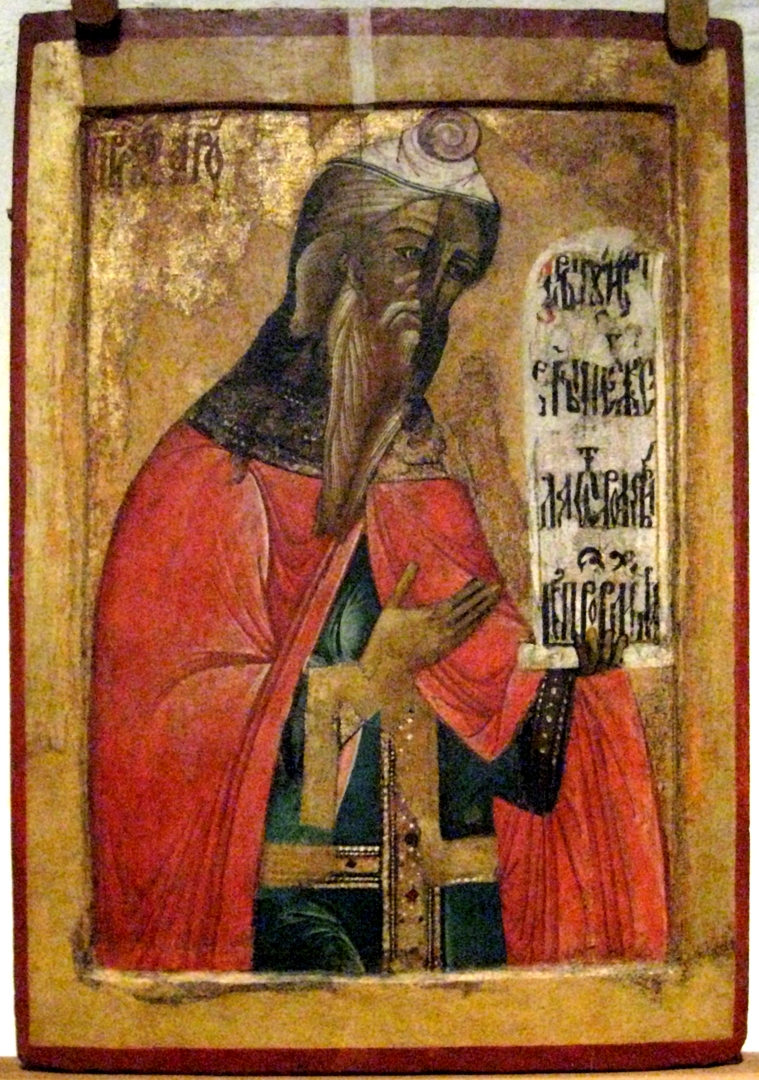
.jpg)
Brother and mouth of Moses
Aaron was born in Egypt to Amram and Jochebed, of the house of Levi, three years before his brother Moses and after their sister Miriam — before, that is, the decree against the Hebrew male children, which is why his infancy has no story. He married Elisheba daughter of Amminadab, of the tribe of Judah, and had four sons: Nadab, Abihu, Eleazar and Ithamar.
He enters the narrative at the burning bush, not in his own right but as the answer to his brother's objection. Moses pleaded that he was slow of speech; the Lord answered that Aaron the Levite could speak well, was already on his way to meet him, and would be to Moses "instead of a mouth" while Moses should be to him "instead of God" (Exodus 4:14–16). The two met in the wilderness, went in together to the elders of Israel, and stood together before Pharaoh. It was Aaron who cast down the rod that became a serpent and swallowed the serpents of the magicians, and Aaron whose stretched-out rod began the first of the plagues; the deliverance of Israel is throughout the work of the pair.
At Rephidim, while Joshua fought Amalek in the plain, Aaron and Hur stood on either side of Moses on the hill and held up his hands until the going down of the sun (Exodus 17:12) — an image the Fathers read at once as a figure of the Cross, the outstretched arms that give the victory, and as the pattern of the Church's intercession, in which the weight of prayer is carried by more than one.
The golden calf
Aaron's great fall is told without mitigation. Left in charge while Moses was forty days on the mountain, and pressed by a people who said "make us gods, which shall go before us," he asked for their golden earrings, cast the metal into the shape of a calf, built an altar before it, and proclaimed a feast to the Lord (Exodus 32). When Moses came down and broke the tablets and demanded an account, Aaron gave the evasive answer of a frightened man: the people were set on mischief, he cast the gold into the fire, "and there came out this calf."
The Scripture does not excuse him, and neither does the tradition; Deuteronomy records that the Lord was angry enough with Aaron to have destroyed him, and that Moses prayed for his brother (Deut. 9:20). What the tradition does is set the episode beside his consecration, and read the two together: the high priest of Israel is a man who has himself needed atonement, and who on the Day of Atonement must offer first for his own sins and then for the people's — the very point on which the Epistle to the Hebrews turns when it distinguishes Aaron's priesthood from Christ's.
The consecration and the priesthood
The chapters of Exodus and Leviticus that describe the vesting and consecration of Aaron are the foundation of everything the Church has since said and worn about priesthood. He was clothed in the ephod and the blue robe with its pomegranates and golden bells, the embroidered coat, the girdle, the mitre with its golden plate inscribed Holiness to the Lord, and the breastplate of judgement bearing twelve precious stones engraved with the names of the twelve tribes, "upon his heart, when he goeth in unto the holy place, for a memorial before the Lord continually" (Exod. 28:29). He was anointed with the holy oil, and his sons with him; he alone entered the Holy of Holies, once a year, with blood and with incense.
The Orthodox reading of this is dense and constant. The vestments of the Christian bishop are consciously described in the commentaries as the fulfilment of Aaron's; the omophorion, the epigonation, the sakkos and the bells of tradition all take part of their meaning from Exodus 28. Above all Hebrews governs the interpretation: "no man taketh this honour unto himself, but he that is called of God, as was Aaron" (Heb. 5:4) — the charter text against self-appointed ministry — set against the greater priesthood "after the order of Melchizedek," which is not by descent, not by mortal succession, and needs no sacrifice for itself.
Two of his sons, Nadab and Abihu, offered strange fire before the Lord and were consumed by fire from before him (Leviticus 10); Aaron, forbidden to mourn, "held his peace." The priesthood descended through Eleazar and Ithamar, and through Eleazar's son Phineas.
Korah, the censer and the budding rod
The rebellion of Korah, Dathan and Abiram (Numbers 16–17) is the crisis of Aaron's high priesthood: two hundred and fifty princes of the congregation challenged the exclusive priesthood of Aaron's house — "all the congregation are holy, every one of them" — and were destroyed, the earth opening for the ringleaders and fire consuming those who had taken censers. When the people murmured the next day and a plague broke out, Aaron ran with his censer into the midst of the congregation and stood between the dead and the living, and the plague was stayed — an image which the Church has taken as the very definition of priestly intercession, and which is echoed in the censing of the faithful at every Liturgy.
Then the Lord ordered a rod taken from each tribe and laid up in the Tabernacle; and on the morrow Aaron's rod, for the house of Levi, had budded, and brought forth buds, and bloomed blossoms, and yielded almonds (Numbers 17:8). The rod was kept before the Testimony, and later, with the pot of manna and the tablets, within the Ark (Heb. 9:4). Of all the Old Testament figures of the Mother of God this is among the most used in Byzantine hymnography: dry wood that bore fruit without planting or watering is the standing image of the virgin conception, sung in the canons of the Theotokos and named in the dogmatic stichera; and the almond, first tree to flower, carries the sense of a life anticipating its season.
Meribah, Mount Hor, and the mourning
At Meribah in the wilderness of Zin the people quarrelled for water, and Moses struck the rock twice with his rod and spoke rashly, and both brothers were told that because they had not sanctified the Lord before the eyes of Israel they should not bring the congregation into the land (Numbers 20:12). The sentence fell on Aaron first. At Mount Hor, on the border of Edom, Moses brought him up the mountain with Eleazar, at the Lord's command stripped Aaron of his garments and put them upon Eleazar his son, and Aaron died there in the top of the mount, in the hundred and twenty-third year of his life and the fortieth of the Exodus; and the whole house of Israel mourned him thirty days (Numbers 20:23–29; 33:38–39).
The transfer of the vestments on the mountain is the Scripture's own picture of succession: the office does not die with the man. Christian commentators from the Fathers onward have used it of episcopal succession, and the monastic tradition has used it — as it used Elijah's mantle falling on Elisha — of the handing on of grace from father to son in the Spirit.
Veneration and reading in the Church
Aaron is honoured among the righteous of the Old Covenant. He is named in the Psalms as the type of the priest ("Moses and Aaron among his priests," Ps. 98/99:6), invoked in the ordination prayers' recollection of the priesthood of the Law, and read at the Vespers of hierarchs. He is commemorated with all the ancestors of Christ on the Sunday of the Holy Forefathers and the Sunday before the Nativity, and among the saints of Sinai; his tomb on Mount Hor — identified since late antiquity with Jebel Harun above Petra, where a shrine has stood for many centuries — is a place of pilgrimage for Christians and Muslims alike, Aaron being honoured in Islam as the prophet Harun.
Feast and commemoration
July 20 (Old Calendar civil August 2) in Slavonic and OCA usage, on the day of the Prophet Elijah; March 12 in Greek practice. He is commemorated also on the Sunday of the Holy Forefathers and the Sunday before the Nativity with all the ancestors of the Lord, and in the Synaxis of the Saints of Sinai kept on Bright Wednesday. No proper office is appointed for the July commemoration, which is sung from the common of the righteous.
Hymns
Troparion
As we celebrate the memory of thy righteous one Aaron, O Lord, through him we entreat thee: save our souls.
Original translation from the Greek
Iconography
Aaron is one of the most easily recognised figures of the Old Testament in Orthodox painting, because he is the only one shown in priestly vestments. He is an old man with a long white beard, wearing the high-priestly mitre — a soft golden or jewelled cap, sometimes with a plate across the brow — over a long robe with the ephod and, in the fuller renderings, the twelve-stoned breastplate on his chest. His attributes are the censer, which he holds smoking in the scenes of the stayed plague, and above all the flowering rod, a slender staff breaking into leaf and white blossom at the top; in Marian contexts the rod is the point of the whole image.
He appears in the prophet or forefather tier of the Russian iconostasis, generally near Moses; in compositions of the Praise of the Mother of God and of the Akathist, where the Old Testament types are ranged around the Virgin, holding his budded rod; in narrative cycles of the Exodus in illuminated Octateuchs and on refectory walls; and in scenes of the Tabernacle and of the consecration of the priesthood. Byzantine manuscript illumination also shows the striking scene on Mount Hor of the vestments passing from Aaron to Eleazar.
The stored image is a Russian prophet-tier panel of the seventeenth century from the Epiphany church of the Cyrillo-Belozersky monastery, ascribed to the Vologda painter Terenty Fomin and inscribed ПРО(РОКЪ) ААРО(НЪ): the high priest half-length in a red mantle over a green tunic, wearing the white high-priestly cap and the dark head-cloth, holding a jewelled censer in his right hand and an inscribed scroll in his left.
Disputed questions
- The date of his feast. The Slavonic menologia and the OCA keep the Righteous Aaron on July 20, the day of the Prophet Elijah; the OCA life notes that Greek practice commemorates him on March 12, the day this corpus keeps his grandson Phineas. The two usages are recorded here without preference; this entry is placed at July 20, the date on which it was authored, and the March 12 usage is noted in the calendar file.
- Chronology. "1445 BC" and the fifteenth century before Christ are the traditional reckoning carried by the synaxaria and repeated in the OCA life; the historical dating of the Exodus is disputed on quite other grounds, and the fifteenth-century date is used here for indexing only, in agreement with the treatment of Phineas.
- His culpability at the calf. Ancient Jewish and some patristic readings soften Aaron's part — that he delayed, that he hoped Moses would return, that he asked for the women's jewellery expecting refusal. The scriptural text supports none of these directly, and the Church's commemoration of him as righteous rests not on his innocence but on his repentance and his office.
- Not to be confused with the several later saints named Aaron, in particular Aaron and Julius, the protomartyrs of Roman Britain kept on July 1 and June 22 in the Western lists carried by this corpus.