
Abraham the Recluse and Mary his Niece
Our Venerable Fathers Abraham the Recluse of Mesopotamia and his Niece the Blessed Mary
Venerable · Priest · b. c. 296 — d. c. 360
Commemorated 29 October — Repose of Abraham
Abraham the Recluse (died c. 360) was a hermit and priest of the village of Kidun, near Edessa in Mesopotamia, whose Life was written by his younger contemporary and countryman Ephrem the Syrian. Having fled his own wedding feast to live walled up in a cell, he was drawn out of solitude twice — once to convert a stubbornly pagan village as its unwilling priest, and once, most famously, to rescue his orphaned niece Mary, whom he had raised in asceticism but who, seduced and then despairing, had fled to a brothel in a distant town. Disguising himself as a customer, the old hermit sought her out, and by tenderness rather than reproach won her back to a repentance so complete that she became a healer of others. Uncle and niece are commemorated together on October 29.
.jpg)
Abraham's flight to the cell
Abraham was born to a wealthy Christian family of the district of Edessa, around the end of the third century, and raised in piety. When he came of age his parents, against his will, arranged his marriage; he went through the wedding feast in obedience, but on the seventh day, the account says, he fled the bridal chamber and his bride and took refuge in a small cell at the edge of the town, where he walled up the door, leaving only a small window through which he received bread and water. There he remained for some fifty years, giving himself to unceasing prayer and to the psalms, untroubled when his parents died and his considerable inheritance passed to him — he asked a friend to give it all to the poor, wishing to own nothing.
The conversion of Kidun
Abraham's holiness became known, and the bishop of the region, needing a pastor for a large village called Kidun (Chidan) whose people had resisted every attempt at conversion and clung to their idols, ordained the reluctant hermit priest and sent him there. Abraham begged to be left in his solitude but submitted. In the village he was met with insults, beatings, and violence; he answered them only with patience and prayer, at first tearing down the pagan altar and building a church, and enduring the people's fury for three years until, worn down by his meekness and moved by his tears, the whole village came to baptism. Having made them Christians and set the church in order, Abraham slipped away by night back to his cell, unwilling to be honoured, and resumed his enclosure.
Mary, and her fall
Abraham had a brother who died, leaving a seven-year-old daughter, Mary, an orphan. The relatives brought the child to the holy recluse, who took her in, lodging her in the outer part of his cell so that a wall stood between them; he taught her the psalms and the ascetic life through the little window, and for some twenty years she grew up in prayer and purity under his care, a joy to his old age.
Her fall came through a visitor. A monk who used to come to Abraham for counsel conceived a passion for Mary, and over a long while, coming and going, seduced her. Awakened to what she had done and unable to bear the shame before her uncle, Mary gave way not to repentance but to despair: judging herself past forgiveness, she abandoned the cell and fled to a distant city, where — concluding that she was already lost — she gave herself over to a life of sin in a brothel.
The rescue
For two days Abraham did not know she was gone; then in a dream he understood her fall, and he wept and prayed for her without ceasing. When after two years he learned through a friend where she was and how she was living, the old man of about seventy did an astonishing thing: he borrowed a horse and a soldier's clothes, put on a wide hat to hide his face, took a gold coin, and rode to the city. Coming to the inn where Mary now lived, he asked the innkeeper, as any customer might, for the company of the woman, and sat down to a meal, keeping up the part. When Mary was brought in and drew near, she caught — the Life says — the scent of the ascetic beneath the disguise and was pierced with memory, and wept; but Abraham, fearing to lose her, held to his role until they were alone. Then he lifted the hat, and with tears called her by name: not to condemn her, but to take her sin upon himself. "I will answer for this sin before God," he told her; "only come back." He reminded her that there is no sin too great for God's mercy, and that despair, not the fall, is what destroys. Her heart broke; she rose that same night and rode back with him to the desert.
Mary's repentance and their repose
Abraham gave Mary the inner cell, the more enclosed of the two, and himself took the outer, and there she spent the rest of her life in a penitence as fervent as her fall had been sudden — in fasting, tears, and prayer — until God granted her, the tradition holds, the grace of healing the sick who came to her. Abraham lived on another ten years and died at about seventy, mourned by the whole country, which venerated him at once as a saint; Mary survived him by some five years, shining in the same holiness, and was gathered to him. Ephrem the Syrian, their fellow-countryman, who had known Abraham, composed the account of their lives and a hymn of praise, and it is largely through him that their story was carried into the Greek and Latin traditions alike.
Place in the tradition of the penitents
The rescue of Mary is one of the great penitence-narratives of the Christian East, told beside those of Pelagia the Penitent and Taisia of Egypt — the harlot brought to sanctity — but with the distinctive note that here the seeker is not a bishop or an abba encountered by chance but the fallen woman's own guardian, who counterfeits sin in order to enter the place of sin and carry her out of it. The Latin West received the Life early; a tenth-century versified reworking by the canoness Hrotsvitha of Gandersheim (her drama Abraham) made it one of the best-known Eastern stories in medieval Europe.
Feast and commemoration
October 29 (church date; Old Calendar civil November 11), kept universally in the Byzantine rite, the day being that of Abraham's repose; Mary is commemorated with him. They share the day with the venerable-martyr Anastasia the Roman, who is the day's other principal commemoration. Care is needed not to confuse Abraham the Recluse with Abraham, Archimandrite of Rostov (†c. 1073), a Russian saint of the same name also commemorated on October 29.
Hymns
Troparion — Tone 8
In thee, O Father, that which is according to the image was preserved with exactness; for taking up thy cross thou didst follow Christ, and by thy deeds thou didst teach us to despise the flesh, for it passeth away, but to care for the soul, a thing immortal. Therefore, O venerable Abraham, thy spirit rejoiceth with the angels.
Original translation from the Greek
Kontakion — Tone 3
In the flesh thou didst appear as an angel upon the earth, and by fasting thou wast like a tree well planted, watered by the streams of abstinence and grown to fair increase; and washing away defilement in the flowing of thy tears, thou wast shown to be, O Abraham, a dwelling-place of the divine Spirit.
Original translation from the Greek
Iconography
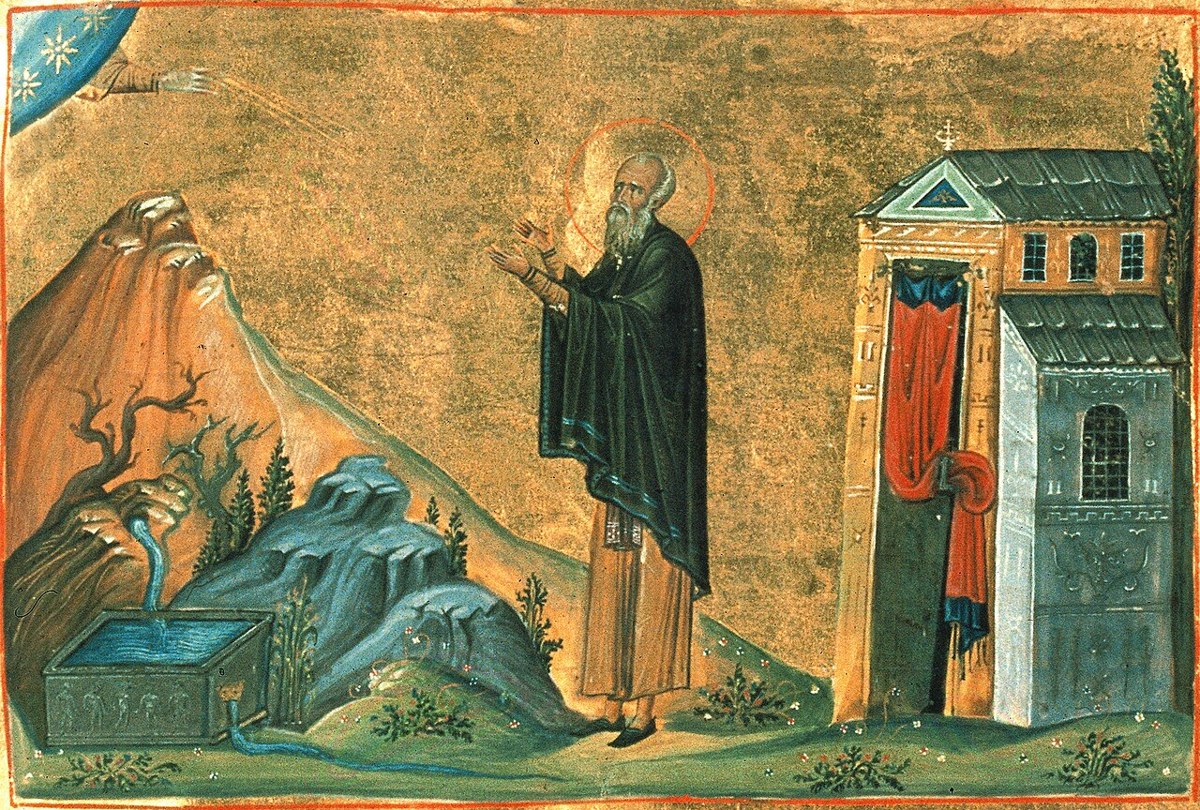
Abraham is depicted as an aged hermit-priest in the monastic habit, a scroll or a blessing hand raised, sometimes shown at the window of his walled cell; Mary appears as a penitent nun, and narrative icons show the central scene of the old man in his borrowed soldier's hat at the inn, drawing his niece back from sin. The stored image is Abraham's miniature from the Menologion of Basil II (Constantinople, c. 985, Vatican Library, Vat. gr. 1613), where he is inscribed as "Abramius the Recluse of Chidan, presbyter" — the recluse alone, without Mary, as the day's principal figure.